
Travel agents are defined as licensed advisors with a legal duty of care to provide accurate, current passport and visa information to every client they serve. This duty goes far beyond booking flights. The role of travel agent passport advice covers everything from verifying document validity before ticketing to guiding travelers through expedited processing when a trip is days away. Agents must communicate realistic processing timelines, flag destination-specific entry rule changes, and confirm that your passport is not just valid but fully “boardable.” For travelers facing urgent or complex situations, this professional guidance can be the difference between boarding your flight and being turned away at the gate.
What is the role of travel agent passport advice?
Travel agents serve as the practical link between complex government regulations and your actual travel plans. Their advisory role, formally recognized under package travel law, requires them to give you transparent, accurate information on passport requirements, not just general guidance pulled from a static website.
A qualified agent checks whether your passport meets the specific entry rules for your destination country, your carrier’s boarding requirements, and any recent policy changes that may have taken effect since your last trip. Agents translate complex rules into clear steps, protecting travelers from denied boarding even when a visa appears valid on paper.

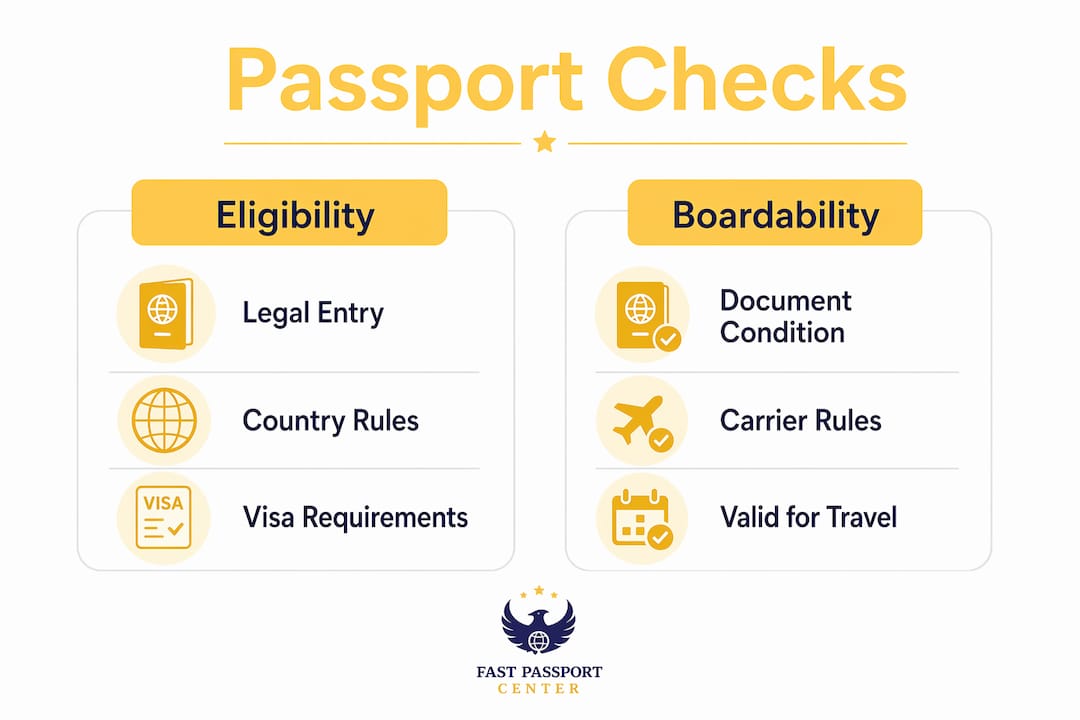
The distinction between eligibility and boardability is one of the most misunderstood concepts in travel. You may be eligible to enter a country based on your nationality, but if you present the wrong passport at the gate, or if your document lacks the required validity period beyond your travel dates, you will not board. A skilled agent catches these gaps before they become expensive problems.
How do travel agents verify passport validity and boardability?
Passport verification is a structured process, not a quick glance at an expiration date. Agents conduct mandatory document audits at two points: before ticketing and again before departure. Since february 2026, UK travel has required agents to confirm correct passport documentation at least once before ticketing and again pre-departure to avoid gate denials. That two-step check has become the professional standard across the industry.
A thorough boardability check covers several specific items:
- Passport expiration date relative to the destination’s minimum validity requirement (many countries require 6 months of validity beyond your travel dates)
- Correct nationality documentation, particularly for travelers who hold citizenship in more than one country
- Destination-specific entry rule changes, which can shift with little public notice
- Carrier requirements, which sometimes differ from government entry rules
- Dual citizenship passport logic, meaning which passport you use for entry versus exit on each leg of your trip
Dual nationals face a specific risk: presenting the wrong passport for a specific leg of travel. Agents build “passport logic” workflows to clarify exactly which document you use at each border crossing. This prevents the scenario where a traveler holds two valid passports but boards with the wrong one and faces complications at the destination.
A common trap for repeat travelers is assuming entry requirements have not changed since their last visit. VFR travelers (those visiting friends and relatives) are especially vulnerable to this complacency. An agent proactively checks for rule changes even on familiar routes.
Pro Tip: Ask your agent to run a full boardability check, not just a validity check. These are two different things, and only one of them guarantees you get on the plane.
What passport application and renewal guidance do travel agents provide?
Travel agents provide step-by-step guidance through the application and renewal process, with particular depth when timelines are tight. For first-time U.S. passport applicants, the correct form is the DS-11 application, which must be submitted in person at an authorized acceptance facility. Agents confirm that you bring physical evidence of citizenship and a physical photo ID, not digital copies, since the U.S. State Department does not accept digital documents at submission.
The application process involves several steps where agents add real value:
- Confirming the correct form. DS-11 applies to first-time applicants and children under 16. DS-82 applies to adult renewals by mail when the previous passport is undamaged and was issued after age 16.
- Reviewing required documentation. Agents verify that your supporting documents, such as a certified birth certificate or naturalization certificate, meet current State Department standards.
- Advising on printing requirements. Passport forms must be printed single-sided to avoid processing delays. This detail trips up many applicants who print double-sided by default.
- Explaining current processing timelines. Routine processing and expedited processing times shift throughout the year. Agents communicate current 2026 processing times so you can plan realistically.
- Identifying the right service tier. For travel within 2–4 weeks, agents direct travelers toward expedited courier services rather than standard mail. For travel within 3 days, an in-person regional passport agency appointment is the only viable path.
For child passports, lost passport replacements, and passport renewal situations, agents clarify which service applies and what documentation is required. A lost passport requires form DS-64 in addition to a new application. A child passport requires consent from both parents or legal guardians. These are details that cause delays when missed.
Pro Tip: Tell your agent your exact travel date on the first call, not just the month. Processing time advice changes significantly depending on whether you leave in 10 days or 25 days.
How do travel agents use IATA’s Timatic to keep passport advice current?
Accurate passport advice depends on current data, and current data requires a reliable source. IATA’s Timatic is the global database sourced from over 1,000 official providers that virtually every airline uses to verify international travel document compliance. Agents who access Timatic pull the same data airlines use at check-in, which means their advice reflects real-time entry requirements rather than outdated government website snapshots.
The table below shows how information sources compare for passport and visa advice reliability:
| Source | Data currency | Handles dual nationality | Covers carrier rules |
|---|---|---|---|
| IATA Timatic | Real-time, 1,000+ official providers | Yes | Yes |
| Government travel websites | Updated periodically | Partial | No |
| General travel blogs | Variable, often outdated | Rarely | No |
| Agent personal knowledge | Depends on training recency | Depends on workflow | Partial |
The practical implication is clear. An agent using Timatic catches a rule change that a traveler researching independently on a government website might miss entirely. Entry rules for high-risk destinations can change within days of a departure date. Timatic updates reflect those changes in near real time.
For complex cases, such as dual nationals traveling between countries with conflicting passport use requirements, Timatic provides the specific guidance that prevents boarding denials. An agent cross-referencing Timatic data with your specific itinerary gives you a level of accuracy that no static web search can match.
What legal responsibilities do travel agents have regarding passport advice?
Travel agents carry legal liability for the passport and visa information they provide. A Cologne Regional Court ruling established that agents must provide average processing times, not just theoretical express timelines, when advising clients on document readiness. Quoting only the fastest possible processing time without disclosing the realistic average is a professional duty breach.
Failing to disclose accurate processing times or omitting critical visa and passport information can expose agents to demands for full refunds under package travel law. This is especially true for short-notice bookings, where the gap between advice given and reality experienced is most damaging.
“Travel agents act as a traveler’s insurance policy, translating complex entry bureaucracy into simple steps to prevent denied boarding and minimize disruption.” — Travel Agent Job Description, JobDescription.org
Agents also carry a proactive duty to communicate government travel advisories. Agents must communicate government notices and their practical impact directly to clients, rather than waiting for travelers to ask. This proactive communication standard protects both the traveler and the agent from avoidable disputes.
The balance between agent responsibility and traveler responsibility is real. Agents advise; travelers must act on that advice and provide accurate information about their citizenship, travel history, and document status. An agent cannot protect you from problems caused by information you withheld.
How can you maximize the benefits of travel agent passport advice?
Getting the most from your agent’s expertise requires active participation on your part. The travelers who avoid last-minute passport crises are the ones who communicate early and completely.
- Disclose your full citizenship status upfront. If you hold dual citizenship, tell your agent which passports you carry and which countries issued them. This information directly affects which document you use on each leg of your trip.
- Share your exact travel date, not just a general window. Processing time advice changes significantly based on your specific departure date.
- Request a formal document audit before ticketing. Ask your agent to confirm boardability in writing, not just verbally.
- Ask about entry rule changes for your destination. Even if you have visited before, rules shift. Agents proactively check for changes rather than relying on your memory of prior trips.
- Understand your renewal options. If your passport is expiring within 6 months of your travel date, ask your agent whether renewal by mail or courier fits your timeline better.
For travelers living more than 2 hours from a regional passport agency, such as those in Tampa, Charlotte, Nashville, Sacramento, or Louisville, an authorized courier service is the most practical option for expedited processing. Regional agencies require in-person appointments and are only the right choice when travel is within 3 days or involves a family emergency.
Pro Tip: Most travelers assume their passport is fine because it has not expired. The real risk is a destination that requires 6 months of validity beyond your travel dates. Check this number, not just the expiration year.
Key takeaways
Travel agents provide legally accountable, real-time passport guidance that protects travelers from denied boarding, processing delays, and costly last-minute document failures.
| Point | Details |
|---|---|
| Boardability vs. eligibility | A valid passport does not guarantee boarding; agents verify destination-specific rules and carrier requirements. |
| Legal duty of care | Agents must disclose realistic processing times and current entry rules or face liability under package travel law. |
| IATA Timatic reliability | Agents using Timatic access real-time data from 1,000+ official sources, far more current than static websites. |
| Dual citizenship risk | Agents build passport logic workflows to confirm which passport you use for entry and exit on each leg. |
| Courier services for urgency | Travelers 2+ hours from a regional agency should use an authorized courier for expedited processing within 2–4 weeks. |
What I have learned watching travelers get this wrong
By Andy Irons
After years of watching travelers navigate passport issues, the pattern I see most often is not ignorance. It is overconfidence. Travelers who have taken the same international trip three or four times assume the rules have not changed. They have not checked their passport’s validity against the destination’s specific requirement. They do not know they are holding the wrong passport for a dual-citizenship itinerary.
The legal accountability placed on travel agents in 2026 is higher than most travelers realize. The Cologne Regional Court ruling I referenced earlier is not an isolated case. Courts are consistently holding agents to a standard of proactive, accurate disclosure. That is actually good news for travelers. It means a qualified agent is professionally motivated to get your passport situation right, not just close the booking.
What I find most agents underestimate is the boardability gap for dual nationals. I have seen travelers with two valid passports get flagged at the gate because they presented the wrong one for that specific leg. The agent who built a clear passport logic workflow for that client would have prevented it entirely. That workflow takes about five minutes to create and can save a trip worth thousands of dollars.
My honest advice: treat your travel agent’s passport guidance the way you treat a doctor’s pre-travel health advice. You would not skip the appointment because you feel fine. Do not skip the document audit because your passport looks valid.
— Andy Irons
Fast Passport Center: expedited passport services when time is short
When your travel window is tight and a regional passport agency is hours away, Fast Passport Center provides a direct path to faster processing.
Fast Passport Center has 20+ years of experience as a U.S. State Department-registered passport courier, with drop-off offices in 24 cities nationwide. Whether you need a new passport application processed quickly, a renewal handled before a trip in the next few weeks, or help replacing a lost passport under time pressure, their experienced agents guide you through every document requirement. With an A+ rating from the Better Business Bureau and over 14,000 positive reviews, Fast Passport Center delivers the accuracy and speed that urgent travel demands. Learn more about how expedited processing works and find the right service for your timeline.
FAQ
What does a travel agent do for passport applications?
Travel agents advise on the correct application form, required documentation, and current processing timelines. They also conduct pre-departure document audits to confirm your passport meets both government entry rules and carrier boarding requirements.
What is the difference between passport eligibility and boardability?
Eligibility means you are legally permitted to enter a country. Boardability means your specific passport document meets all carrier and destination requirements for that trip, including validity periods and correct passport use for dual nationals.
How do travel agents stay current on passport and visa rules?
Most professional agents use IATA Timatic, a real-time database sourced from over 1,000 official providers. This gives agents the same document compliance data that airlines use at check-in.
Are travel agents legally responsible for passport advice?
Yes. Under package travel law, agents have a legal duty of care to provide accurate passport and visa information, including realistic processing times. Courts have ruled that quoting only express timelines without disclosing average times constitutes a professional duty breach.
When should I use a courier service instead of a travel agent for my passport?
If your travel date is 2–4 weeks away and you live more than 2 hours from a regional passport agency, an authorized courier service is the most practical option. Fast Passport Center offers expedited courier processing with direct collaboration with the U.S. Department of State.
Recommended
- International Travel Tips for U.S. Passport Holders — Validity Rules, Visa Requirements & Emergency Guide | Fast Passport Center
- Passport Courier vs Agency: What Changes? – Fast Passport Center
- The Role of Proof of Travel Passport for International Trips
- Passport Entry Requirements for International Travel: 2026 Guide