
When you report a lost or stolen passport, federal law requires you to submit a sworn statement because that declaration creates a legally binding record under penalty of perjury, protecting the integrity of the U.S. passport system and guarding against fraud and identity theft.
Three things happen the moment you file that statement:
- Statutory authority: 22 U.S.C. §213 requires that passport applications be verified by oath or affirmation.
- Forms involved: DS-64 (Statement Regarding a Lost or Stolen U.S. Passport) carries perjury language and triggers cancellation; DS-11 is the replacement application you sign under oath before an acceptance agent.
- Practical outcome: Your lost passport number is permanently canceled in the State Department’s system, making it invalid for travel even if someone finds it.
Table of Contents
- Why the law requires a sworn verification for passport applications
- How DS-64 and DS-11 work together in the replacement process
- When does a sworn statement actually apply to your situation?
- Oath vs. notarized affidavit: what’s the actual legal difference?
- Documents to bring, realistic timelines, and government fees
- What happens if your sworn statement contains errors or false information
- Why third parties often insist on notarized affidavits even when DS-64 suffices
- Key Takeaways
- A passport professional’s perspective on what actually goes wrong
- Fast Passport Center can get your replacement moving today
- Official sources and further reading
- FAQ
Why the law requires a sworn verification for passport applications
The statutory foundation is 22 U.S.C. §213, which directs that before a passport is issued, the application must be verified by oath or in the manner the statute authorizes. That mandate is not bureaucratic formality. A passport is one of the most powerful identity documents a U.S. citizen can hold, and an uncanceled lost passport in the wrong hands is a ready-made tool for fraud.
“DS-64 asks for detailed circumstances, the passport number if known, and includes a signature under penalty of perjury; the form is entered into the Lost and Stolen Passport System.”
— U.S. Department of State, DS-64 form
The DS-64 and DS-11 are the State Department’s practical implementation of that statutory requirement. DS-64 reports the loss and cancels the document; DS-11 opens the replacement application with a fresh sworn verification. Together, they close the window between a missing passport and a fraudulent one.
How DS-64 and DS-11 work together in the replacement process
Replacing a lost or stolen passport follows a specific sequence. Skipping a step or signing in the wrong order is one of the most common reasons applications get delayed.
- Complete DS-64 to report the loss. Provide the passport number if you have it, the circumstances of the loss, and the date. Do not sign it yet.
- Complete DS-11 as your replacement application. Again, do not sign it in advance.
- Gather your documents (see the checklist in the next section) and locate an acceptance facility, regional passport agency, or U.S. embassy or consulate if you are abroad.
- Appear in person. An acceptance agent verifies your identity and administers the oath. You sign DS-11 and DS-64 only when the agent instructs you, because those signatures are made under penalty of perjury.
- Submit everything together: DS-64, DS-11, proof of citizenship, government-issued ID, passport photo, and applicable fees.
If you lost your passport while abroad, you must apply in person at a U.S. embassy or consulate. A police report is not required by the State Department, but it creates a time-stamped record that can matter later if the passport is used fraudulently or if insurers ask for documentation.
Pro Tip: Before your appointment, make a photocopy of every document you plan to submit. Acceptance facilities often require copies alongside originals, and arriving without them can cost you a second trip.
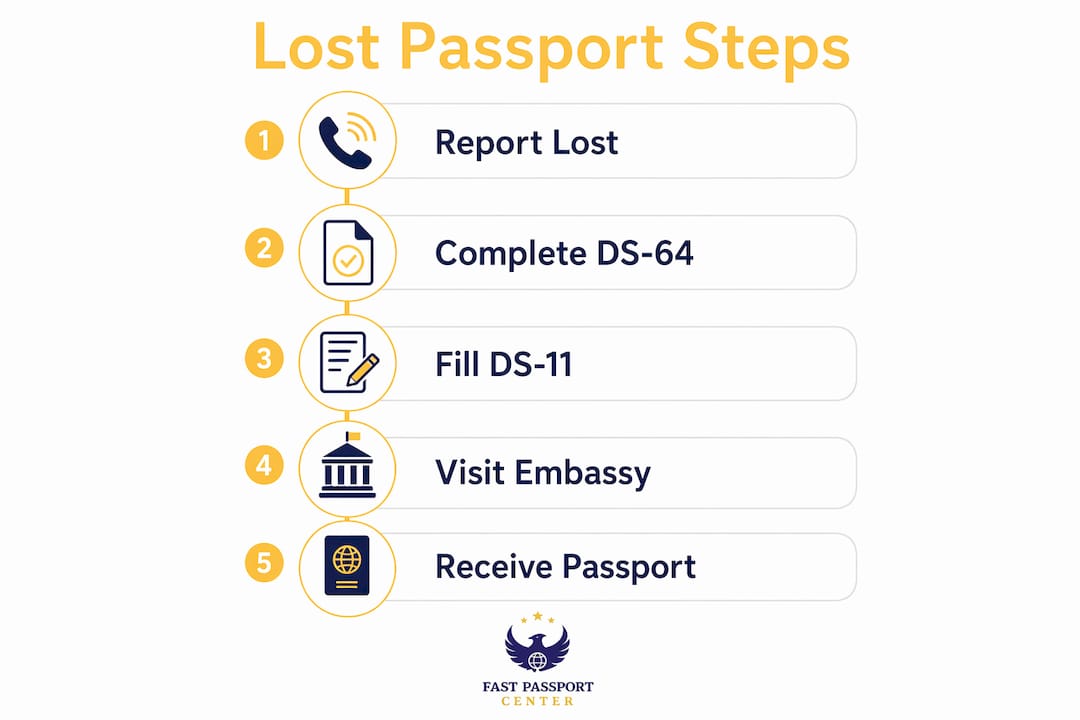
For a detailed walkthrough of how to replace a lost passport fast, including which form applies to your situation, review the DS-11 vs. DS-82 guidance before you visit.
When does a sworn statement actually apply to your situation?
Not every passport transaction triggers the same verification requirement. Here is where a sworn statement is specifically required:
- Lost or stolen passport that cannot be submitted: Because you cannot return the old document, DS-64’s sworn declaration substitutes for physical surrender.
- First-time adult applicants: DS-11 requires a sworn verification regardless of loss, because no prior passport exists to confirm identity.
- Replacement after damage: A damaged passport that cannot be read by electronic scanners follows a similar in-person, sworn-application path.
Scenarios where the State Department does not require notarization but third parties might ask for it:
- Your travel insurer requests a notarized affidavit of loss before reimbursing trip costs.
- An airline requires documentation to reissue a ticket tied to a stolen booking.
- A foreign consulate asks for a notarized statement before reissuing a visa.
Two practical examples worth knowing: if you discover your passport missing the week before a domestic trip, you still need to file DS-64 before applying for a replacement, even if travel is not international. If you find your passport after already reporting it lost, the State Department has already canceled that document, and you cannot use it for travel.
Oath vs. notarized affidavit: what’s the actual legal difference?
This is where most travelers get confused, and the distinction has real consequences.

A sworn statement (like DS-64) contains perjury language, meaning you attest to the truth of your statements under the same legal penalty as a court oath. Federal law under 28 U.S.C. §1746 allows unsworn declarations with proper perjury language to carry the same legal weight as a notarized affidavit in many federal contexts. DS-64 works exactly this way: no notary seal required.
A notarized affidavit goes one step further. A licensed notary public witnesses your signature, verifies your identity, and applies an official seal. That seal adds evidentiary weight that some private parties and foreign authorities specifically require.
| Who accepts it | Document type | Notary required? |
|---|---|---|
| U.S. Department of State | DS-64 sworn statement | No |
| Travel insurers | Notarized affidavit of loss | Usually yes |
| Airlines (ticket reissue) | Notarized affidavit | Often yes |
| Foreign visa consulates | Notarized affidavit | Often yes |
The State Department accepts DS-64 without notarization, but that does not mean a notarized affidavit is unnecessary. If you anticipate filing an insurance claim or need a visa reissued, getting a notarized affidavit at the same time costs little extra effort.
Pro Tip: Online and mobile notary services let you get a notarized affidavit of loss within hours, often from your phone. Services like Notary Page connect you with a commissioned notary remotely, which is especially useful if you are traveling and cannot visit a physical office.
Documents to bring, realistic timelines, and government fees
What to bring
- Proof of U.S. citizenship: certified birth certificate or naturalization certificate
- Government-issued photo ID: driver’s license or state ID
- Two passport photos (2×2 inches, white background)
- Completed DS-64 and DS-11 (unsigned until instructed by the agent)
- Copy of a police report, if available (not required, but recommended for theft)
- Payment for government fees
You can review the full required forms and documents checklist before your appointment to avoid missing anything.
Timelines by route
| Route | Who it’s for | Typical processing time |
|---|---|---|
| USPS acceptance facility | Travel 4+ weeks out | Routine or expedited mail processing |
| Courier/expediting service | Travel 2 days–4 weeks out | Faster than standard; varies by service |
| Regional passport agency | Travel within 3 days or family emergency | In-person appointment required |
Government fees
The State Department charges separate fees for passport books and passport cards. Current fee amounts are listed on travel.state.gov and change periodically; always verify before your appointment. Courier and expediting services charge their own service fees on top of government fees.
What happens if your sworn statement contains errors or false information
The perjury language on DS-64 and DS-11 is not decorative. Submitting false information on a federal passport application carries serious legal and practical consequences.
Beyond criminal exposure, the practical fallout is significant: your replacement application will be denied or delayed, your travel plans may collapse, and any insurance or visa reissuance tied to the false statement becomes compromised. If you realize after submission that you made an error, act quickly:
- Contact the National Passport Information Center immediately.
- Explain the error in writing and request guidance on correcting your application.
- Do not attempt to travel on any document connected to an unresolved discrepancy.
- If the error involves a police report or insurance claim, notify those parties as well.
Accuracy matters most under time pressure, which is exactly when mistakes happen. Taking a few extra minutes to verify every detail before signing is worth it.
Why third parties often insist on notarized affidavits even when DS-64 suffices
The State Department’s acceptance of DS-64 without a notary seal does not mean every organization you deal with will follow the same standard. Insurers and consulates often prefer a notarized affidavit because it carries independent evidentiary weight: a notary has verified your identity and witnessed your signature, creating a record that holds up in claims processing and legal proceedings.
Consider a traveler abroad who loses their passport and needs both a replacement U.S. passport and a visa reissue from a foreign consulate. DS-64 satisfies the State Department. The foreign consulate, however, may require a notarized affidavit before reissuing the visa, and the traveler’s insurer will likely ask for the same document before reimbursing lost travel costs.
- Travel insurers use notarized affidavits to verify claims and prevent fraud.
- Airlines may require notarized documentation to reissue tickets tied to a stolen booking.
- Foreign consulates often have their own evidentiary standards that exceed U.S. federal minimums.
Pro Tip: If you are replacing a lost passport and expect to file an insurance claim or need a foreign visa reissued, get a notarized affidavit of loss at the same time you complete DS-64. Doing both together prevents a second round of paperwork later. Fast Passport Center recommends this step for any traveler with international plans within the next 30 days.
Key Takeaways
A lost passport requires a sworn statement because 22 U.S.C. §213 mandates oath-based verification for passport applications, and DS-64 implements that requirement by canceling the lost document and creating a perjury-backed record.
| Point | Details |
|---|---|
| Statutory basis | 22 U.S.C. §213 requires passport applications to be verified by oath or affirmation. |
| DS-64 vs. affidavit | DS-64 is a sworn statement accepted by the State Department without notarization; third parties often require a notarized affidavit. |
| Do not sign early | Sign DS-64 and DS-11 only when the acceptance agent instructs you; signatures are made under penalty of perjury. |
| Timeline drives your route | Use a courier/expediting service for travel 2 days–4 weeks out; reserve regional agency visits for travel within 3 days. |
| Fast Passport Center | For travelers 2+ hours from a regional agency, Fast Passport Center provides expedited courier delivery, form assistance, and concierge support for lost/stolen replacements. |
A passport professional’s perspective on what actually goes wrong
Most of the stress around lost passport replacements comes from one misunderstanding: people assume the oath or sworn statement is a formality. It is not. The perjury language on DS-64 and DS-11 is the mechanism that makes the entire replacement system trustworthy. Without it, there would be no reliable way to cancel a missing document or verify that the person applying for a replacement is who they claim to be.
What actually trips travelers up is the timing. Arriving at an acceptance facility with pre-signed forms is one of the most common errors, and it forces a restart. Bringing originals without copies is another. The third, and most consequential, is waiting too long to report the loss, which leaves a valid, uncanceled passport in circulation.
The routing question matters just as much as the paperwork. A traveler in Nashville or Sacramento who needs a passport in ten days is not well served by driving four hours to a regional agency. A courier/expediting service handles the State Department submission on their behalf, often faster and with less disruption to their schedule. Regional agencies are the right call only when travel is within 72 hours and there is no other option.
Fast Passport Center has handled lost and stolen passport replacements for over 20 years, with drop-off offices in 24 cities and direct courier delivery to the State Department. The combination of form guidance, real-time tracking, and concierge support for notarized affidavits is specifically built for the traveler who cannot afford a misstep.
Fast Passport Center can get your replacement moving today
When your passport is lost and your travel window is 2 days to 4 weeks out, a passport expediting service is the practical path forward, especially if you live more than two hours from a regional passport agency.
Fast Passport Center is a U.S. Department of State registered courier with 20+ years of experience. The service covers every step of a lost or stolen passport replacement: DS-64 and DS-11 form guidance, courier hand-delivery to the State Department, real-time order tracking, and concierge support for notarized affidavits when insurers or consulates require them. Drop-off offices in 24 cities mean you can hand your documents directly to an agent rather than trusting them to the mail. Visit FastPassportCenter.com to start your replacement and get a clear timeline based on your travel date.
Official sources and further reading
These are the primary documents and pages you will need to verify details, download forms, or start your application:
- DS-64 form (PDF): the official statement to report a lost or stolen U.S. passport
- State Department lost/stolen passport guidance: current instructions, fees, and reporting steps
- Lost or stolen passport abroad: embassy and consulate procedures for overseas losses
- Apply for your adult passport: acceptance facility procedures and DS-11 guidance
- 22 U.S.C. §213: the federal statute requiring oath-based verification for passport applications
- Fast Passport Center contact and services: expedited replacement help for travelers with urgent timelines
Always confirm current fees and processing times directly on travel.state.gov before your appointment, as both change periodically.
FAQ
Do I have to take an oath to get a replacement passport?
Yes. Federal law under 22 U.S.C. §213 requires passport applications to be verified by oath or affirmation, and you sign DS-11 under penalty of perjury before an acceptance agent.
What documents do I need if I lost my U.S. passport?
You need a completed DS-64, a completed DS-11 (both unsigned until instructed), proof of U.S. citizenship, a government-issued photo ID, two passport photos, and payment for government fees. A police report is not required but is recommended for stolen passports.
Do I need a notarized affidavit for a lost passport?
The State Department does not require notarization; DS-64 is a sworn statement accepted without a notary seal. However, travel insurers, airlines, and some foreign consulates commonly request a notarized affidavit of loss for claims and visa reissuance.
What happens after I submit DS-64?
The State Department enters your passport number into the Lost and Stolen Passport System, permanently canceling that document so it cannot be used for travel even if recovered.
Can Fast Passport Center help me replace a lost passport quickly?
Yes. For travel 2 days to 4 weeks out, Fast Passport Center provides expedited courier delivery, DS-64 and DS-11 form assistance, and real-time tracking. Visit FastPassportCenter.com to start your replacement.