
A proof of travel passport is the primary legal document that certifies a traveler’s identity and nationality, enabling lawful international movement across borders. Without it, no visa, airline ticket, or hotel reservation carries legal weight at a port of entry. The role of proof of travel passport documentation goes beyond a simple ID check. It forms the foundation of every international trip, and understanding how it works with supporting travel documents prevents denied boarding, visa refusals, and costly last-minute scrambles.
What is proof of travel, and why is it required alongside your passport?
Proof of travel refers to documents that confirm a traveler’s planned itinerary, including confirmed airline tickets, hotel reservations, and onward or return travel bookings. A passport certifies who you are, and proof of travel documents confirm what you intend to do once you arrive. Immigration officers and airlines use both together to assess whether a traveler poses a risk of overstaying a visa or entering without a clear exit plan.
Airlines bear direct financial responsibility for passengers they carry who are later deemed inadmissible by immigration. That financial exposure is why carriers enforce proof of onward travel at check-in, often more aggressively than immigration officers do at the border. A traveler without a confirmed return or connecting flight can be denied boarding before ever reaching the gate.

Immigration authorities use proof of travel as a risk management tool. Authorities evaluate your travel plans to determine whether your stated purpose and duration of stay are credible. A one-way ticket to a country with no confirmed onward booking raises a flag, even if your passport is valid and your visa is in order.
Accepted forms of proof of travel include:
- Confirmed round-trip or onward airline tickets with a verifiable booking reference (PNR)
- Hotel reservations showing dates that align with your stated length of stay
- Tour or cruise itineraries from a licensed operator
- Invitation letters from a host in the destination country, often required for visa applications
- Travel insurance documentation showing coverage dates that match your trip
Pro Tip: Always keep a verifiable PNR, not just a screenshot. Airlines check live booking status at check-in, and a canceled or unconfirmed reservation will fail that check even if the printout looks legitimate.
How passport validity and condition affect your international travel
Passport validity is one of the most misunderstood travel requirements. Many travelers assume a passport is valid as long as it has not expired. That assumption causes denied boarding every year. Many countries require passports to remain valid for at least six months beyond the traveler’s planned return date. A passport expiring in three months may be perfectly legal at home but unacceptable at a foreign border.
The six-month rule is not universal, but it is widespread enough to treat as a default standard. Countries in the European Union, for example, generally require only that your passport be valid for the duration of your stay, while nations across Southeast Asia, the Middle East, and Africa commonly enforce the full six-month requirement. Checking the specific entry rules for your destination before booking is not optional. It is the first step in travel planning.
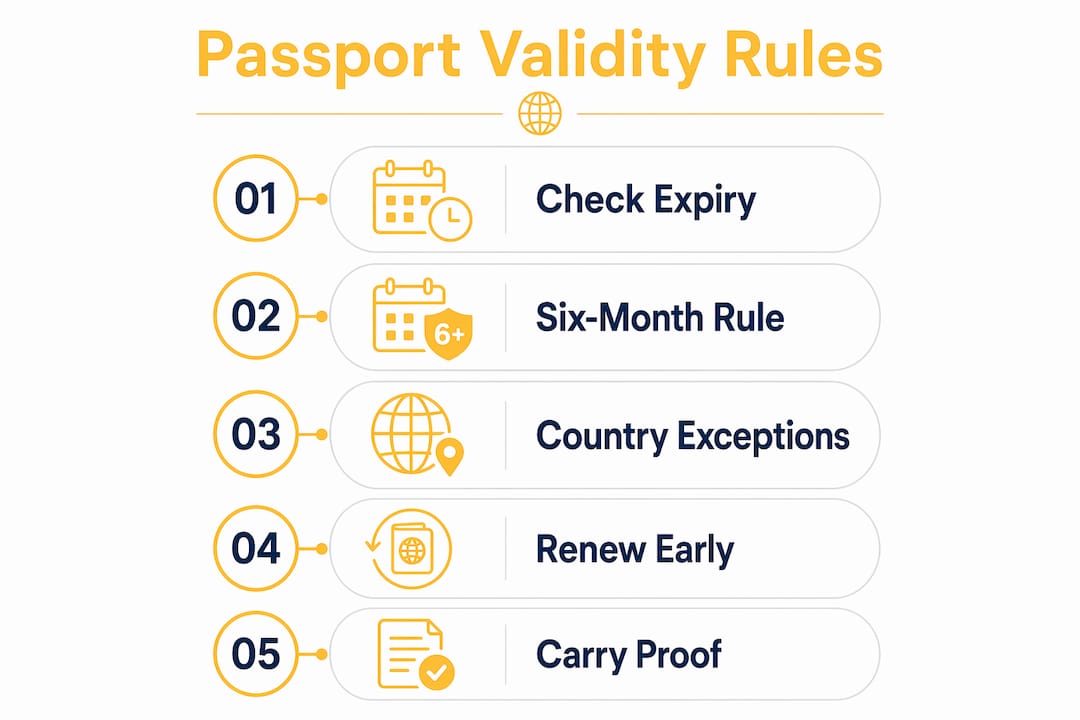
Passport condition matters just as much as expiration dates. A damaged passport, one with a torn cover, water damage, or missing pages, can be rejected at the border even if it is technically unexpired. U.S. Customs and Border Protection considers a passport invalid if it has been significantly altered or damaged. Border officers have discretion, and a worn document creates unnecessary risk.
Follow these steps to protect your passport’s validity before any international trip:
- Check your passport expiration date at least six months before your departure date, not your return date.
- Verify the six-month rule for every country on your itinerary, including layover countries where you clear immigration.
- Inspect your passport physically for damage, torn pages, or a detached cover before traveling.
- Confirm your passport has enough blank visa pages since many countries require at least two blank pages for entry stamps.
- Renew early if your passport falls short of any requirement. Standard passport renewal takes weeks, and delays are common during peak travel seasons.
Pro Tip: Review the three and six-month passport rules for your specific destination before purchasing flights. Buying a nonrefundable ticket before confirming your passport meets entry requirements is one of the most expensive mistakes a traveler can make.
Urgent passport appointments: how proof of travel affects processing
Proof of travel is not just for airlines and immigration. It also determines whether you qualify for an urgent in-person passport appointment at a U.S. Passport Agency. Urgent appointments require proof of travel within the next 14 calendar days, or proof of a foreign visa appointment within 28 days. Standard expedited processing, which typically takes 2–3 weeks, does not require proof of imminent travel.
This distinction matters enormously for travelers who realize their passport is expired or expiring close to a departure date. Walking into a passport agency without qualifying proof of travel will result in a turned-away appointment. The agency staff will not make exceptions based on verbal explanations or unconfirmed plans.
Printed documents are required for urgent passport appointments. Digital-only itineraries displayed on a phone screen may be rejected. The U.S. Department of State expects high-quality printouts of confirmed bookings showing your name, travel dates, and destination. Blurry screenshots or email previews do not meet that standard.
Acceptable forms of proof for an urgent passport appointment include:
- Confirmed airline ticket printouts showing your full legal name, departure date within 14 days, and flight details
- Foreign visa appointment confirmation with a date within 28 days, printed and legible
- Cruise or tour documentation from an operator confirming departure within the qualifying window
- Medical emergency documentation for life-or-death cases, which follow a separate expedited track with similar proof requirements
For travelers who need to rush passport renewal and are unsure whether their proof of travel meets agency standards, working with an experienced expediting service removes the guesswork entirely.
Common mistakes with travel documents and how to avoid them
The most frequent travel document errors are preventable. Name mismatches between a passport and an airline ticket are the single most common cause of denied boarding at check-in. Airlines rely on TIMATIC, a proprietary global database, to verify passenger travel documents automatically. TIMATIC requires exact name matches between the passport and the booking. A middle name omitted from a ticket or a nickname used instead of a legal name can trigger a boarding denial.
Expired documents are the second most common problem. Travelers often carry old passports out of habit or as backup ID, and occasionally present the wrong one at check-in. Keeping your current passport in a dedicated travel wallet, separate from expired documents, eliminates that risk.
Missing printed confirmations create problems at passport agencies and some international borders. Maintaining both physical and digital backups of all travel documents, stored in a cloud service and printed before departure, is the most reliable approach. A phone with a dead battery or a lost bag should never be the reason a trip falls apart.
Common mistakes to avoid before every international trip:
- Name discrepancies between your passport and any booking. Use your full legal name exactly as it appears on your passport when purchasing tickets.
- Relying on digital-only documents for passport agency appointments or destinations that require printed proof.
- Ignoring layover country requirements. If you clear immigration during a connection, that country’s entry rules apply to your passport.
- Failing to check visa page availability. Some countries stamp multiple pages per entry, and a nearly full passport can cause problems even if the expiration date is fine.
Pro Tip: Photograph every travel document, including your passport photo page, visa stamps, and hotel confirmations, and upload them to a secure cloud folder before you leave home. If your bag is stolen, you will have everything you need to contact your embassy and rebook.
Key takeaways
A passport is the legally recognized foundation of all international travel, and proof of travel documents complete the picture that airlines and immigration require.
| Point | Details |
|---|---|
| Passport as primary document | A passport certifies identity and nationality, and no other travel document replaces it at a border. |
| Proof of travel supports entry | Confirmed tickets, hotel bookings, and itineraries show intent and reduce overstay risk for immigration. |
| Six-month validity rule | Many countries require passports valid for six months beyond your return date, not just your departure date. |
| Urgent appointments need printed proof | U.S. Passport Agency appointments for travel within 14 days require printed, confirmed travel documentation. |
| Name matching is non-negotiable | TIMATIC checks exact name matches between your passport and booking, and any discrepancy can result in denied boarding. |
What I’ve learned from years of watching travelers get this wrong
Travelers consistently underestimate how interconnected these documents are. A valid passport without proof of onward travel gets you denied boarding. A confirmed ticket with a passport expiring in two months gets you turned away at the border. Neither document works without the other.
The part that surprises most people is how little margin for error exists. TIMATIC does not care that your embassy told you something different. The system flags a discrepancy, and the check-in agent follows the system. I have seen travelers with perfectly valid visas get denied boarding because the name on their ticket was missing a middle name that appeared on their passport. That is not a bureaucratic technicality. That is the system working exactly as designed.
My strongest advice is to treat travel document management as a system, not a checklist you run through once. Keep a dedicated folder, physical and digital, that you update every time you book a trip. Review Europe travel rule updates and destination-specific requirements at least 90 days before departure. Regulations change, and 2026 has brought new biometric and validity requirements for several popular destinations.
The travelers who never have problems at the airport are not lucky. They are prepared.
— David
How Fastpassportcenter helps when your passport timeline is tight
When your travel date is close and your passport is not ready, the process becomes stressful fast. Fastpassportcenter specializes in expedited passport processing for travelers who need documents quickly, including those who must present proof of imminent travel to qualify for an urgent appointment. Their agents work directly with the U.S. Department of State through a courier collaboration that delivers faster results than standard methods.
Fastpassportcenter holds an A+ rating from the Better Business Bureau and has earned over 14,000 positive reviews from travelers who needed their passports processed without delays. If your departure is within days and your documentation needs to be airtight, their team handles every detail, from verifying your proof of travel meets agency standards to tracking your application through to completion.
FAQ
What does “proof of travel” mean for a passport application?
Proof of travel refers to confirmed travel documents, such as airline tickets or a foreign visa appointment, that show you have imminent international travel. For urgent U.S. Passport Agency appointments, travel must be within 14 calendar days or a visa appointment within 28 days.
Do airlines check proof of onward travel at check-in?
Yes. Airlines use the TIMATIC database to verify travel documents automatically at check-in, and they enforce proof of onward travel more consistently than many immigration checkpoints do. Failure to show a confirmed return or connecting booking can result in denied boarding.
How long does my passport need to be valid for international travel?
Many countries require your passport to be valid for at least six months beyond your planned return date. Requirements vary by destination, so check the specific entry rules for every country on your itinerary, including layover countries.
Can I use a digital copy of my travel documents at a passport agency?
No. U.S. Passport Agency appointments for urgent processing require printed, high-quality copies of confirmed travel documents. Digital-only versions displayed on a phone may be rejected at the appointment.
What happens if my name on the ticket does not match my passport?
TIMATIC flags name discrepancies automatically, and check-in agents are required to follow the system’s output. Even a missing middle name can result in denied boarding, so always book travel using your full legal name exactly as it appears on your passport.