
For domestic flights, you need a REAL ID-compliant state license or an accepted alternative like a U.S. passport at the TSA checkpoint. For international flights, only a passport book works, since REAL ID is not valid for crossing any border. If you fly often within the U.S., get a REAL ID for convenience. If international travel is anywhere on your radar, get your passport first and let it double as a backup.
TL;DR:
- A passport book remains valid for international travel and complements a REAL ID, making it the best choice if international trips are planned within the next year.
- Getting a REAL ID involves an in-person DMV visit requiring proof of identity, Social Security number, and address, with renewal cycles generally shorter and more state-dependent than passports.
- TSA accepts several IDs including passports, Trusted Traveler cards, military IDs, and federally issued IDs, but not expired or pending licenses, so verify compliance before travel.
- Using TSA ConfirmID as a backup is unreliable because verification is not guaranteed and can cause delays or flight misses; carrying your passport is a safer fallback.
- Expedited passport services are most effective if you need a new or renewed passport within 2 days to 4 weeks, especially when traveling on short notice or from remote locations.
Table of Contents
- Passport vs Real ID for Travel: What TSA Accepts at the Checkpoint
- Passport vs REAL ID for Travel: When Each One Actually Works
- How to Get a REAL ID From Your State DMV
- What Happens If You Show Up Without Acceptable ID
- Should You Get a REAL ID or a Passport First?
- Does REAL ID Affect Trains and Buses?
- Renewing a Passport vs Renewing a REAL ID
- What Happens If You Use the Wrong ID at the Airport
- Practitioner Perspective: Risks, Common Mistakes, and Best Practices
- Get Your Passport Fast Without the Regional Agency Trip
- Sources
- FAQ
Passport vs Real ID for Travel: What TSA Accepts at the Checkpoint
Since May 7, 2025, every air traveler 18 or older must show a REAL ID-compliant document or another TSA-approved form of ID before reaching the gate. A standard, non-compliant driver’s license no longer works on its own.
TSA checkpoints accept several documents beyond a REAL ID license:
- REAL ID-compliant driver’s license or state ID (look for a star in the upper corner)
- U.S. passport book
- U.S. passport card
- DHS Trusted Traveler cards: Global Entry, NEXUS, SENTRI, or FAST
- Department of Defense ID (active military and dependents)
- Permanent resident card (Green Card)
- Other federally issued photo ID that meets TSA standards
Most states now issue mobile driver’s licenses (mDLs) that some TSA lanes accept through digital ID readers, though availability varies by airport. Temporary paper licenses, expired IDs, and IDs still pending state mailing are not acceptable on their own. If you’re not sure whether your card is REAL ID compliant, check your state DMV’s website before you head to the airport, not after.
Passport vs REAL ID for Travel: When Each One Actually Works
REAL ID is a federal security standard, not a document type. It sets minimum verification requirements states must meet before issuing a license that satisfies TSA rules for boarding a domestic flight or entering certain federal facilities. It has no authority once you leave the country.
That distinction plays out differently depending on which passport document you’re holding:
- Passport book: required for international air travel and accepted everywhere domestically that a REAL ID is accepted.
- Passport card: valid for land and sea crossings to Canada, Mexico, and the Caribbean, but it is not valid for international air travel.
- REAL ID license: works for domestic flights only; it cannot substitute for a passport at any international border, by air or otherwise.
Validity snapshot: A U.S. passport book runs 10 years for adults (5 years for children under 16), while REAL ID renewal cycles are set by each state and typically fall between 4 and 8 years.
That gap matters when you’re planning ahead. A passport issued today likely outlasts two REAL ID renewal cycles.
How to Get a REAL ID From Your State DMV
Getting a REAL ID means an in-person DMV visit; no state currently issues one entirely online. Expect to bring:
- Proof of identity (certified birth certificate or valid passport)
- Your Social Security number (card, W2, or SSA paperwork)
- Two documents proving your current address (utility bill, lease, or bank statement)
- Proof of any legal name change, if applicable (marriage certificate, court order)
Book an appointment before you go. Walk-in wait times at busy DMV offices routinely stretch into hours, and requirements shift slightly by state, so confirm the exact list on your state DMV page first.
Most people walk out with a REAL ID the same day or receive it by mail within a few weeks. That timeline works fine if your next flight is domestic and a month or more away. It does nothing for you if you’re flying internationally next week. In that case, skip the DMV line entirely and put your energy into your passport instead.
Pro Tip: If your driver’s license is about to expire and you also don’t have a current passport, handle the REAL ID renewal and the passport application in the same week. Trying to do both back to back wastes weeks you may not have.
What Happens If You Show Up Without Acceptable ID
TSA offers a backup option called TSA ConfirmID, which verifies your identity through personal information instead of a physical document. It costs $45, and the verification stays valid for 10 days.
That sounds like a safety net. It isn’t one you should plan around.
- ConfirmID is not guaranteed to clear you through security, even after you pay the fee.
- The added verification steps can tack on 30 to 90 minutes or more, and travelers who fail the check are turned away regardless.
- A missed flight because of a failed ID check rarely comes with a free rebooking.
If there’s any chance you’ll be short on acceptable ID, the safer move is carrying your passport as backup, adjusting your departure to build in buffer time, or leaning on an expedited passport service if the real problem is that your passport itself is missing or expired.
Should You Get a REAL ID or a Passport First?
The right first move depends entirely on your travel timeline and travel pattern, not on which document sounds more official.
- Frequent domestic flyer, no international trips planned: Get the REAL ID first. It’s the faster, cheaper option for routine flights, and you can add a passport later without urgency.
- International travel is likely within the next year: Get the passport first. It works domestically too, so you cover both bases with one document.
- Departing in 0 to 3 days, traveling abroad: Skip the DMV and the mailbox. An in-person regional passport agency is the only realistic option on that timeline.
- Departing in 2 days to 4 weeks: A registered courier or expediting service is usually your best bet, especially if you live two or more hours from a regional agency, as is common in Tampa, Charlotte, Sacramento, Nashville, and Louisville.
- Departing 4 or more weeks out: Routine processing through USPS is fine. No rush fees, no courier needed.
Pro Tip: Check your existing passport’s expiration date the moment a trip gets booked, not the week before. Many countries require six months of validity remaining beyond your return date, which catches travelers off guard more often than an expired REAL ID does.
Does REAL ID Affect Trains and Buses?
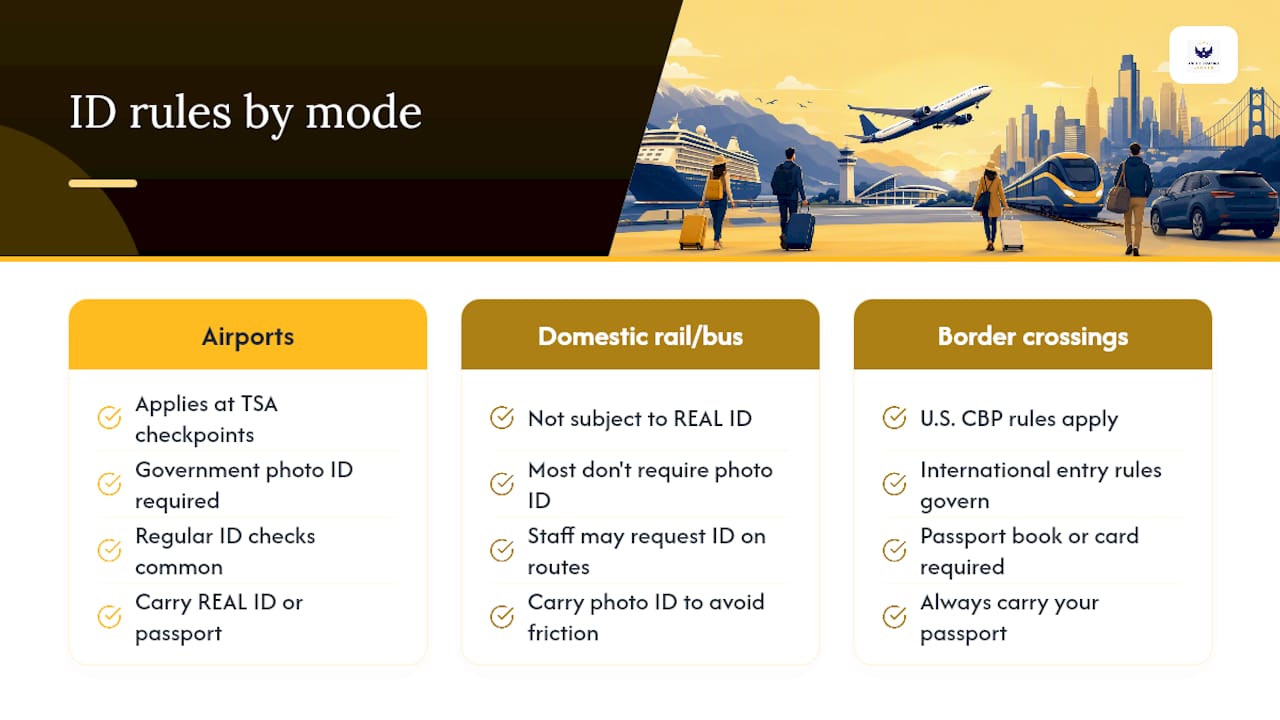
REAL ID enforcement applies specifically to TSA airport checkpoints and to entry into certain secure federal facilities. Amtrak, Greyhound, and city or regional transit systems are not subject to the same identification mandate, and most don’t require government photo ID at all for a standard ticket purchase and boarding.
That said, “not required” doesn’t mean “never asked for.” Amtrak staff can request ID during ticket checks, especially on longer routes or when purchasing certain fare types, and having a valid ID on hand avoids friction if a conductor asks. International rail and bus routes, like a bus crossing into Canada or Mexico, are a different matter entirely: those crossings fall under U.S. Customs and Border Protection rules, and a passport book or passport card becomes necessary depending on the mode of entry.
The practical takeaway: if your travel is strictly domestic and doesn’t involve flying, REAL ID enforcement barely touches you. If your itinerary includes a border crossing by any method, air, rail, or road, treat it the same way you’d treat an international flight and carry your passport. Relying on a REAL ID alone for a cross-border bus trip is a mistake that can leave you stuck at the crossing with no fallback.
Renewing a Passport vs Renewing a REAL ID
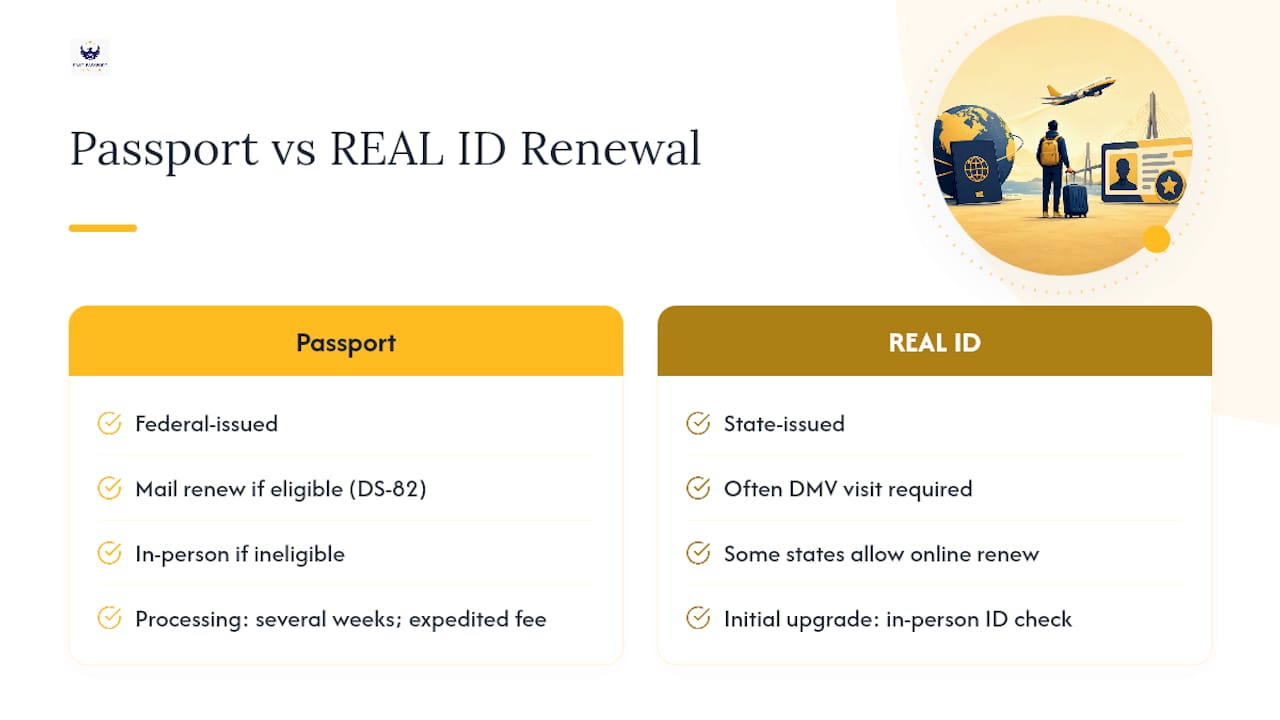
Passport renewal is one of the more forgiving government processes, provided your current passport was issued as an adult, is undamaged, and was issued within the last 15 years under your current name. In that case, you can renew by mail using Form DS-82 without visiting an office at all. Processing through routine State Department channels typically runs several weeks, and expedited service or a registered courier cuts that down considerably, for an added fee.
If your passport doesn’t qualify for mail renewal, perhaps it’s damaged, more than 15 years old, or issued under a name you’ve since changed, you’ll need to apply in person as if it were a first-time application.
REAL ID renewal works differently since it’s a state process, not a federal one. Some states allow online renewal for a REAL ID-compliant license if nothing about your information has changed, but many still require an in-person DMV visit to re-verify your identity documents, particularly the first time you upgrade to REAL ID status. After that initial verification, subsequent renewals in some states get simpler.
The core difference worth remembering: your passport renewal clock resets every 10 years and is largely in your control through the mail. Your REAL ID renewal clock is set by your state, tends to run shorter, and often demands a physical visit. Track both dates separately. Losing track of either one at the wrong moment is how travelers end up scrambling days before a flight.
What Happens If You Use the Wrong ID at the Airport
Showing up with the wrong document doesn’t just slow you down, it can end your trip before it starts. A traveler with only an expired, non-REAL-ID license and no passport will typically be routed to TSA ConfirmID, and if that verification fails or takes too long, boarding gets denied outright.
The consequences stack up fast. Missing a flight because of an ID problem usually means no refund on that leg, a same-day rebooking fee, and in the case of international connections, a cascade of missed transfers that can cost far more than the original ticket. Airlines are not obligated to accommodate a passenger who can’t clear TSA screening, and gate agents have no authority to override a security denial.
The most common version of this mistake isn’t ignorance of the rules. It’s assumption. Travelers assume a passport card works for a flight to Cancun (it doesn’t) or that a REAL ID will get them through customs abroad (it won’t). Both errors are avoidable with a five-minute check of your documents against your actual itinerary before you leave home. If your passport has expired and international travel is close, that’s the moment to move quickly rather than hope a REAL ID will cover the gap. It won’t.
Practitioner Perspective: Risks, Common Mistakes, and Best Practices
The biggest mistake travelers make isn’t picking the wrong document; it’s assuming one document covers every situation. Keep your passport current even if you mainly fly domestic on a REAL ID; store it somewhere safe and check the expiration date twice a year. Treat TSA ConfirmID as an emergency fallback, never a plan, since the delay and denial risk are real. If you live far from a regional passport agency, the mistake is waiting until a week before departure to notice your passport is expired. Plan early, and when you can’t, use a courier or expediting service rather than gambling on a DMV counter or a ConfirmID line.
— Andy Irons
Get Your Passport Fast Without the Regional Agency Trip
If you’ve just discovered your passport is expired, damaged, or missing and your flight is two days to four weeks away, you don’t need to drive hours to a regional passport agency to fix it. Fast Passport Center is a U.S. State Department-registered courier with drop-off offices in 24 cities, built specifically for travelers who can’t easily reach an agency in person, whether you’re in Tampa, Charlotte, Sacramento, Nashville, or Louisville.
Fast Passport Center handles the parts that eat up time on your own: form review from an experienced agent, courier hand-delivery directly to the State Department, and real-time tracking so you’re not left guessing where your application stands. If your trip is genuinely within 72 hours or tied to a family emergency, a regional agency visit is still the right call. For everything else in that 2-day-to-4-week window, start your expedited passport order and check current processing times before you book your flight.
Sources
- REAL ID Frequently Asked Questions | Transportation Security Administration
- U.S. passport FAQ | U.S. Department of State
FAQ
Should I get my REAL ID or my passport first?
Get your passport first if international travel is even a possibility, since it works for both domestic and international trips. Get your REAL ID first only if your travel stays strictly domestic.
Does a U.S. passport replace a REAL ID?
Yes. A valid U.S. passport book satisfies TSA’s domestic ID requirement and works internationally, so it fully covers what a REAL ID does at the checkpoint and more.
Is it faster to get your REAL ID or your passport?
A REAL ID at the DMV is often quicker if your state issues it same day, but a passport under time pressure can move faster through an expedited courier service than a routine State Department application.
Can I fly with just my Social Security card?
No. A Social Security card is not a TSA-acceptable form of photo ID for boarding a flight; you need a REAL ID-compliant license, passport, or another approved document listed by TSA.
Recommended
- 2–4 Weeks Until Travel? How to Book a Flight Without a Passport in the U.S.
- Traveling in 3 Days? U.S. Passport Signature Rules and Fast Fixes
- New Passport Application (DS-11) — First-Time, Lost, Damaged, Child & Replacement
- U.S. Citizen Passport Guide — How to Get a Passport Fast Through a Registered Courier