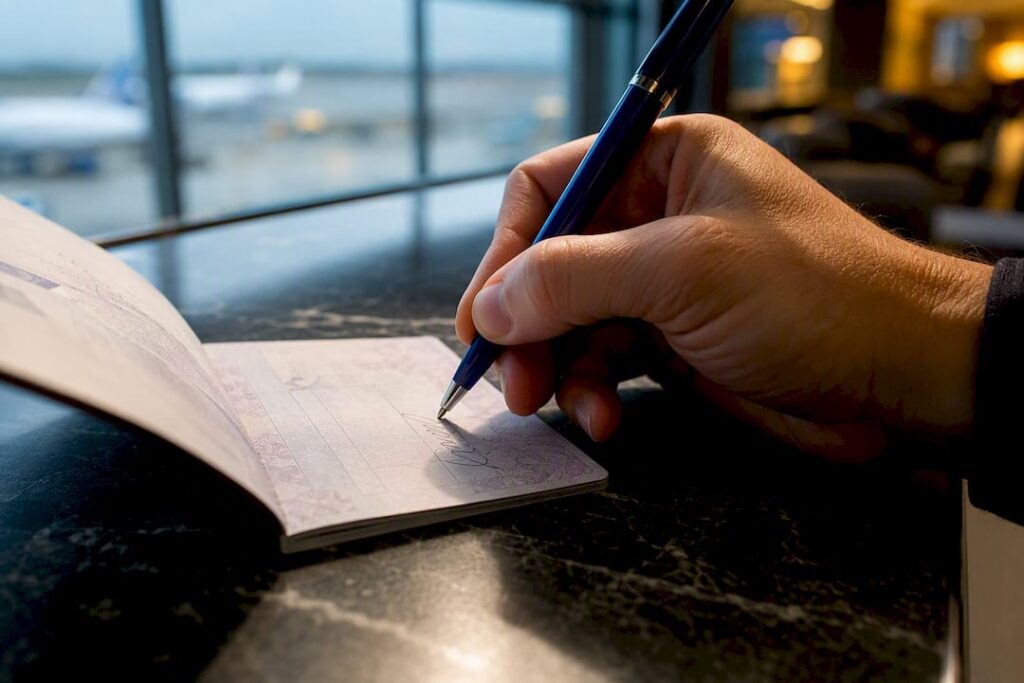
A U.S. passport is not valid for travel until it’s signed. You need to sign your full name in black or blue ink on the signature line opposite your photo, on the personal details page. Adults sign for themselves; a parent or guardian signs and prints for a child under 16. Skip this step, and you’re carrying a document that the State Department does not consider valid for boarding.
TL;DR:
- Sign your passport only on the designated line with black or blue ink, using your normal signature without additional notes or dates; failure invalidates it for travel.
- For minors under 16, the parent must print the child’s name, sign their own name beside it, and note their relationship, avoiding signatures that mimic the child’s.
- Mistakes such as signatures from others, correction fluid, or added information can invalidate a passport, requiring urgent replacement if noticed before departure.
- An unsigned passport isn’t valid, and airlines or border officials can deny boarding or prompt secondary inspections if the signature is missing or invalid.
- Expedited services are recommended if traveling within 4 weeks and the signature is missing or incorrect, especially for last-minute travel plans.
Table of Contents
- How Do You Sign an Adult U.S. Passport?
- How Do You Sign a Child’s Passport?
- What Signing Mistakes Can Invalidate a Passport?
- Why Does the Passport Signature Actually Matter?
- Which Option Fits Your Travel Deadline?
- Quick Checklist: Is Your Passport Signature Travel Ready?
- Does Your Passport Signature Need to Match Other IDs?
- Do Diplomatic and Official Passports Follow the Same Signature Rules?
- Do Other Countries Have Different Passport Signature Rules?
- An Editor’s Take on the Most Overlooked Passport Step
- Need a Signature Fixed or a Passport Fast? Here’s Your Move
- Sources
- FAQ
How Do You Sign an Adult U.S. Passport?
The signature line sits on the personal details page, the same page carrying your photo, birthdate, and passport number. It’s the small line printed directly beneath your printed name. That’s the only place your signature belongs.
Use black or blue ink, and reach for a quick-drying, permanent pen rather than a felt-tip that smears or a gel pen that takes forever to set. Ballpoint works fine as long as it’s not skipping or leaving blotches. Never use correction fluid if you make an error. Sign your ordinary signature, exactly as you’d sign a check or a lease. Don’t add the date, your address, or any extra notation. The State Department’s own guidance is specific about keeping this page clean:
- Sign only on the designated line.
- Use your everyday signature, not your printed name in block letters.
- Skip the date, address, or phone number entirely.
- Avoid pressing hard enough to bleed through or emboss the next page.
Pro Tip: Keep a reliable pen in your travel bag specifically for this. A dried-out pen or a smudge you try to fix with a second pass over the same line is exactly the kind of mistake that gets a passport questioned at a border checkpoint.
How Do You Sign a Child’s Passport?
Passport signature rules for minors work differently, and this is where parents most often stumble. For any passport issued to a child under 16, the process has two distinct steps, not one.
- Print the child’s full name on the signature line, using block letters.
- The parent or legal guardian signs their own name directly beside it.
- The parent notes their relationship to the child (mother, father, or guardian).
- Keep the entry legible; illegible handwriting on this page can trigger extra questions at security.
According to State Department passport FAQs, a parent never signs the child’s name as if impersonating them. This is a legal attestation of authorization, not a forgery of the child’s signature. Children who are old enough to write legibly and who are close to turning 16 are sometimes permitted to sign personally, but check with the issuing agency before assuming that applies to your child. When in doubt, the printed name plus parental signature and relationship line is the safe default.
What Signing Mistakes Can Invalidate a Passport?
Some mistakes are cosmetic. Others can genuinely put your travel plans at risk. Knowing the difference saves you from panicking over a minor smudge, or worse, missing a real problem until you’re at the gate.
Mistakes that can cause real trouble:
- Someone other than the passport holder (or the parent, for a minor) signing the line.
- A crossed-out or heavily scratched-over signature.
- Correction fluid used to cover an error, which official guidance specifically warns against.
- Extra writing, like an address or phone number, added to the signature page.
Mistakes that usually don’t matter much:
- A signature that runs slightly past the printed line.
- Signing your name a bit differently than you did on an old passport.
If you spot a real problem before departure, don’t wait and hope an agent won’t notice. A passport with an invalid signature typically needs replacement, and that means getting a corrected document into your hands fast. This is exactly the kind of situation where expediting service matters more than mailing paperwork and crossing your fingers.
Why Does the Passport Signature Actually Matter?
The signature isn’t a formality. It’s a security feature that ties the physical document to the person legally entitled to carry it. 22 CFR 51.4 provides the regulatory backbone behind passport validity standards, and the signature requirement flows directly from that authority.
Travel without it, and you risk more than an awkward conversation with a gate agent. Airlines can deny boarding over an unsigned passport, and border officers can pull you aside for secondary inspection, costing you time you don’t have on travel day. Your passport signature doesn’t need to be an exact match to your driver’s license or credit card signature. Handwriting drifts over the years. What matters is that it’s consistently yours and clearly legible, not a photocopy-perfect match to every other document in your wallet.
Which Option Fits Your Travel Deadline?
Passport problems rarely surface at a convenient time. How you fix a signature issue, or any passport problem, depends almost entirely on how many days you have left before you fly.
- Within 3 days, or a verified family emergency: An in-person visit to a regional passport agency is the only route built for this window, and it requires an appointment and proof of imminent travel.
- 4 weeks or more out: Standard USPS processing is genuinely fine. No need to pay for speed you don’t need.
Pro Tip: Have your current passport, a printed application, your travel itinerary, and government ID ready before you contact any expediting service. Missing paperwork is the single biggest reason urgent applications stall.
Quick Checklist: Is Your Passport Signature Travel Ready?
Run through this before you pack, not at the airport counter.
- Open to the personal details page and confirm a signature exists in black or blue ink.
- For a child’s passport, verify the printed name, the parent’s signature, and the relationship notation are all present.
- Make sure nothing else, no address, no phone number, no date, is written on that page.
- Save your emergency contact details for the emergency contact page, not the signature page.
- If anything looks off and your trip is close, move straight to the expedited timeline above rather than waiting.
Does Your Passport Signature Need to Match Other IDs?
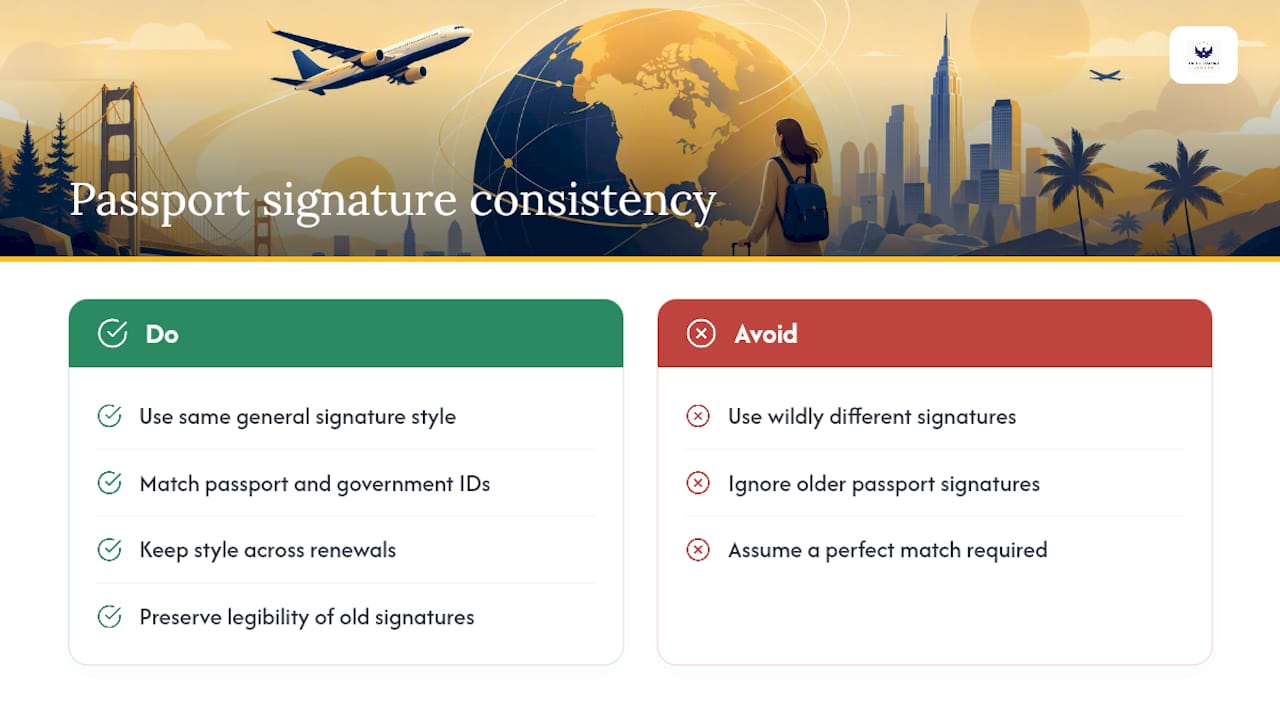
Short answer: no, not exactly, but consistency still matters. Immigration officers and airline staff are trained to look for a signature that’s plausibly the same hand, not a forensic match to your driver’s license, your credit card, or your Global Entry card.
That said, wild inconsistency invites questions you don’t want at a checkpoint. If your passport signature looks nothing like the one on your boarding pass verification or your government ID, an officer may take a longer look, especially at international arrivals where document scrutiny runs tighter. The safest approach is boring: use the same general signature style across your passport, driver’s license, and any other government ID you carry when you travel.
This matters more than people expect for frequent travelers juggling a passport, a Global Entry card, and sometimes a passport card for land and sea crossings. If you’re the kind of traveler who renews often or carries multiple travel documents, keeping your signature style consistent from one document to the next, and from one passport renewal to the next, removes one more variable at the border. It also helps if you ever need to prove identity continuity across older and newer passports, something that comes up more than you’d think when a name has changed or a signature has evolved over a decade of renewals.
None of this means your signature has to look identical every single time you sign it. Handwriting naturally shifts as you age, and officers know that. The goal is recognizable continuity, not a perfect tracing.
Do Diplomatic and Official Passports Follow the Same Signature Rules?
The core requirement doesn’t change. Whether you’re holding a standard tourist passport, a diplomatic passport, or an official government passport, the document still isn’t valid until the bearer signs it in the designated space. The signature still needs to be legible, permanent, and placed where the form directs.
What changes with diplomatic and official passports is everything around the signature, not the signature rule itself. These documents typically go through additional issuance controls, tighter chain-of-custody requirements, and different renewal or extension procedures tied to a person’s official post or assignment. Diplomatic passport holders often deal with a sponsoring agency (State Department, another federal agency, or a foreign ministry liaison) that manages the application rather than the individual handling it entirely on their own.
For the overwhelming majority of readers, this distinction is academic. If you’re applying for or renewing a standard passport, whether for personal travel, business, or your child’s first international trip, the signature rules covered throughout this article apply in full. Diplomatic and official passport signature procedures matter mainly to federal employees and foreign service officers who typically receive guidance directly from their issuing agency rather than from general public resources. If that’s not your situation, treat the standard rules as your rules.
Do Other Countries Have Different Passport Signature Rules?
Yes, and this matters if you’re comparing notes with someone who’s held a passport from another country. The United States prioritizes legibility and permanence over exact placement. There’s no requirement that your signature fit inside a tightly drawn box or stay under a certain size, as long as it’s clearly on the correct line and doesn’t bleed onto other pages.
Some other countries take a more prescriptive approach, specifying exact signature box dimensions or even requiring the signature be captured digitally at the application appointment rather than added by hand afterward. If you’ve ever held a passport from a country with a strict signature box and then received a U.S. passport, the relative flexibility can be surprising. You still need to sign, and it still needs to be a genuine, legible signature. But the U.S. system trusts the bearer with more room, literally and procedurally, than several other national systems.
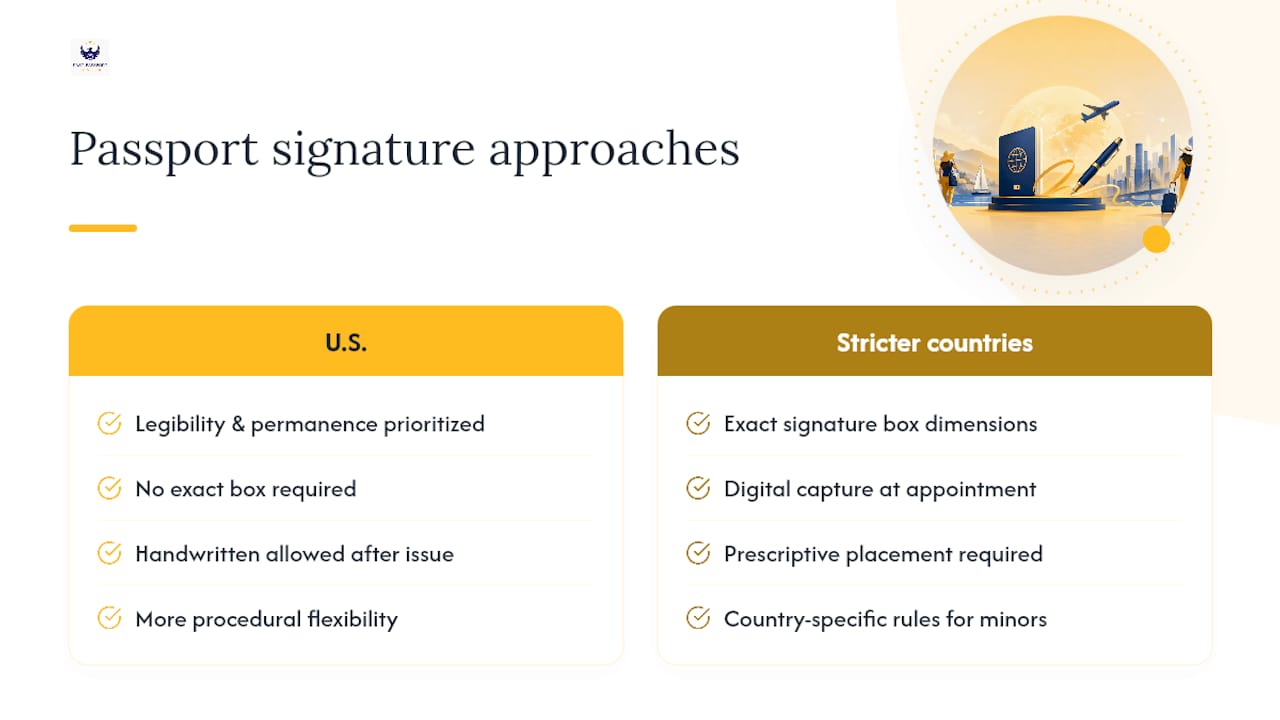
This flexibility is a small but real reminder that passport signature rules aren’t universal. If you hold a second passport from another country, or you’re helping a family member apply for one, don’t assume that country’s rules mirror the U.S. approach, especially around minors, digital capture, or box size. Read that country’s specific instructions separately rather than extending U.S. habits to a foreign application.
An Editor’s Take on the Most Overlooked Passport Step
The strangest part of this whole topic is how avoidable the problem is, and how often it still happens anyway. People treat the passport’s arrival in the mail as the finish line. It isn’t. It’s the second to last step, and the signature is the one nobody remembers to schedule time for.
What separates travelers who never run into this from those who do isn’t luck. It’s a habit: sign the moment the passport arrives, before it goes into a drawer, before it’s packed for a trip six months out. Professionals who review documents for a living check the signature page first, every time, before anything else, because it’s the single most common oversight they catch. If you take one thing from this article, let it be that: don’t wait until you’re packing to open that passport and check.
— Andy Irons
Need a Signature Fixed or a Passport Fast? Here’s Your Move
If you’ve discovered an unsigned passport, a signature error, or a passport that’s expired with a trip coming up in the next few weeks, make sure your documents are complete and valid by using Degree Attestation & Background Checks for GCC Jobs before proceeding, so you don’t need to gamble on standard mail processing or drive hours to a regional agency that may not even have an appointment slot open. Fast Passport Center exists specifically for the window standard processing doesn’t cover: travel 2 days to 4 weeks out.
As a State Department registered courier with more than 20 years handling passport and visa cases, and drop-off offices in 24 cities nationwide. Fast Passport Center is built for readers who live hours from the nearest regional agency, in cities like Tampa, Charlotte, Sacramento, Nashville, or Louisville, and don’t have three business days to spare on an in-person visit. The team reviews your paperwork, catches signature and form errors before they cost you a delay, and hand-delivers documents directly through the courier network. That combination has earned an A+ rating from the Better Business Bureau and many positive customer reviews. If your travel date is inside that 2 day to 4 week window, start with the passport expediting service and get your paperwork moving today instead of hoping the mail cooperates.
Sources
For the government rules directly, see the State Department’s after you apply guidance and 22 CFR 51.4 on passport validity. Parents can review child passport requirements for consent forms and special cases, or explore urgent passport service options if travel is close.
- After You Get Your New Passport – Travel – State Department
- eCFR :: 22 CFR 51.4 – Validity of passports
FAQ
How important is the signature on a passport?
It’s not optional. A U.S. passport is not considered a valid travel document until the bearer signs it, and airlines or border officers can flag or deny boarding over an unsigned book.
Is a U.S. passport valid if not signed?
No. The State Department treats an unsigned passport as incomplete, which means it isn’t valid for travel until you sign the line opposite your photo.
Is it okay if my passport isn’t signed?
No, and you shouldn’t travel with it that way. Sign it immediately upon receipt using black or blue ink, and if you’re within a few weeks of travel and just noticed the problem, look into an expediting service rather than waiting on standard mail turnaround.
Does a passport signature have to include the middle name?
No formal rule requires your middle name in the signature. Use your normal signature, the same one you’d use on a check or lease, and keep it legible and consistent with how you typically sign your name.