
No, you cannot officially pay to rush a Schengen visa the way you can expedite a U.S. passport. The realistic minimum sits around 10 to 15 working days, and only documented emergencies get embassy discretion for faster handling. If your trip is inside that window, start now: confirm your passport is valid, search consulate and VFS/BLS appointment portals immediately, and gather proof if your case qualifies as urgent. The checklist below spells out exactly how to move.
TL;DR:
- Visa processing generally takes 15 days, but complex cases can extend up to 45 days, and appointment wait times can add several weeks.
- Emergency eligibility for faster visas includes medical issues, family death, urgent legal proceedings, or time-sensitive work or academic commitments, backed by proper documentation.
- Ensuring your passport has at least three months of validity and blank pages is critical, as passport issues are the main bottleneck in urgent applications.
- Using expedited passport services, especially in cities without fast government offices, can significantly reduce delays and keep visa and passport processing aligned.
- Applying at least 4 to 6 weeks before travel during off-peak times or 6+ weeks during peak season improves chances; last-minute planning often risks delays or rejection.
Table of Contents
- How Long Does a Schengen Visa Actually Take to Process?
- When Will an Embassy Actually Expedite Your Case?
- How Can You Speed Up Your Schengen Visa Application?
- Is Your Passport the Real Bottleneck?
- Is Rushing Worth It, or Should You Wait?
- Get Your Passport Ready Before the Visa Clock Starts
- Sources
- FAQ
How Long Does a Schengen Visa Actually Take to Process?
Under the Schengen Visa Code, consulates have a standard 15 calendar days to decide on a visa application. That window can stretch to 45 days when a case requires deeper review or extra documents, according to the European Commission’s Migration and Home Affairs guidance. The Schengen Visa Code (Regulation 810/2009) is the legal source for these timelines, and it also sets the application window: you can apply as early as six months before travel, but no later than 15 days before departure.
Those 15 days are calendar days from the date of a complete, accepted application. That’s a distinct measurement from the days you spend hunting for an appointment slot, which can eat weeks on its own during busy periods.
Quick fact: Standard Schengen processing runs about 15 days, with legal extensions up to 45 days for complex cases.
Processing speed also depends heavily on which country and which season you’re dealing with. Some consulates run lean operations with same-week turnarounds in slow months; others back up for weeks once summer travel hits. General guidance from visa-tracking services recommends applying 4 to 6 weeks ahead in normal periods, and 6 or more weeks during peak season, which typically runs from April through August and again around the December holidays.
Here’s the practical breakdown for U.S. applicants:
- Off-peak months (January to March, September to November): 4 to 6 weeks lead time is usually sufficient.
- Peak season (April to August, December): Plan for 6+ weeks; appointment slots vanish fast.
- Complex applications (self-employed, multiple prior refusals, unusual travel history): budget toward the 45-day ceiling.
If your travel date falls inside 2 to 4 weeks from today, treat your situation as urgent and move directly to the rush tactics later in this guide.
When Will an Embassy Actually Expedite Your Case?
Embassies don’t run a general express lane for tourists, but they retain discretion to move faster in specific circumstances. Guidance on emergency Schengen visa handling consistently points to the same short list of qualifying situations, and each one needs paperwork to back it up.
- Medical emergency abroad requiring your presence, supported by a hospital letter or physician’s statement naming dates and the patient.
- Death in the immediate family within the Schengen area, documented with a death certificate or funeral notice.
- Urgent legal proceedings, such as a court summons requiring your appearance, verified by the court document itself.
- Time-sensitive academic or business obligations, such as a thesis defense or a signed contract deadline, backed by an employer or institution letter.
Even with solid documentation, there is no official express Schengen tourist visa, and expedited handling in genuine emergencies still runs anywhere from a few days to about a week. Nothing is guaranteed. The embassy makes a discretionary call case by case.
Pro Tip: Put a one-page cover letter on top of your application marked “URGENT REVIEW REQUESTED,” summarizing the emergency in three sentences and pointing to the attached proof. Consulate staff process hundreds of files a week; a letter that makes your case obvious in ten seconds gets read differently than a stack of unmarked forms.
How Can You Speed Up Your Schengen Visa Application?
Rushing a Schengen visa is less about one clever trick and more about eliminating every avoidable delay. Here’s the order of operations that gives you the best shot.
Step 1: Triage your passport first. Your passport needs at least three months of validity beyond your planned departure from the Schengen area, plus blank visa pages. If it’s expired, damaged, or too close to that line, nothing else on this list matters until it’s fixed. This is where most last-minute applicants get stuck without realizing it.
Step 2: Confirm the correct consulate. You generally must apply where your main destination lies, meaning the country where you’ll spend the most nights. When nights are split evenly, the rule shifts to your first point of entry into the Schengen area. Applying somewhere else to “find a faster consulate” only works when your actual itinerary legitimately supports it.
Step 3: Hunt appointments aggressively. Consulate and third-party portals like VFS Global and BLS International handle scheduling for most U.S. jurisdictions. Their prime or premium appointment tiers can get you a booking slot faster, but they don’t speed up the consulate’s actual adjudication. Check portals daily, set cancellation alerts if the provider offers them, and stay flexible on which drop-off location you’ll accept.
Step 4: Build a complete file the first time. Incomplete applications are the single most common cause of the 45-day extension. Make sure you have:
- A fully completed application form with no blank fields
- Travel insurance meeting the Schengen minimum coverage
- Recent bank statements showing sufficient funds
- An employer letter or invitation letter, as applicable
- Passport photos meeting exact size and background specs
Step 5: Submit and track. Index your documents in the order the checklist requests them, keep your originals in hand, and get a stamped receipt or tracking number. If your case is genuinely urgent, escalate by calling VFS/BLS support or the consulate directly once you’ve passed the timeline you were quoted, and have refundable travel bookings ready in case plans need to shift.
Pro Tip: Rising demand during peak travel months has made appointment slots noticeably harder to secure at several U.S. consulates. If your dates are flexible, book the earliest available appointment even if it’s inconvenient. You can always adjust travel plans around a confirmed visa slot, but you can’t adjust a visa slot around your travel plans.
Is Your Passport the Real Bottleneck?
Here’s what a lot of urgent Schengen applicants miss: the visa application isn’t usually what’s broken. It’s the passport underneath it. You need at least three months of validity past your Schengen departure date and open visa pages, and if either one is missing, no consulate can move forward, no matter how strong your documentation is.
Passport problems tend to surface at the worst possible moment: a family finds an expired passport while packing, a parent realizes their child has never had one, or a traveler discovers water damage from a forgotten backpack pocket. Once that happens, your available path depends entirely on how much time is left.
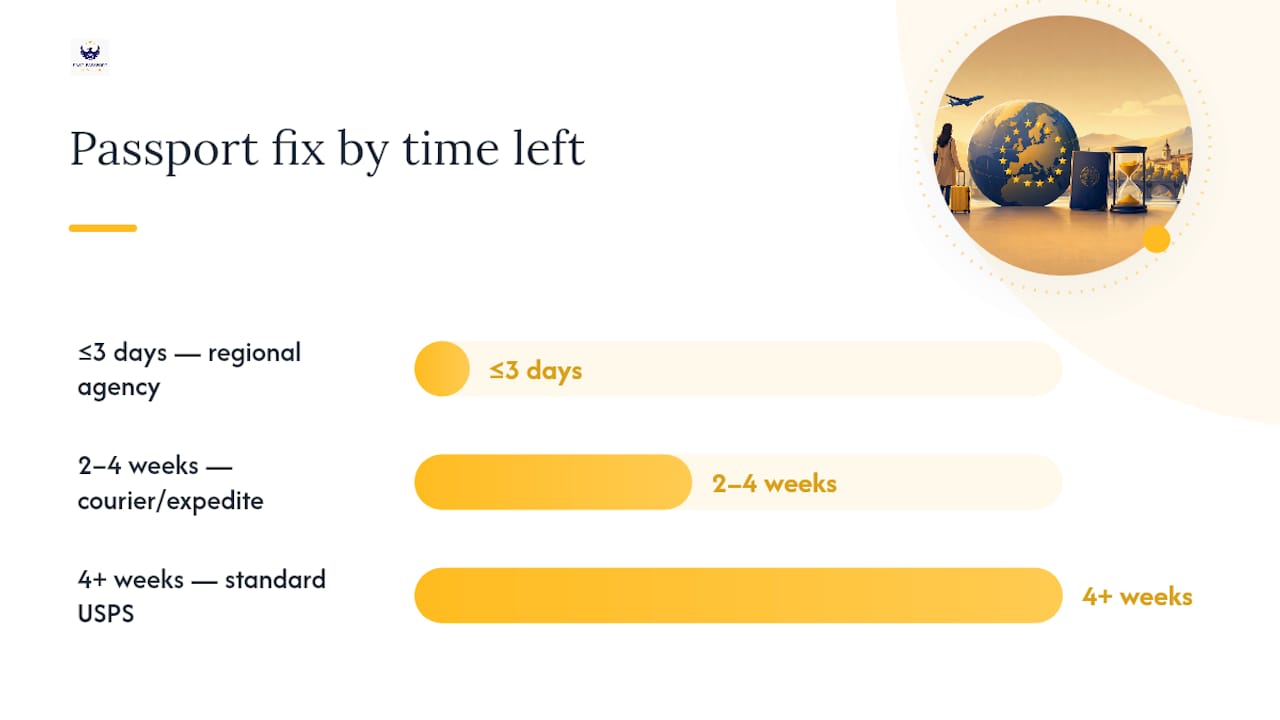
- Travel within 3 days, or a genuine family emergency: an in-person visit to a regional passport agency is generally the only route fast enough, and it requires proof of travel and an appointment.
- Travel 2 days to 4 weeks out: this is where a courier and expediting service becomes the practical option, since it avoids the agency’s limited appointment slots entirely.
- Travel 4 or more weeks out: a standard USPS post office application usually has enough runway to complete on its own.
Quick fact: A passport with fewer than three months of validity left, or one lacking blank pages, will block a Schengen visa application regardless of how complete the rest of your file is.
If you’re in Tampa, Charlotte, Sacramento, Nashville, Louisville, or another city sitting two or more hours from the nearest regional passport agency, that middle tier matters most. Fast Passport Center is a U.S. State Department-registered courier with drop-off offices in 24 cities, built specifically for travelers in that position. The service hand-delivers your passport application through direct courier channels to speed processing, and it can help coordinate the simultaneous visa processing benefit so your passport and visa timelines run in parallel instead of stacking one after another. For a fuller breakdown of options by timeline, the expedited passport and visa routes guide is worth a look before you decide.
Is Rushing Worth It, or Should You Wait?
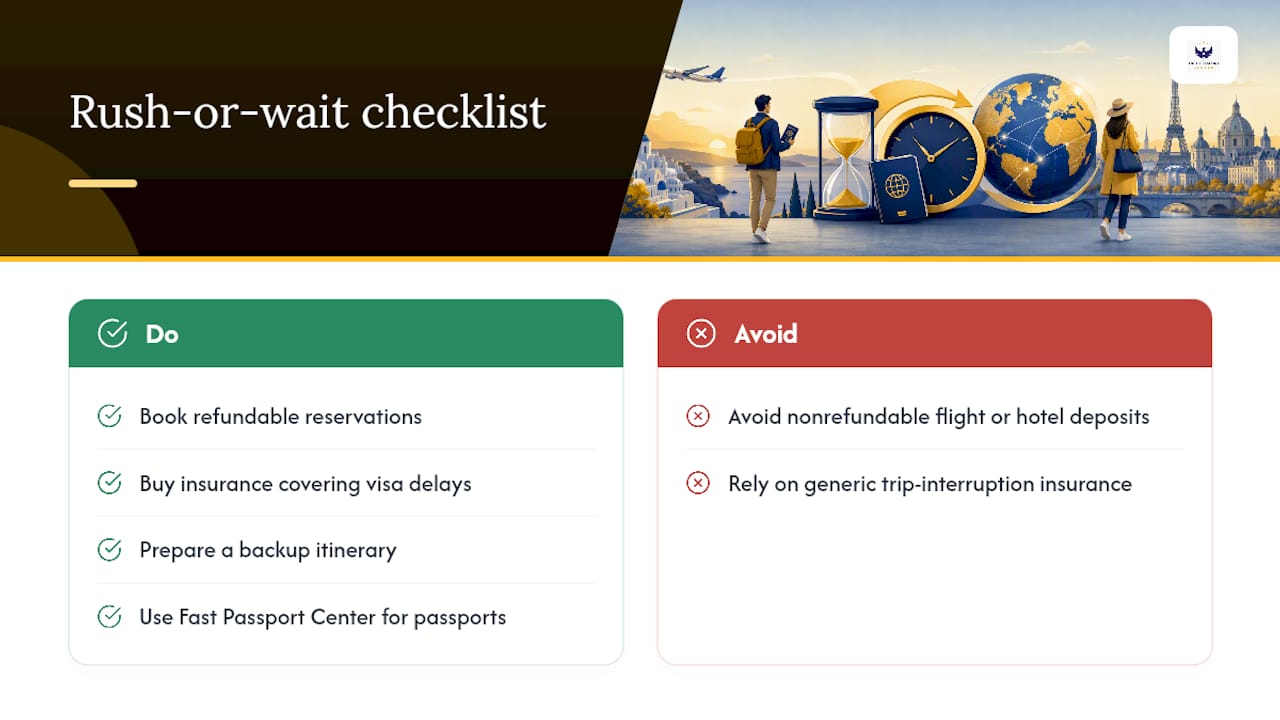
Weigh the cost honestly. Expedited passport and courier fees are real money, but so is a nonrefundable flight and hotel deposit lost to a delayed visa. Before you commit to the rush path, book refundable reservations where possible, and add travel insurance that explicitly covers visa delays rather than generic trip interruption. A backup itinerary, even a rough one, gives you room to shift dates without starting over.
Fast Passport Center fits this approach well for travelers who’ve decided to move forward: it removes the passport bottleneck fast so your energy goes into the visa appointment fight, not two crises at once.
— Andy Irons
Get Your Passport Ready Before the Visa Clock Starts
A Schengen visa can’t move faster than the passport behind it, and that’s the piece most travelers underestimate until they’re staring down a departure date. Fast Passport Center is the practical alternative to waiting on a regional agency appointment for anyone 2 to 4 weeks out: as a State Department-registered courier with drop-off offices in 24 cities, it hand-delivers your application through direct government channels instead of relying on standard mail processing.
If your Schengen trip is inside that same window, check appointment availability now and gather your supporting documents, proof of travel, current photos, and any prior passport, before you place an order. Start with the passport expediting service to lock in your timeline, and pair it with the simultaneous visa processing benefit if your Schengen visa and passport renewal need to happen at the same time.
Sources
- Applying for a Schengen visa – Migration and Home Affairs
- EUR-Lex: Schengen Visa Code (Regulation 810/2009) — consolidated text
- Schengen Visa Processing Time 2026: Per-Country Timelines & What Causes Delays
FAQ
How fast can I get a Schengen visa in the USA?
Standard processing is about 15 calendar days from a complete application, though it can extend to 45 days for complex cases, per the Schengen Visa Code. Add appointment wait times on top, which can push total lead time to several weeks.
Can I get a Schengen visa in 3 days?
Only in rare, documented emergencies like a medical crisis or death in the family, and only at the embassy’s discretion. There’s no general paid express service that guarantees a 3-day tourist Schengen visa.
Can you get a Schengen visa in 2 days?
No. No Schengen country offers an official 2-day tourist visa program, and any service claiming to guarantee one should be treated with caution unless the embassy confirms it in writing for your specific emergency case.
Which country is quickest to get a Schengen visa?
Processing speed varies by consulate and season rather than by a fixed ranking, so the “quickest” country changes month to month based on demand. Checking current per-country timelines before you apply is more reliable than following general reputation.
What should I do if my Schengen visa gets delayed?
Contact the consulate or VFS/BLS support once you’ve passed your quoted timeline, and provide any updated proof of urgency you have. If your departure date is at risk, prioritize refundable bookings and consider adjusting travel dates rather than losing a nonrefundable trip entirely.
Recommended
- International Travel Tips for U.S. Passport Holders — Validity Rules, Visa Requirements & Emergency Guide
- New Passport Application (DS-11) — First-Time, Lost, Damaged, Child & Replacement
- 5 DS-11 Mistakes That Force a Courier for U.S. Travelers 2–4 Weeks Out
- Leaving in 0–3 Days? What U.S. Travelers Need: Passport or REAL ID