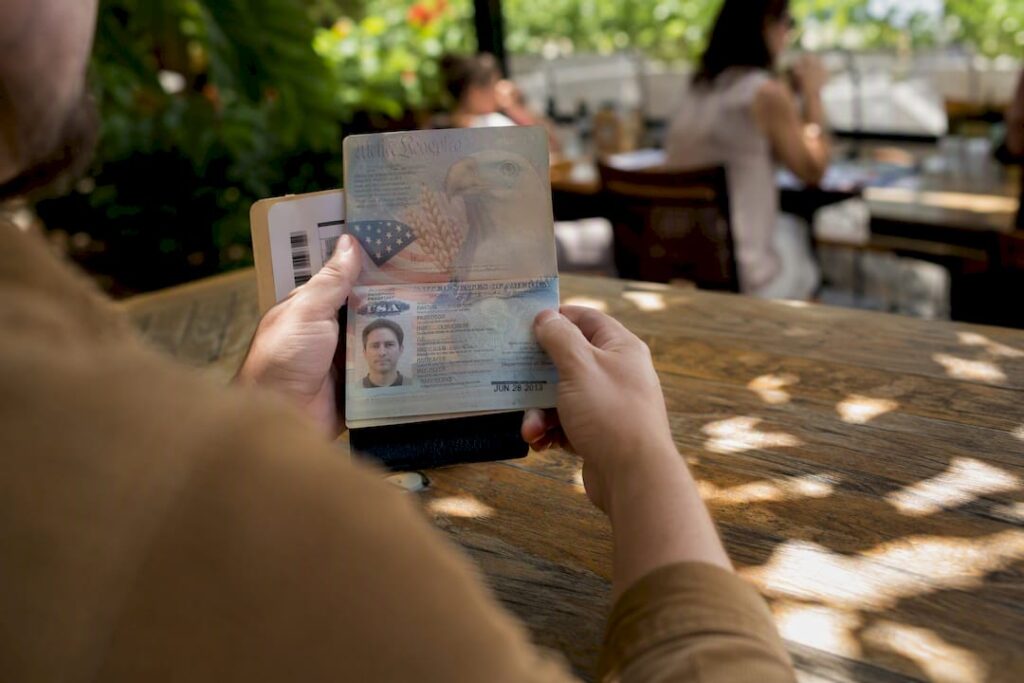
A domestic flight can go forward with an expired passport in many cases, since TSA runs a grace period for identification at the checkpoint. International travel and reentry into the U.S. are a different matter entirely: the State Department requires a valid, unexpired passport, with only narrow, temporary exceptions on record. If your trip is international and your passport has lapsed, your next move depends on how many days you have left, which we break down by timeline below.
TL;DR:
- Travelers can often board domestic flights with an expired passport if it’s within two years past its expiration date, using TSA’s acceptance policy.
- International travel and reentry require a valid, unexpired passport, with many countries imposing a six-month validity requirement beyond the travel dates.
- Emergency passport issuance abroad is limited to a temporary document from U.S. embassies or consulates; planning ahead is crucial to avoid being stranded.
- For trips within 14 days, urgent appointments at regional passport agencies are available but require proof of travel and can be hard to secure without prior planning.
- Courier expediting services typically offer the fastest and most reliable option for renewing passports 2 to 4 weeks before departure, especially if distant from regional agencies.
Table of Contents
- Can You Travel Domestically With an Expired Passport?
- Do You Need an Unexpired Passport for International Travel?
- What If You’re Stranded Abroad With an Expired Passport?
- Your Timeline Action Plan: 2 Weeks, 2 to 4 Weeks, or 4 Plus Weeks Out
- How a Registered Passport Courier Handles Urgent Cases
- How Regional Passport Agency Appointments Actually Work
- What Happens If You Travel Without a Valid Passport?
- Should You Call the Airline About Your Expired Passport?
- Need a Fast Passport Solution? Here’s Where to Start
- An Editor’s Perspective on Cutting It Close
- Sources
- FAQ
Can You Travel Domestically With an Expired Passport?
You can often board a domestic flight with an expired U.S. passport, because TSA currently accepts expired IDs, including passports, for up to two years past their expiration date at the security checkpoint. That two-year window applies to several forms of identification, not just passports, and it’s worth knowing your other options in case an officer asks for something else:
- A valid, unexpired U.S. passport or passport card
- A REAL ID-compliant driver’s license
- A Trusted Traveler Program card (Global Entry, NEXUS, SENTRI)
- A U.S. military ID or permanent resident card
If your only ID has been expired for more than two years, or you show up without any accepted document, TSA will route you through a process called TSA ConfirmID, which verifies your identity using other information you provide. Airlines echo this same guidance on their own travel document pages, but a gate agent’s internal policy can still add friction even when TSA lets you through.
Pro Tip: Arrive at least 30 minutes earlier than usual if you’re flying on an expired ID, and carry a secondary document, like a credit card with your name or a utility bill, in case you get flagged for extra screening.
Do You Need an Unexpired Passport for International Travel?
Yes. The rules that let you board a domestic flight on an expired passport do not extend past U.S. borders. State Department guidance is explicit that a valid, unexpired passport is required for international travel and for reentry to the United States, and an expired one generally will not work at a foreign border or a check-in counter.
Layered on top of that is the six-month rule: many countries require your passport to remain valid for at least six months beyond your travel dates, not just through your return flight. Airlines enforce this at check-in on behalf of destination governments, so a passport that’s technically unexpired but close to its expiration date can still get you denied boarding. Treat six months out as your real deadline, not the date printed on the passport’s cover.
Before you assume you’re covered, or before you toss an old passport in a drawer, run through this checklist:
- Confirm your destination’s specific entry requirements, since validity rules vary by country
- Check your airline’s own passport policy, which can be stricter than the destination’s minimum
- Look through any expired passport for valid visas; some visas remain usable in a new passport, others need reissuance, and the issuing consulate can confirm which applies
Our guide to the three-month and six-month passport validity rules walks through country-specific nuances if you want the full picture.
What If You’re Stranded Abroad With an Expired Passport?
CBP has, in the past, published temporary bulletins allowing limited direct return to the U.S. on certain expired passports. One such bulletin from the Carrier Liaison Program applied narrow, specific conditions and was never a general rule you could count on. Don’t assume a similar exception currently applies to your situation. The standard, reliable path is through the nearest U.S. embassy or consulate:
- Contact the embassy or consulate closest to you as soon as you realize your passport has expired, ideally before your return flight.
- Gather proof of U.S. citizenship, a government-issued photo ID, and a passport photo that meets State Department specifications.
- Bring evidence of your return travel, such as a flight itinerary, since emergency document issuance is tied to imminent departure.
- Confirm with your airline that it will accept the emergency passport or travel document the embassy issues before you head to the airport.
Embassies typically issue a limited-validity emergency passport built to get you home, not a full ten-year replacement.
Your Timeline Action Plan: 2 Weeks, 2 to 4 Weeks, or 4 Plus Weeks Out
Your options change entirely based on how much runway you have, and picking the wrong channel for your timeline is the single most common mistake travelers make.
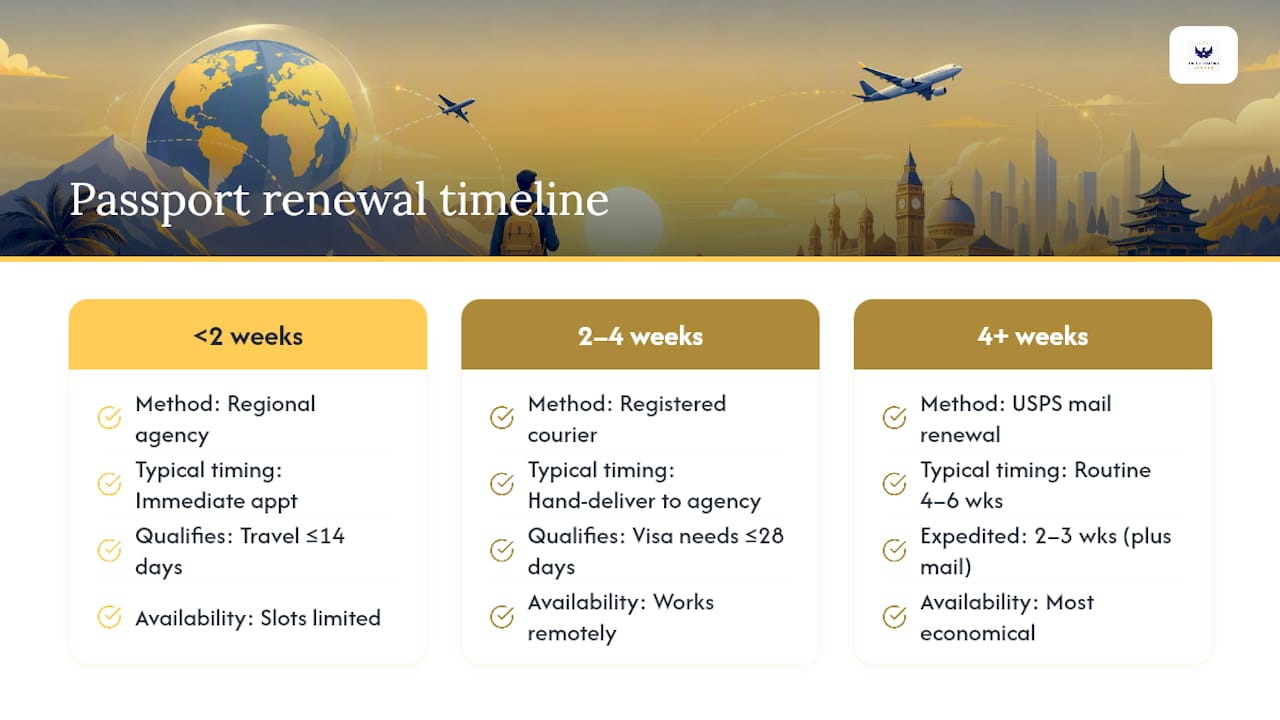
Under 14 days. Regional passport agencies handle urgent appointments for travel within 14 days, or for visa needs within 28 days, but slots are limited and you must show proof of travel to qualify. If you live in a city like Tampa, Charlotte, Sacramento, Nashville, or Louisville, getting to an agency in person often means a multi-hour drive on top of an already tight window, and appointments can fill up fast. This route makes sense mainly for genuine emergencies where no other option is available in time.
2 to 4 weeks out. This is where a registered courier service typically outperforms fighting for a scarce agency slot, especially if you’re nowhere near a regional office. A courier picks up your paperwork, hand-delivers it to the agency on your behalf, and tracks it through processing, which sidesteps the appointment bottleneck entirely. Our rush renewal guide breaks down what that process looks like end to end.

4 or more weeks out. Mail renewal through the standard USPS channel is the most economical choice here. Routine processing runs 4 to 6 weeks, and expedited mail service runs 2 to 3 weeks, not counting mailing time in either direction, which can add up to two more weeks.
Pro Tip: If you’re mailing your application, pay for faster return shipping. It costs more, but shaving a few days off the mail leg can be the difference between having your passport in hand and missing your flight.
How a Registered Passport Courier Handles Urgent Cases
A courier’s job on an urgent case comes down to catching errors before they cost you days, not just carrying paperwork faster. The workflow usually runs through document verification, form review, hand-delivery to the passport agency, and tracked return shipping, with an agent checking your file for the kinds of mistakes that get applications bounced back.
Before you start, gather these documents:
- Your most recent passport book or another accepted proof of citizenship
- A valid, government-issued photo ID
- A passport photo meeting current size and background requirements
- Proof of upcoming travel, such as a flight confirmation
The most common documentation mistakes are wrong photo dimensions, an unsigned application, and missing evidence of travel for expedited requests.
Fast Passport Center is a State Department-registered courier with more than 20 years in this business, an A+ Better Business Bureau rating, and drop-off offices in 24 cities nationwide.
| Your situation | Best channel |
|---|---|
| Travel within 3 days, or a documented family emergency | Regional passport agency, in person |
| Travel 2 days to 4 weeks out | Registered courier / expediting service |
| Travel 4 or more weeks out | USPS mail renewal (routine or expedited) |
| Live near an agency | Courier, regardless of timeline, when possible |
How Regional Passport Agency Appointments Actually Work
Regional agencies aren’t a general-purpose renewal counter. They exist for urgent, documented needs, and the appointment system reflects that: urgent appointments cover travel within 14 days or visa needs within 28 days, while routine and expedited requests are supposed to go through the mail instead.
Booking one requires an online reservation system that often fills up days in advance, especially around holidays and peak summer travel months. You’ll need to show proof of travel, typically a flight confirmation or itinerary, and arrive with every supporting document already in order, because agency staff won’t walk you through form corrections on the spot the way an expediter will.
This is also where geography becomes the real obstacle for a lot of travelers. If you live within a short drive of a regional agency, an urgent appointment is a legitimate option worth pursuing directly. If you’re several hours away, the drive time alone can eat into the narrow window you have, and a missed or rescheduled appointment can cost you the trip. That’s precisely the gap a registered courier service is built to close, since it removes the need to physically show up at an agency at all.
What Happens If You Travel Without a Valid Passport?
The risks scale sharply depending on whether you’re flying domestically or trying to leave the country. Domestically, the downside is mostly inconvenience: extra screening time, a ConfirmID process, or in rare cases a missed flight if an officer isn’t confident in your identity documents.
Internationally, the consequences get much more serious. Airlines routinely deny boarding to passengers whose passports don’t meet the six-month validity buffer, and they typically do this at check-in, before you ever reach a gate. That means you can lose the cost of your ticket entirely, with no guarantee of a refund, simply because your passport’s printed expiration date didn’t leave enough margin.
Arriving at a foreign border with an expired or soon-to-expire passport carries its own risk: denial of entry, and in some cases, the airline that brought you there is required to fly you back at its own expense, which creates its own logistical mess. If you’re already abroad when you discover the problem, you’re relying on embassy services that take time you may not have, especially if you’re in a country with limited consular staffing.
None of these outcomes are guaranteed, but all of them are avoidable with a few weeks of lead time. That’s the entire logic behind treating your passport’s expiration date as a planning deadline rather than a hard cutoff you can push right up against.
Should You Call the Airline About Your Expired Passport?
Yes, and do it before you assume TSA’s grace period or your passport’s printed expiration date settles the question. Airlines enforce their own document policies at check-in, separate from what TSA allows at the security checkpoint, and those policies can be stricter than the government minimum.
When you call, ask specifically about your route: domestic flights rarely require anything beyond what TSA accepts, but international flights and connections through a third country can trigger validity requirements you wouldn’t expect. A flight to Europe with a layover in another country, for instance, may require your passport to satisfy that layover country’s entry rules even if you never leave the airport.
Travel agencies and booking platforms are a useful second check, particularly if your itinerary involves multiple countries or a cruise with several ports of call, since cruise lines often enforce their own passport validity windows independent of any single country’s rules. If your trip involves a visa, and you’re working with an international visa processing partner like Goodhand’s UAE visa services, confirm passport validity requirements with them directly, since visa-issuing countries frequently set their own, sometimes stricter, standards.
Get this confirmation in writing when you can, whether that’s an email from the airline or a screenshot of their policy page. It’s a small step that can save you an argument at the counter later.
Need a Fast Passport Solution? Here’s Where to Start
If your travel falls anywhere between 2 days and 4 weeks out, or if you live far from a regional passport agency in a city like Tampa, Charlotte, Sacramento, Nashville, or Louisville, Fast Passport Center is built specifically for your situation. Unlike a regional agency, which requires an in-person appointment you may not be able to get or reach in time, our courier service handles the hand-delivery and tracking for you, so you never have to fight for a slot at all.
Getting started takes three things: your most recent passport (or proof of citizenship), a valid photo ID, and proof of upcoming travel. Once you place an order through our passport expediting service, one of our agents reviews your documents for the errors that typically cause delays, completes your forms, and hand-delivers your application directly to a regional agency using our direct courier relationship with the U.S. Department of State. You’ll get real-time tracking the entire way, so you’re not left guessing where your application stands. If you’re still deciding between routes, our comparison of passport expediting versus a regional agency visit lays out exactly when each makes sense.
An Editor’s Perspective on Cutting It Close
Most people don’t discover their passport has expired with months to spare. It happens two or three weeks before a trip, usually while packing, and that’s precisely when panic makes people reach for whichever option sounds fastest rather than the one that’s actually appropriate for their timeline.
The timeline framework in this piece isn’t a suggestion, it’s the difference between making your flight and eating the cost of a ticket. If you’re inside two weeks, a regional agency appointment is worth pursuing, but only if you can genuinely get there. If you’re anywhere in that two-to-four-week window, don’t gamble on securing a same-week appointment slot when a courier service can start today. Check our emergency renewal checklist and get your documents together now, before you know for certain you’ll need them.
— Andy Irons
Sources
- Acceptable Identification at the TSA Checkpoint
- Frequently Asked Questions about Passport Services – Travel
FAQ
Can I travel inside the U.S. with an expired passport?
Often, yes. TSA currently accepts expired passports and other expired IDs for up to two years past their expiration date at domestic checkpoints, though a REAL ID-compliant license or other valid ID avoids any question at all.
Will TSA accept an expired U.S. passport?
TSA generally accepts an expired U.S. passport within its two-year grace period, but if it’s expired longer than that, you’ll likely need to go through the TSA ConfirmID identity verification process instead.
Can I travel internationally with an expired passport?
No. The State Department requires a valid, unexpired passport for international travel, and most destinations also require at least six months of remaining validity beyond your travel dates.
Can I travel back to the U.S. with an expired passport?
Standard policy requires a valid passport to reenter the country; CBP has issued narrow, temporary bulletins allowing limited exceptions in the past, but these are not something you can currently rely on. If you’re stranded abroad with an expired passport, contact the nearest U.S. embassy or consulate for an emergency travel document.
How far in advance should I renew my passport before a trip?
Renew as soon as you know your passport will expire within six months of your travel dates. If your trip is 2 to 4 weeks away, a registered courier service is usually the most reliable path to getting a new passport in time.