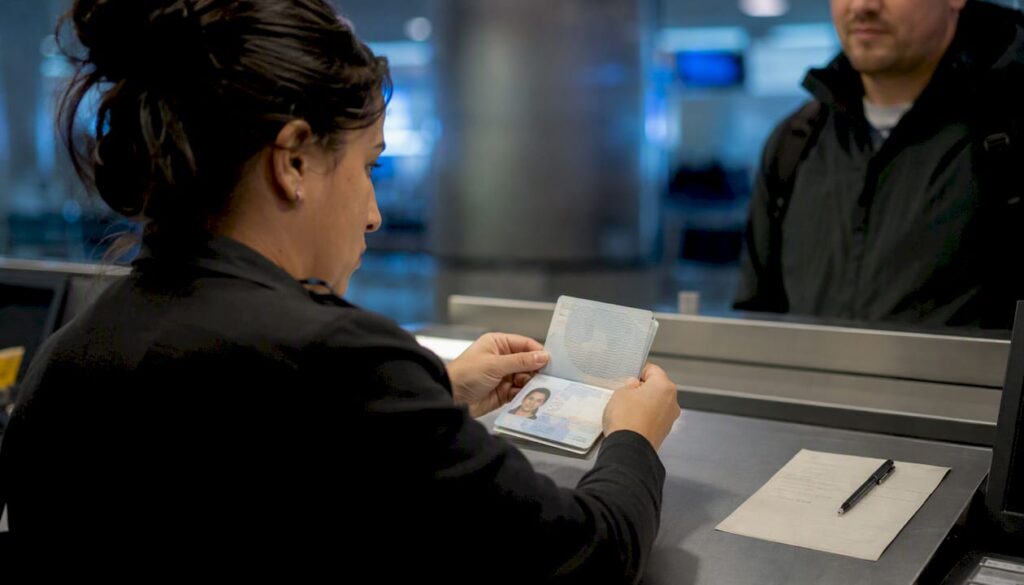
Airlines check passport expiration because they are legally and financially on the hook if you land somewhere you’re not allowed to enter. If a destination country turns you away, the airline that flew you there has to fly you back, often at its own cost, and may face fines from that government. That single liability is why gate agents, check-in staff, and even the software behind your online check-in are all trained to catch a passport that won’t clear customs on arrival.
Three systems drive this. IATA’s Timatic database tells airlines exactly which validity rules apply to your route. U.S. Department of State travel guidance spells out what American travelers need for specific countries. And carrier liability rules, the ones that make an airline pay when it carries an inadmissible passenger, give airlines every incentive to check twice and err on the side of caution.
Before you head to the airport, run through this:
- Check your expiration date against the destination’s required buffer, not just today’s date. Many countries want a few months of validity left after your arrival or departure.
- Confirm your visa or Electronic Travel Authorization matches your current passport number. A new passport can invalidate an old e-visa.
- Flip through your passport for blank visa pages and physical damage. A water-stained cover or a missing page can trigger a denial even if the expiration date is fine.
Key Takeaways
Airlines check passport expiration because they carry the legal and financial liability for any passenger denied entry at a destination, and they enforce the strictest validity rules across your entire itinerary to avoid that risk.
| Point | Details |
|---|---|
| Airline liability drives enforcement | Carriers must return inadmissible passengers at their own cost and can face fines, so they check conservatively. |
| Expiry is measured at arrival | A passport valid at boarding can fail on arrival after a long flight, so check against your landing date. |
| The strictest rule wins | Transit and connecting countries can impose tougher validity requirements than your final destination. |
| Self-audit beyond the date | Blank pages, damage, and name mismatches with visas can trigger denial even with a valid expiration date. |
| Match your service to your timeline | Use a regional agency within 3 days, a courier like Fast Passport Center for 2 days to 4 weeks, and USPS for 4+ weeks out. |
This article is general information, not a substitute for advice from a qualified lawyer. Consult a qualified legal professional about your own circumstances before acting on anything here.
Table of Contents
- How Passport Validity Rules Actually Work
- When and How Airlines Verify Your Passport
- What Happens If Your Passport Doesn’t Meet Destination Requirements
- Common Passport Issues Airlines Flag Besides Expiration
- If Your Passport Is Close to Expiring, Here’s Your Timeline
- How to Confirm the Exact Rules for Your Itinerary
- The Traps Nobody Warns You About
- When an Expedited Passport Service Solves the Problem
- Sources
- FAQ
How Passport Validity Rules Actually Work
A passport that isn’t expired can still fail a country’s entry requirements. That’s the trap most travelers never see coming. The expiration date on the cover is only half the story. What actually matters is the “remaining validity” window, the amount of time left on your passport at the moment you arrive, not the moment you leave home.
Most countries set that window at three or six months beyond your travel dates. The Schengen Area requires your passport to be valid for at least three months past your planned departure from the zone, plus a separate rule requiring the passport to have been issued within the last 10 years. That second rule catches people constantly. A passport can show 14 months of remaining validity and still get rejected at check-in because it was issued more than a decade ago, a quirk left over from when some countries extended validity by adding extra years onto an existing passport rather than issuing a new one.
Other regions default to a six-month cushion. The State Department’s own passport FAQ warns that airlines may deny boarding outright if that six-month requirement isn’t met, even for U.S. citizens holding a technically valid document.
| Destination | Typical validity rule | Notable quirk |
|---|---|---|
| Schengen Area | 3 months beyond departure | Passport must be under 10 years old |
| United States | Valid through trip dates (ESTA/visa-dependent) | Some visa categories require 6 months |
| United Kingdom | Valid through stay | No fixed extra-month rule for most visitors |
| United Arab Emirates | a validity buffer beyond arrival | Strictly enforced at check-in |
| India | a validity buffer beyond arrival | Applies to both e-visa and paper visa holders |
| Singapore | a validity buffer beyond arrival | Enforced for most visa-exempt nationalities |
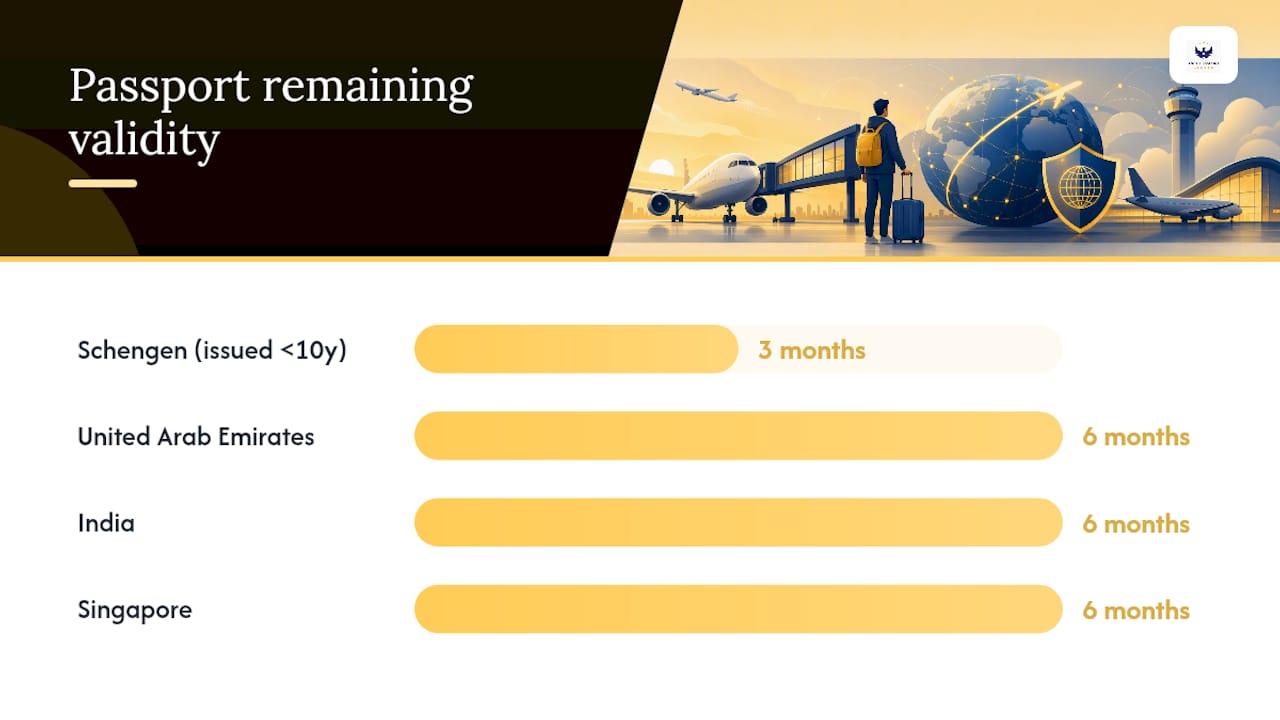
When your trip involves more than one country, whether that’s a layover, a cruise stop, or a multi-city itinerary, the strictest rule across every leg applies, not just the rule for your final destination. Flying to Singapore through Dubai means your passport has to satisfy both the UAE’s and Singapore’s six-month standards, even if you never leave the Dubai airport.
A few things to keep in mind before you assume you’re covered:
- Some countries publish formal exemptions to the six-month rule, and U.S. Customs and Border Protection tracks these updates for travelers and carriers alike.
- Cruise lines often apply even stricter validity windows than the ports they visit, since a ship denied entry can’t simply turn around at a border checkpoint.
- Embassy and consulate websites are more current than most travel blogs, so when a rule seems unusual, check the primary source before you rebook anything.
When and How Airlines Verify Your Passport
You get checked more than once, and the checks start well before you reach the gate. Online check-in is often the first tripwire. When you enter your passport number and expiration date to check in from home, many airline systems run that data against destination rules immediately, sometimes blocking you from generating a boarding pass at all if something doesn’t line up.

Airport check-in is the second layer, where an agent physically inspects the document and re-runs the same eligibility check the online system already performed, catching anything the algorithm missed, like a damaged page or a name mismatch with your ticket. The boarding gate is the last stop, largely a visual and systems recheck, especially on international routes where gate staff have final authority to pull a boarding pass if something looks wrong.
The technology behind all three checkpoints usually traces back to Timatic, the same eligibility engine IATA describes as the industry standard for cross-referencing a passenger’s document data, pulled straight from the machine-readable zone (MRZ) at the bottom of your passport’s photo page, against the entry, transit, and exit rules for every leg of your itinerary. That’s why a single flaw anywhere in your journey can flag you before you’ve even reached your final stop.
Here’s the detail almost every traveler misses: expiration is measured against your arrival in the destination, not your departure time. On a long-haul flight, it’s entirely possible to board with a passport that’s technically valid and land with one that has expired mid-flight. Airlines calculate against the arrival date specifically because that’s the moment the destination country’s rules actually apply to you.
Pro Tip: If you’re borderline on validity, don’t rely on your own math. Show the check-in agent your passport’s issue date and expiration date together, and ask them to run your specific itinerary through their system. A five-minute conversation at the counter beats a denied boarding two hours later.
What Happens If Your Passport Doesn’t Meet Destination Requirements
The consequences escalate fast, and none of them are cheap. If your passport fails to meet a destination’s entry requirements, here’s what typically follows:
- Denied boarding. The airline simply won’t let you fly, often with no refund on your original fare.
- Refusal of entry on arrival, in the rare case an inadmissible passenger somehow gets through the origin check.
- Mandatory return, usually at the airline’s expense. Carriers are legally required to fly inadmissible passengers back to where they came from.
- Fines and operational penalties for the carrier, sometimes running into the thousands of dollars per passenger, depending on the destination government.
That liability is exactly why airlines lean conservative. An airline employee at check-in isn’t guessing at whether your passport will pass muster. They’re protecting their employer from a bill that lands squarely on the company, not on you, once you’ve already been flown somewhere you can’t legally enter. That financial exposure explains why gate staff sometimes seem stricter than the actual written rule, they’d rather turn away a borderline case than risk the fine.
Visa and Electronic Travel Authorization issues compound the problem. A valid passport paired with an e-visa tied to your old passport number, or a return ticket that doesn’t satisfy a destination’s proof-of-onward-travel requirement, can trigger the same denied boarding outcome even when your passport dates are perfectly fine.
Common Passport Issues Airlines Flag Besides Expiration
Expiration gets most of the attention, but it’s far from the only thing that stops travelers at check-in. Run through this self-audit before you leave the house:
- Blank visa or stamp pages. Some countries require a minimum number of consecutive blank pages, not just any blank page scattered through the booklet.
- Physical damage. Water stains, a torn cover, or a delaminated photo page can get a passport rejected regardless of the expiration date.
- Name or date mismatches. If your visa or ETA lists a name spelled slightly differently than your passport, or references a passport number you’ve since replaced, expect trouble.
- The Schengen 10-year issue-date rule, which catches travelers whose passports were extended rather than reissued.
- Wrong passport linked to an e-visa. If you renewed your passport after applying for an e-visa, the visa may still be tied to the old, now-canceled document.
Transit and one-way itineraries draw extra scrutiny almost everywhere. A one-way ticket with no onward travel documented can look, to an airline’s eligibility system, like an intent to overstay, which is precisely the kind of case that pushes agents to ask more questions and check more carefully.
Pro Tip: Do this five-minute check the night before you fly: lay your passport flat and count your remaining blank visa pages, check the issue date against the 10-year mark if you’re headed to Europe, and confirm any visa or ETA number matches the passport you’re actually carrying, not a previous one. Research on inconsistent digital document formats shows that even electronic travel authorizations can create verification gaps at the counter, so bring the physical passport regardless of what digital paperwork you also hold.
If Your Passport Is Close to Expiring, Here’s Your Timeline
The right move depends entirely on how many days you have left before departure, not on which service sounds most convenient. Match your situation to one of these three windows.
- Travel within 3 days, or a genuine family emergency. Your only realistic option is an in-person visit to a regional passport agency, which requires proof of imminent international travel and an appointment. This route works, but it demands a same-day trip to a federal agency location, something that’s a real obstacle if you live in a city like Tampa, Charlotte, Sacramento, Nashville, or Louisville, where the nearest agency can be hours away.
- Travel in 2 days to 4 weeks. This is where a registered courier and expediting service does the heavy lifting. A passport renewal service that hand-delivers your application to a passport agency can secure an appointment and processing slot you can’t easily get on your own, without requiring you to travel to an agency at all.
- Travel 4 or more weeks out. Routine processing through your local USPS post office is usually the most economical choice, since you have the time buffer to absorb standard government processing windows.
| Timeline before travel | Recommended path | What to expect |
|---|---|---|
| Within 3 days | Regional passport agency (in-person) | Same-day or next-day appointment, proof of travel required |
| 2 days to 4 weeks | Courier or expediting service | Courier hand-delivery, tracked processing, no agency visit required |
| 4+ weeks | USPS post office (routine renewal) | Standard mail-in processing over several weeks |
If you fall into that middle window, and especially if you’re nowhere near a regional agency, an expedited passport service backed by a State Department registered courier can secure the appointment and hand-delivery you’d otherwise have to chase down yourself. Whichever path you choose, keep your documentation organized: proof of citizenship, a valid photo ID, your travel itinerary, and passport photos that meet current specifications. Missing paperwork is the single most common reason an otherwise-urgent application gets bounced back and loses days you don’t have. Also budget for two separate charges: the government’s own processing fee, and a separate service fee if you use a courier or expediter, they are never the same line item.
How to Confirm the Exact Rules for Your Itinerary
Never trust a travel blog’s general rule over the source built for your specific route. A few resources actually carry authority here:
- IATA’s Timatic system, accessed through your airline, is the same database gate agents use, and it evaluates your exact document against your exact itinerary rather than a generic country summary.
- Embassy and consulate websites for every country on your itinerary, including layover stops, not just your final destination.
- U.S. Department of State travel pages, which stay current on validity requirements and carrier liability guidance for American citizens.
- Your airline’s own travel-document page, which usually restates the Timatic result in plain language before you book.
When you check any of these, have your passport’s issue date, expiration date, and full itinerary, including every transit leg, ready before you start. Checking only your final destination’s rules is one of the most common ways travelers miss a transit-country requirement that ends up being stricter than the one for where they’re actually headed. For a deeper breakdown of how these rules vary by country, a detailed passport validity guide can help you cross-check before you commit to a booking, and travelers building out multi-leg trips sometimes find it useful to review trusted traveler program guidance alongside their passport check, since expedited entry programs carry their own document requirements.
The Traps Nobody Warns You About
Most passport denials I’ve seen described share the same root cause: someone did the math from the wrong starting point. They counted validity from their departure date instead of their return date, or worse, their arrival date at a connecting airport they never intended to leave. That single miscalculation is responsible for more denied boardings than any actual passport damage or missing visa.
The Schengen 10-year issue-date rule deserves more attention than it gets. It’s the kind of rule that feels like a technicality until it strands you at a check-in counter with a passport that has 18 months of remaining validity and still fails, because it was issued 10 years and one month ago. If your passport was ever extended rather than fully reissued, that’s worth checking specifically, not assuming.
One-way tickets get more scrutiny than round-trip bookings almost universally, and it has nothing to do with your intentions and everything to do with how airline systems flag potential overstays. If you’re booking one-way for a legitimate reason, digital nomad work, a permanent move, an extended stay, carry documentation that supports your onward plans, even if no one asks for it at the counter.
The broader pattern here is that airlines will always apply the strictest interpretation available to them across your entire itinerary, not the most generous one. That’s not bureaucratic overcaution. It’s a direct response to the liability they carry every time they let someone board. Don’t assume a rule that applied on your last trip still applies now, and don’t assume the rule for your destination is the only rule that matters if you’re connecting through anywhere else.
When an Expedited Passport Service Solves the Problem
If you’ve read this far and realized your passport won’t clear your destination’s validity window, the fix depends on how many days you actually have, not on how stressed you feel about it. Fast Passport Center exists specifically for the window that traps most travelers: 2 days to 4 weeks before departure, when a regional agency visit isn’t realistic but standard mail-in renewal through USPS is too slow to make your flight.
As a U.S. Department of State registered courier with more than 20 years of experience and drop-off offices in 24 cities, Fast Passport Center hand-delivers your application directly to a passport agency, cutting out the appointment-hunting and mail delays that make routine processing unpredictable. That matters most if you live somewhere without easy access to a federal passport agency, places like Tampa, Charlotte, Sacramento, Nashville, or Louisville, where the nearest agency is a multi-hour drive rather than a quick trip. An A+ Better Business Bureau rating and more than 14,000 customer reviews back up a service built around exactly this scenario: new passports, renewals, lost or stolen replacements, first-time child passports, and damaged documents that need fixing fast.
Government fees and Fast Passport Center’s service fees are always separate charges, and having your proof of citizenship, photo ID, and current passport photos ready before you start avoids the delays that cost people their travel dates. If your trip is inside that 2 day to 4 week window, start your expedited passport application today rather than waiting to see if the mail catches up to your calendar.
Sources
- Ies
- U.S. Department of State — Travel to Europe: Passport validity guidance
- IATA — What actually happens when a passenger’s travel documents get checked
- U.S. Customs and Border Protection — Six-month passport validity update (Carrier Liaison Program bulletin)
FAQ
Why does my passport always get flagged at check-in?
It’s usually a remaining-validity issue rather than an actual expiration problem. Many countries require three or six months of validity beyond your arrival date, so a passport that looks fine on the cover can still fail that buffer.
Can I fly with three months left on my passport?
It depends entirely on your destination. The Schengen Area’s three-month rule is measured from your planned departure date, but many other countries require a full six months, so three months can get you denied boarding elsewhere.
At what point do they check your passport at the airport?
Checks typically happen at online check-in, again at the airport check-in counter, and once more at the boarding gate, with each stage cross-referencing your document against Timatic’s eligibility rules for your full itinerary.
How do you know if your passport is flagged?
Airline systems usually flag an issue the moment you enter your passport details during online check-in, blocking your boarding pass, though sometimes the problem only surfaces when an agent manually reviews your document at the counter.
What if my passport is fine but I’m traveling in under two weeks?
A courier and expediting service is built for exactly that window, since it hand-delivers your renewal application without requiring an in-person agency appointment.