
How the U.S. passport tracking system works at each stage
Understanding how passport use tracking works starts with one key distinction: the system tracks processing milestones, not the physical location of your passport book. The U.S. Department of State monitors your application as it moves through three primary stages: arrival at a mail sorting facility, intake at a processing center, and review by a passport agency specialist. Only the final step, delivery of the finished passport book, uses a trackable courier service you can follow in real time.
Your application status updates are tied to a 9-digit application locator number. The first two digits of that number identify which regional agency or processing center is handling your file, which becomes critical information if you need to call and request an urgent appointment. Status labels like “In Process” or “Mailed” have specific technical meanings within the State Department’s workflow. Knowing what each label actually signals helps you avoid unnecessary anxiety and respond appropriately when something looks stalled.
Table of Contents
- What your e-passport chip does and does not track about you
- What to do when your travel is urgent and tracking feels insufficient
- How passport books are tracked during production
- How Fast Passport Center helps you navigate urgent passport needs
- How airline and border control systems interact with your passport data
- Tracking at different stages: application, issuance, and travel
- How to enroll in expedited passport services
- How to verify that your passport status information is legitimate
- Key Takeaways
- FAQ
What your e-passport chip does and does not track about you
The RFID chip embedded in your U.S. e-passport is a passive device. It has no battery, cannot broadcast a signal, and cannot be read remotely beyond approximately 10 cm from an authorized reader. There is no GPS component, and the chip does not log your location or travel history.
What the chip does store is your biometric identity data: name, date of birth, photo, and document number, supported by access control measures detailed in the Hassle-Free Personalised Employment Pass Application in Singapore. Accessing that data requires the reader to first scan the machine-readable zone (MRZ) printed on the photo page. That two-step access control process means only an authorized reader with the correct MRZ data can unlock the chip’s contents. Modern U.S. passport covers also incorporate shielding material that blocks radio signals when the book is closed, adding another layer of protection against unauthorized scanning.
Pro Tip: If you use a passport cover or wallet with RFID-blocking material, you get an extra layer of protection in crowded airports or transit hubs, though the passport’s built-in shielding already handles most scenarios.
What to do when your travel is urgent and tracking feels insufficient
If your departure is within 14 days or you need a visa within 28 days, contact the State Department directly rather than relying solely on the online status tool. Standard online tracking often lags behind the actual processing state of expedited cases, which means a status that reads “In Process” may not reflect work already completed on your file.
Common reasons tracking updates stall include high application volumes, document verification holds, and system sync delays between processing centers. Having your 9-digit locator number ready when you call the National Passport Information Center speeds up the conversation considerably. For travelers in cities like Tampa, Charlotte, Sacramento, Nashville, or Louisville, getting to a regional passport agency in person is rarely practical on short notice.
Fast Passport Center has served U.S. travelers for over 20 years as a registered State Department courier, earning a BBB A+ rating and more than 14,000 positive customer reviews. For travelers who cannot reach a regional agency, a passport courier service bridges that gap directly.
How passport books are tracked during production
Before a passport ever reaches your mailbox, it passes through an industrial tracking chain that most travelers never see. Each passport booklet receives a unique digital serial identifier at the start of production, with barcode and RFID tags applied to individual components as they move through manufacturing. This creates an unbroken audit trail from raw materials to finished document.
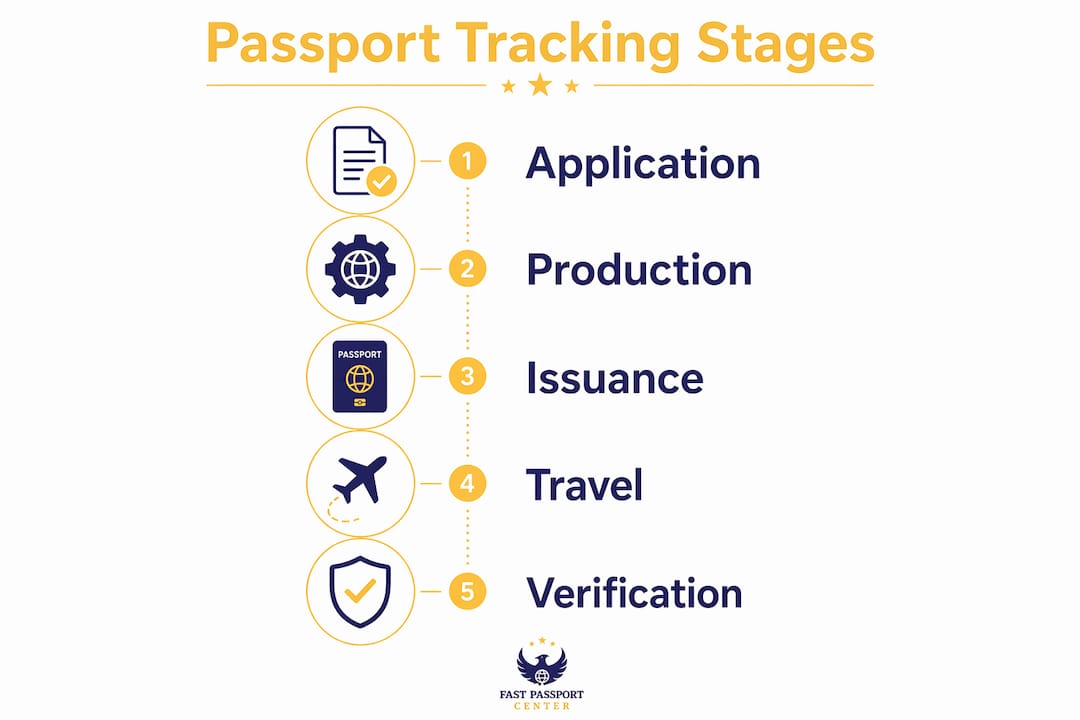
Automated data capture replaces manual logging at each production step, which reduces errors and enables real-time detection of any anomaly in the line. The result is audit-proof documentation that supports both regulatory compliance and security verification. This production-level tracking is entirely separate from the application status system you access as a traveler, but the two systems are complementary: one ensures the document is genuine, the other ensures it reaches the right person.
How Fast Passport Center helps you navigate urgent passport needs
Fast Passport Center is a U.S. Department of State-registered passport courier with over 20 years of experience and physical drop-off offices in 24 cities nationwide. For travelers with upcoming trips in the near future, a courier service is often the better option compared to navigating a regional agency on your own.
The team at Fast Passport Center reviews your documents before submission, catching errors that would otherwise cause delays. Their direct working relationship with the State Department means your application moves through the system with the attention an urgent case requires. With a BBB A+ rating and over 14,000 positive reviews, the track record speaks for itself.
If your passport expired last week and your flight leaves in 10 days, Fast Passport Center is built for exactly that scenario. Same-day and expedited services are available, and experienced agents guide you through every document requirement so nothing gets missed.
Start your expedited application at FastPassportCenter.com and get your passport moving today.
How airline and border control systems interact with your passport data
When you hand your passport to a border officer or scan it at an automated kiosk, the MRZ is read optically and cross-referenced against government watchlists and entry databases in seconds. The RFID chip is then queried to verify that the biometric data on the chip matches the printed data, confirming the document has not been altered. Airlines access similar data through advance passenger information systems, which governments use to screen travelers before boarding. None of these interactions create a real-time location trail stored in your passport. The chip responds to each query independently, with no memory of prior reads.

Tracking at different stages: application, issuance, and travel
Each phase of your passport’s life involves a different tracking mechanism. During the application stage, the State Department’s milestone system logs your file’s progress through processing centers. During issuance, the industrial serialization system described above tracks the physical booklet through production and quality control. During international travel, border agencies use optical MRZ scanning and RFID chip verification at each crossing, but those reads are logged in government entry systems, not in the passport itself. Understanding which system applies at which stage helps you ask the right questions and contact the right authority when something goes wrong.
How to enroll in expedited passport services
Expedited processing through the State Department costs an additional government fee on top of the standard application fee, and current processing times vary. For most travelers with trips 2–4 weeks out, the fastest path is submitting through a registered courier like Fast Passport Center rather than mailing directly to a processing center. You will need proof of travel (a flight itinerary showing your departure date), a completed DS-82 or DS-11 form depending on your situation, a current photo, and payment. Fast Passport Center’s agents verify your package before it leaves your hands, which eliminates the most common cause of expedited application delays: incomplete or incorrect documentation. Learn more about how to expedite passport processing and what each timeline requires.
How to verify that your passport status information is legitimate
The only official source for U.S. passport application status is travel.state.gov or the National Passport Information Center phone line. Third-party sites that claim to provide status updates are not connected to State Department systems and cannot offer accurate information. If you receive an email or text claiming your passport has been flagged or requires additional payment, treat it as a phishing attempt. Legitimate status changes are reflected in the official online tool or communicated through your registered courier. Fast Passport Center clients receive direct updates from their assigned agent, removing the guesswork entirely.
Key Takeaways
Passport use tracking covers application milestones and RFID identity verification, but neither system tracks your physical location in real time.
| Point | Details |
|---|---|
| Milestone tracking only | The State Department tracks processing stages, not the real-time location of your passport book. |
| RFID chip is passive | The e-passport chip has no GPS, no battery, and cannot be read beyond approximately 10 cm. |
| Locator number matters | Your 9-digit application locator number identifies your regional agency and speeds up urgent inquiries. |
| Courier beats mail for urgency | For travel 2 days–4 weeks out, a registered courier like Fast Passport Center is faster than standard mail. |
| One official source | Only travel.state.gov and the National Passport Information Center provide legitimate U.S. passport status. |
FAQ
What does the U.S. passport tracking system actually show you?
It shows processing milestones: when your application arrived at a sorting facility, entered a processing center, and reached an agency specialist. It does not show the physical location of your passport book until the final delivery scan.
Can your passport’s RFID chip be used to track your location?
No. The chip is passive, has no battery, and only responds when held within about 10 cm of an authorized reader. It stores identity data but does not log or broadcast location.
When should you contact the State Department instead of checking online?
Contact the State Department directly if your trip is within 14 days or you need a visa within 28 days, since the online tool may not reflect the current status of expedited cases.
Who should use a passport courier service instead of a regional agency?
Travelers with trips 2 days to 4 weeks out who live more than two hours from a regional passport agency benefit most from a courier service like Fast Passport Center, which handles submission and follow-up on your behalf.
How do you know if a passport status website is legitimate?
Only travel.state.gov and the National Passport Information Center phone line are official. Any third-party site claiming to access State Department passport status data is not authorized and should not be trusted.