
No, a child under age 16 cannot renew a U.S. passport online or by mail. Every application requires an in-person appearance at a passport acceptance facility, no exceptions. The Department of State is explicit: children must apply in person each time, using Form DS-11, with both parents or guardians present. If your child’s passport has expired or is about to, your first move is to gather a certified birth certificate, both parents’ photo IDs, and a compliant passport photo, then schedule an appointment at a local acceptance facility or contact a courier if travel is within the next four weeks.
This isn’t a technicality that will quietly change. The rule exists for serious child-protection reasons, and understanding it helps you plan the right way, without wasted trips or last-minute scrambles.
Table of Contents
- Which ages does the in-person rule actually cover?
- What the U.S. Department of State requires for a child passport
- Why the government requires children to appear in person
- Step-by-step: what to bring and how to prepare for the appointment
- Exceptions and special cases that change the process
- What to do when your child needs a passport quickly
- Key Takeaways
- The detail that actually matters most
- Fast Passport Center handles child passport applications when time is short
- Useful sources
- FAQ
Which ages does the in-person rule actually cover?
The age threshold is 16. Children under the age of 16 must appear in person for every passport application, regardless of whether they have held a passport before. There is no mail renewal option, no online pathway, and no exception based on prior passport history.
At 16 or 17, the rules shift closer to adult standards, though some in-person requirements may still apply depending on the circumstances. Adults who are 18 and older and meet specific eligibility criteria, including holding a 10-year passport, may qualify for online renewal through the Department of State’s pilot program. Minors do not meet those criteria under any circumstances.
One detail parents often overlook: child passports are valid for only 5 years, compared to 10 years for adults. That shorter validity window means you will go through this in-person process more frequently than you might expect. A passport issued when your child is 8 will expire before they turn 14, requiring a full new application, not a simple renewal.
What the U.S. Department of State requires for a child passport
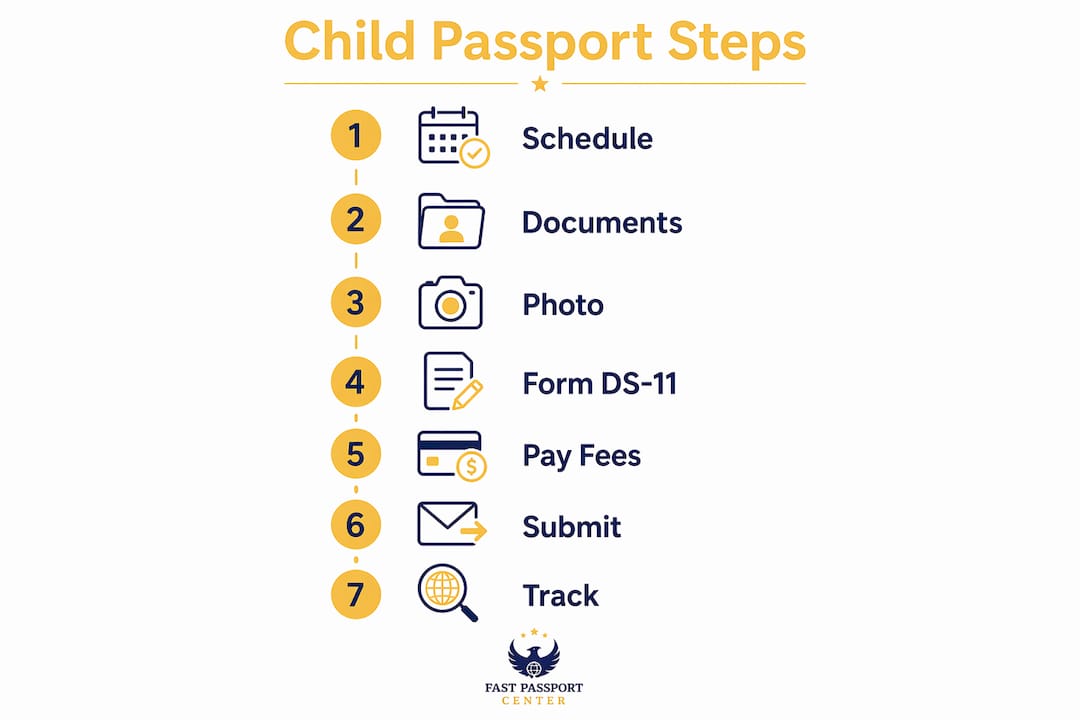
The Department of State treats every child passport application as a new application. Form DS-11 is the required form, and it must be submitted in person at a passport acceptance facility or regional passport agency. Form DS-82, the mail-in renewal form used by adults, does not apply to children under 16.
Required documents at the acceptance facility:
- Certified birth certificate or other proof of U.S. citizenship (original, not a photocopy)
- Both parents’ or guardians’ valid photo IDs
- Photocopies of the front and back of each parent’s ID
- One compliant passport photo meeting Department of State specifications
- Completed Form DS-11 (filled out but left unsigned until you are at the counter)
- Form DS-3053 (Statement of Consent), notarized, if one parent cannot attend
- Evidence of sole custody or a court order, if applicable
- Proof of travel for expedited processing requests
Both parents or guardians must typically appear with the child. If one parent cannot be present, the absent parent must provide a notarized DS-3053. If one parent has sole legal custody, documentation such as a court order or death certificate is required. The official Department of State forms and fee tables are updated regularly, so verify current amounts before your appointment.
Government fees for a child passport application cover the application fee and an execution fee, paid separately at the acceptance facility. Any courier or expediting service charges its own fee on top of those government costs.
Pro Tip: Complete Form DS-11 in advance but do not sign it at home. The acceptance facility agent must witness your signature. Signing beforehand is one of the most common reasons applications are rejected on the spot.
Why the government requires children to appear in person
The in-person requirement is not procedural friction. It is a deliberate legal safeguard with two distinct purposes: verifying parental consent and protecting children from unauthorized international travel.

The Department of State’s protocols treat in-person consent witnessing as a primary defense against parental child abduction and fraud. When both parents appear at an acceptance facility, an agent witnesses their consent and verifies their identities against government-issued IDs. That chain of custody makes it significantly harder for one parent to obtain a passport for a child without the other’s knowledge, which is a real concern in custody disputes and international abduction cases.
There is also a practical identity-verification reason. Young children change dramatically in five years. A photo taken at age 3 may bear little resemblance to the child at 8. Requiring a current, in-person photo at each application keeps the document accurate and reduces the risk of fraudulent use.
Online renewal systems, by contrast, rely on document matching and facial recognition against an existing photo. That approach works reasonably well for adults whose appearance changes slowly. For children, it would create an identity-verification gap the Department of State is not willing to accept.
Step-by-step: what to bring and how to prepare for the appointment
Preparation is where most applications succeed or fail. Missing a single document means a wasted trip and a delayed passport.
1. Schedule your appointment. Use the passport acceptance facility locator on travel.state.gov to find a post office, library, or county office near you. For urgent travel within three days or a documented family emergency, you need a regional passport agency appointment instead.
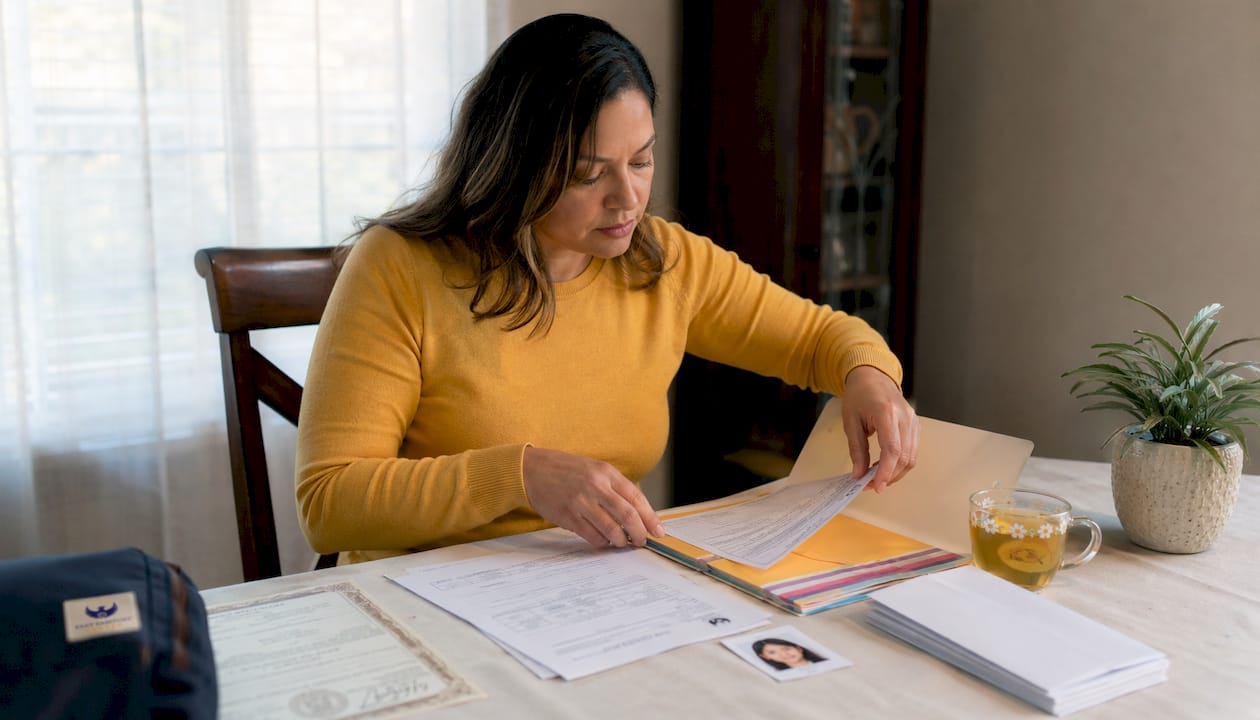
2. Gather your documents before the day. Collect the certified birth certificate (not a hospital record), both parents’ photo IDs, and photocopies of each. If one parent will be absent, have the notarized DS-3053 ready in advance.
3. Get the passport photo. The photo must meet Department of State specifications: 2×2 inches, white background, taken within the last six months. Many pharmacies and shipping stores offer compliant photos.
4. Complete Form DS-11 without signing it. Fill in every field carefully. Leave the signature line blank until you are standing at the counter.
5. Bring originals and photocopies. The facility keeps the originals for processing. Bring photocopies of every document so you are not caught short.
6. Pay fees at the counter. Government fees are paid at the acceptance facility. If you are using a courier or expediting service, those fees are handled separately through that service.
7. Track your application. After submission, you can track status through the Department of State’s online tool.
Common rejection causes include unsigned DS-11 forms, non-certified birth certificates (hospital-issued copies are not accepted), photos that do not meet spec, and missing photocopies. Arriving with everything organized and complete is the single most reliable way to avoid a second trip.
For parents organizing travel for school groups or multiple children, reviewing a student travel forms checklist can help you keep every child’s documents in order before the appointment.
Exceptions and special cases that change the process
Most families will follow the standard path, but several situations call for different documentation or a different process entirely.
One parent cannot attend. The absent parent must provide a notarized Form DS-3053. This form must be notarized by a licensed notary, not just witnessed. It cannot be submitted without a notary seal.
Sole legal custody. If one parent has sole custody, bring the court order or divorce decree that establishes it. A death certificate is required if the other parent is deceased.
Lost or stolen passports. A child whose passport was lost or stolen still applies in person using Form DS-11. The Department of State requires in-person reapplication for lost or stolen documents, and processing may take longer as additional verification steps apply.
Emergency travel. If your child needs to travel within three days due to a life-or-death emergency or a serious illness in the family, a regional passport agency can issue a passport on an expedited basis. You must provide proof of the emergency, such as a death notice or hospital documentation, along with proof of imminent travel (airline tickets or itinerary). Without that documentation, the agency will not schedule an emergency appointment.
Ages 16–17. Teenagers in this range are treated more like adults for passport purposes. They may be eligible for mail renewal using DS-82 if they meet all standard adult criteria, though some circumstances still require in-person appearance. Check current Department of State guidance for the specific rules that apply to your teenager’s situation.
What to do when your child needs a passport quickly
Your best option depends almost entirely on your timeline and how far you live from a regional passport agency.
| Timeline | Best option |
|---|---|
| Travel within 72 hours or family emergency | Regional passport agency (in-person appointment required) |
| Travel in 3 days–2 weeks | Fast Passport Center courier/expedite service |
| Travel in 2–4 weeks | Fast Passport Center courier/expedite service |
| Travel in 4+ weeks | USPS acceptance facility, standard processing |
Regional passport agencies handle true emergencies, but they require proof of imminent travel or a documented family emergency to grant an appointment. If you live in Tampa, Charlotte, Sacramento, Nashville, or Louisville, the nearest regional agency may be two or more hours away. Getting there, waiting, and returning is a full-day commitment, and appointments are not guaranteed without the right documentation.
For parents with travel coming up in the next two to four weeks, a registered courier service is often the faster, more practical route. Couriers like Fast Passport Center hand-deliver your child’s application directly to a passport agency, manage the document chain of custody, and provide real-time tracking. You do not have to drive to an agency or navigate the appointment system yourself. You can expedite a child passport through a registered courier even when you are not near a regional office.
Decision checkpoints before you contact a courier:
- Documents ready: certified birth certificate, both parents’ IDs, DS-11 completed but unsigned, DS-3053 if one parent is absent
- Proof of travel: airline tickets or confirmed itinerary
- Parent availability: one parent must be available for in-person drop-off at a courier office or to ship documents securely
Pro Tip: If your child’s passport photo was taken more than six months ago, get a new one before your appointment or courier submission. An outdated photo is one of the most avoidable rejection causes, and it adds days to an already tight timeline.
Getting the paperwork right on the first attempt is the single biggest factor in how fast a child passport is issued. Experienced expediters recommend a document pre-check before submission, especially for urgent cases where there is no time for a second attempt.
Key Takeaways
Children under 16 cannot renew a U.S. passport online or by mail; every application requires in-person appearance at an acceptance facility, with both parents present and Form DS-11 submitted unsigned.
| Point | Details |
|---|---|
| In-person required for under 16 | No online or mail option exists; every child passport application uses Form DS-11 at an acceptance facility. |
| Child passports are valid for 5 years | Shorter validity means you will repeat this process more often than for an adult passport. |
| Both parents must typically appear | If one parent is absent, a notarized DS-3053 is required; sole custody requires court documentation. |
| Prepare documents before the appointment | Missing a certified birth certificate, compliant photo, or unsigned DS-11 causes same-day rejection. |
| Fast Passport Center for urgent timelines | For travel within 2–4 weeks, Fast Passport Center’s courier service hand-delivers to a passport agency without requiring you to visit one. |
The detail that actually matters most
Most parents focus on the wrong thing when they first learn about the in-person requirement. They worry about the appointment itself, the drive, the wait time. What actually determines whether a child passport is issued on time is document completeness, not the appointment.
The Department of State’s in-person rule is genuinely protective. It exists because a passport is one of the most powerful travel documents a person can carry, and issuing one for a child without verified parental consent creates real risk. That rationale is sound, and no amount of digital identity verification currently replaces what an acceptance facility agent does when both parents stand in front of them.
What experienced expediters know, and what most parents discover only after a rejected application, is that the process is unforgiving about paperwork. A non-certified birth certificate, a photo with the wrong background, a DS-11 signed at home before the appointment: any one of these sends you back to square one. The families who get through the process quickly are the ones who treat document preparation as seriously as the appointment itself.
If your timeline is tight and you are not close to a regional passport agency, the practical answer is a registered courier service that reviews your documents before submission. That pre-check step is what separates a smooth application from a stressful one.
Fast Passport Center handles child passport applications when time is short
When your child needs a passport and travel is weeks away, not months, Fast Passport Center offers a direct path that does not require you to secure a regional agency appointment on your own.
As a U.S. Department of State registered passport courier with over 20 years of experience and drop-off offices in 24 cities, Fast Passport Center reviews your documents before submission, hand-delivers your child’s application to a passport agency, and provides real-time tracking throughout the process. For parents in cities like Tampa, Charlotte, Sacramento, Nashville, and Louisville who cannot easily reach a regional agency, that courier hand-delivery is what makes an expedited timeline realistic.
Government fees are paid separately to the Department of State. Fast Passport Center’s service fee covers document review, courier delivery, agency routing, and tracking. For travel within 2–4 weeks, the expedited passport service is the right starting point. For travel within 72 hours or a documented family emergency, a regional agency appointment is the appropriate channel, and Fast Passport Center can help you understand which path fits your situation.
Start your child’s application at FastPassportCenter.com or visit one of the 24 drop-off offices to have your documents reviewed by an experienced agent before submission.
Useful sources
Official Department of State resources for parents:
- Apply for a Child’s Passport Under 16: the primary rule page covering Form DS-11, parental consent, and in-person requirements
- Apply for a Child’s Passport (Under Age 18): forms, fee tables, and acceptance facility locator
- Renew Your Passport Online: eligibility criteria that confirm why minors do not qualify
- Renew Your Passport by Mail: explains when DS-82 applies and when in-person reapplication is required
- Passport Services FAQ: official answers to common questions including child passport renewal rules
Fast Passport Center resources:
- How to get a child passport fast: practical options for urgent child passport needs
- Child passport guide: parental consent and special cases: DS-3053, sole custody, and edge-case documentation
FAQ
Can you renew a child’s passport online?
No. The Department of State does not allow online or mail renewal for children under 16. Every application requires in-person submission of Form DS-11 at a passport acceptance facility.
Why can’t minors renew passports the way adults do?
Children under 16 must apply in person because the process requires verified parental consent, a current photo, and identity confirmation that cannot be completed remotely. Adult online renewal relies on facial matching against an existing photo, a method the Department of State does not consider reliable for children whose appearance changes significantly over five years.
Can a 17-year-old renew a U.S. passport online?
Not typically. Online renewal eligibility requires a 10-year adult passport and meeting other strict criteria. Most 17-year-olds hold a 5-year child passport, which does not qualify. Check current Department of State guidance for your teenager’s specific situation.
What is the fastest way to get a child passport?
For travel within 72 hours or a documented family emergency, a regional passport agency appointment is the fastest option. For travel within 2–4 weeks, using a registered courier service like Fast Passport Center, which hand-delivers applications directly to a passport agency, is the most practical route for parents who are not near a regional office.
What happens if one parent can’t attend the passport appointment?
The absent parent must provide a notarized Form DS-3053 (Statement of Consent). If one parent has sole legal custody, a court order or equivalent documentation replaces the DS-3053. Without one of these, the application cannot be accepted.