
Passport renewal and a new passport application follow completely different rules, and choosing the wrong path can delay your travel plans by weeks. The U.S. Department of State determines which process applies to you based on your passport’s age, condition, and whether your name or other biographical details have changed. Get it right from the start, and the process is straightforward. Get it wrong, and you’re resubmitting paperwork you can’t afford to lose time on.
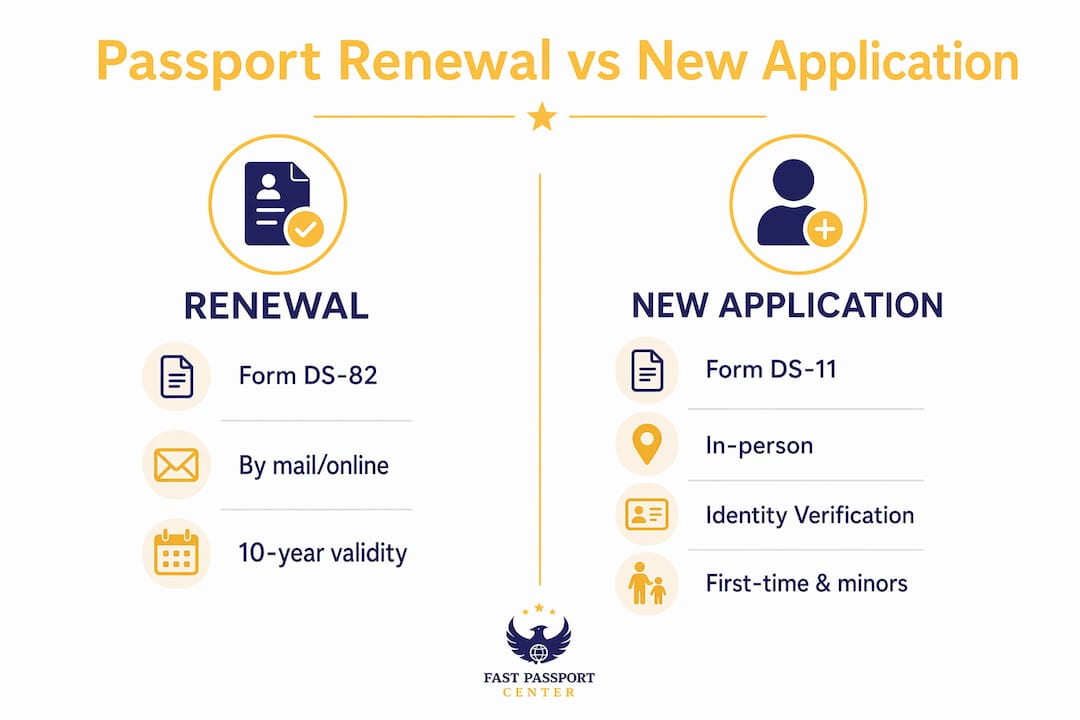
How passport renewal differs from a new application
The core distinction comes down to eligibility. Renewal is the simpler path, available by mail or online, while a new passport application requires an in-person appearance at an acceptance facility. Here’s what separates them:
- Renewal (Form DS-82): Your passport was issued when you were 16 or older, is less than 15 years old, is undamaged, and your name matches or you have legal documentation for any change.
- New application (Form DS-11): Your passport was issued before age 16, is more than 15 years old, was lost, stolen, or damaged, or you changed your name without legal documentation.
- Submission method: Renewals go by mail or online. New applications require you to appear in person at a passport acceptance facility.
- Cost: A passport book renewal costs $130. A new adult passport book costs $130 for the application fee plus a $35 acceptance fee, bringing the total to $165.
- Processing: Both qualify for expedited service, but online renewal is only available for routine processing with no expedite option.
Knowing which category you fall into before you gather a single document saves you from the most common and costly mistake applicants make.
Who qualifies for renewal and who must apply in person?

Eligibility is the first question to answer, and the U.S. State Department’s rules are specific. You can renew if your most recent passport was issued at age 16 or older, is less than 15 years old, is in your possession and undamaged, and reflects your current legal name or you can document a name change.
You must apply for a new passport if any of the following apply:
- Your passport was issued before age 16 or more than 15 years ago.
- Your passport was lost, stolen, or damaged.
- Your current legal name differs from your passport and you lack certified documentation proving the change.
- You are applying for a child under age 16.
One situation that catches travelers off guard: if your passport was issued in a previous name and you cannot produce a marriage certificate, divorce decree, or court order linking the names, you cannot renew by mail. The only path forward is a new application in person using Form DS-11.
What the application process looks like for each path
Renewing by mail or online starts with Form DS-82. You complete it, attach your most recent passport, a new passport photo, and the applicable fee, then mail the package to the State Department. The online renewal option is available if you are 25 or older, your passport is expiring within one year or expired less than five years ago, and you are not changing any personal information. Note that online renewals cannot be expedited, so if your travel is within six weeks, mail is the better route.
Applying for a new passport requires Form DS-11 and an in-person appointment at a passport acceptance facility, typically a post office, library, or clerk of court that handles passport applications. You cannot submit DS-11 by mail. A passport acceptance agent must witness your signature and verify your identity documents before the application moves forward.
For travelers with trips coming up in 2–4 weeks, neither the standard mail timeline nor a post office appointment is fast enough on its own. That’s where a registered courier service like Fast Passport Center steps in, handling document preparation and submission to move your application through expedited processing faster than the standard route.
Pro Tip: Never book international travel using your old passport number as the reference. Once you submit a renewal or new application, the old passport is invalidated. Your new passport will carry a different number, and booking travel before it arrives can create complications at check-in.
What documents you need for each process
Getting your documents right the first time prevents rejection and weeks of delay. Here’s what each process requires:
For renewal (DS-82):
- Your most recent U.S. passport (it will be invalidated and returned separately, often up to two weeks after your new passport arrives)
- Completed Form DS-82
- One passport photo meeting State Department specifications
- Payment for the applicable fee
- Certified legal name change document, if your name has changed
For a new application (DS-11):
- Proof of U.S. citizenship (birth certificate, naturalization certificate, or prior passport)
- Valid government-issued photo ID
- A photocopy of the front and back of your ID
- Completed Form DS-11, signed in front of an acceptance agent
- One passport photo
- Payment for both the application fee and acceptance fee
If your passport was lost or stolen, you also need to complete Form DS-64 to report it before or alongside your DS-11 submission. A damaged passport requires a written statement of how the damage occurred. These extra steps add time, which is why starting the process as early as possible matters.
Why new applications require in-person identity verification
The State Department’s in-person requirement for new applications is a deliberate security measure, not a bureaucratic inconvenience. Since passport amendments were eliminated in 2005, any change to biographical data on the data page or the embedded electronic chip requires issuing an entirely new passport. There is no shortcut.
For applicants who do not qualify for renewal, appearing in person allows an acceptance agent to physically verify identity documents, confirm the applicant’s presence, and catch discrepancies before they become fraud. This applies to first-time applicants, those with lost or stolen passports, and anyone whose name has changed without documentation. Travelers living in cities like Tampa, Charlotte, or Nashville, far from a regional passport agency, often find that a registered courier handles the logistics of getting their application to the right place quickly, without requiring them to drive hours for an appointment.
Tips to avoid delays when renewing or applying for a new passport
Timing and preparation are the two variables you control. Here’s where most applications go wrong:
- Do not book international flights until your new passport is physically in hand. New passports carry unique numbers that invalidate the old one, and airlines match your booking to the document you present at the gate.
- When renewing by mail, account for the fact that your submitted passport is held during processing and returned separately. If that passport contains visas you need for your trip, plan around the gap.
- If your travel is 2–4 weeks out and you live more than two hours from a regional passport agency, use a registered expediting service rather than a standard post office submission.
- Double-check that your passport photo meets the State Department’s current specifications. Photo rejections are one of the leading causes of application delays.
Pro Tip: If you need a name change passport but lack the legal documentation, you must apply in person with Form DS-11. Fast Passport Center can guide you through the name change process and expedite the application so your travel timeline stays intact.
Common reasons you cannot renew and must apply for a new passport
Several situations disqualify you from renewal outright. A passport issued more than 15 years ago cannot be renewed regardless of its condition. A passport issued before your 16th birthday is also ineligible, because children’s passports carry a five-year validity period and different application rules than adult passports. Lost, stolen, and damaged passports require new applications because the State Department cannot process a document it does not have or that has been compromised.
Name changes without supporting documentation are another common disqualifier. If you married, divorced, or legally changed your name but cannot produce a certified copy of the relevant legal document, renewal is off the table. The same applies to any applicant who has had a prior passport revoked or who is applying for the first time with no prior U.S. passport on record.
How minors’ passport applications differ from adult renewals
Children under age 16 cannot renew their passports under any circumstances. Every application for a child in this age group is treated as a new application, requiring Form DS-11 and an in-person appearance. Both parents or guardians must generally consent to the application, either by appearing together or by providing a notarized statement of consent from the absent parent.
Children’s passports are valid for only five years, compared to ten years for adults. That shorter validity period means families with young children apply more frequently, and each application goes through the full in-person process. Teens aged 16 and 17 follow a slightly different set of rules and apply using a separate process from both younger children and adults. For families coordinating travel on a tight timeline, working with an expediting service that understands the specific documentation requirements for minors can prevent last-minute complications.
Key Takeaways
Renewal eligibility, documentation accuracy, and submission method are the three factors that determine whether your passport arrives before your departure date.
| Point | Details |
|---|---|
| Renewal eligibility cutoff | Passports issued more than 15 years ago or before age 16 require a new in-person application. |
| Form determines the path | Renewal uses Form DS-82 by mail or online; new applications require Form DS-11 in person. |
| Name change documentation | Without certified legal documents, a name change disqualifies you from renewal and requires Form DS-11. |
| Old passport returned separately | Your submitted passport is invalidated and mailed back up to two weeks after your new one arrives. |
| Minors always apply new | Children under 16 cannot renew; every application is a new in-person submission with parental consent. |
FAQ
Can I renew a passport that expired more than 15 years ago?
No. A passport expired more than 15 years ago does not qualify for renewal. You must apply for a new passport in person using Form DS-11.
What form do I use for a new passport application vs. a renewal?
New passport applications require Form DS-11, submitted in person at an acceptance facility. Renewals use Form DS-82, which you can submit by mail or, if eligible, online.
Does a name change always require a new passport?
Not always. If you have certified legal documentation such as a marriage certificate or court order, you can still renew by mail with that document included. Without it, you must apply for a new passport in person.
How long does passport renewal take compared to a new application?
Processing times are similar for both, but mailing time adds roughly two weeks on each end for renewals. Expedited service is available for both renewal and new applications, except for online renewals, which are routine only.
Can children renew their passports the same way adults do?
No. Children under age 16 cannot renew and must apply for a new passport in person every time, with both parents or guardians typically required to provide consent.