
The passport adjudication process is the specialist review phase where a U.S. government examiner verifies your identity, citizenship documents, and legal eligibility before issuing your passport. This is not a routine clerical check. A trained adjudicator cross-references your application against federal databases, screens for legal red flags, and makes the final call on whether your passport gets approved or denied. Knowing exactly how this review works gives you a real advantage: you can submit a stronger application, respond faster when flagged, and avoid the delays that catch most applicants off guard.
What is the passport adjudication process and how does it work?
Passport adjudication is the formal term for the eligibility determination stage of passport processing. The U.S. Department of State uses this term internally, but most applicants only see its effects through status updates and processing timelines. The review covers three core areas: proof of U.S. citizenship, proof of identity, and a legal screening for barriers to issuance.
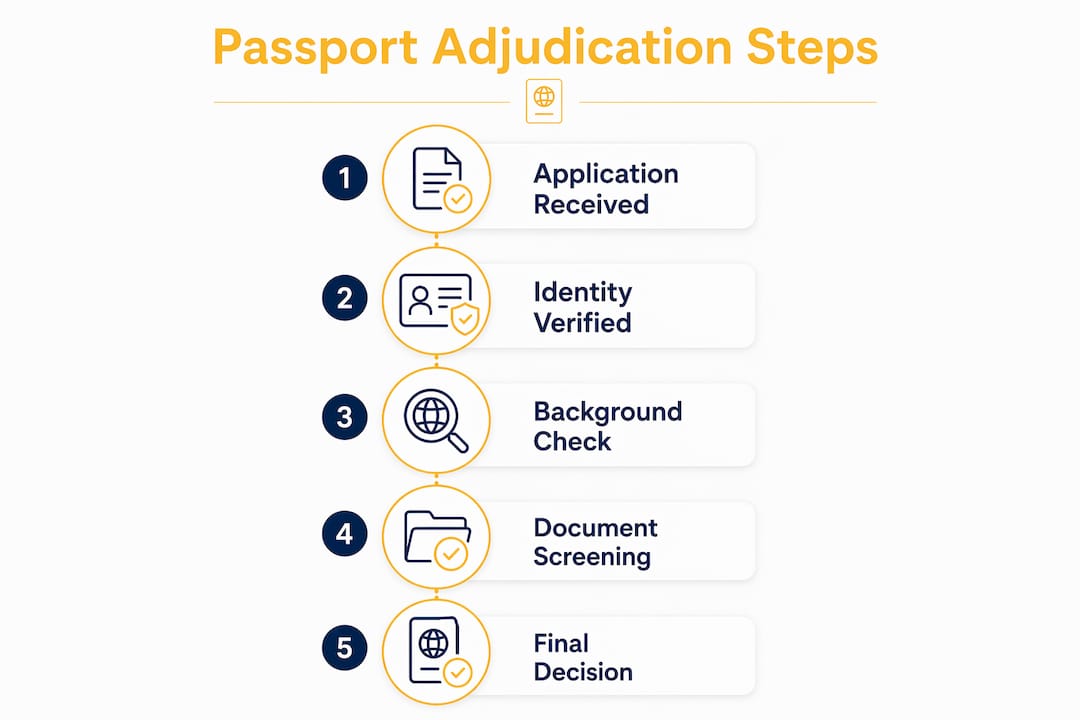
The adjudication process moves through four defined stages:
- Application Received. Your documents arrive at a processing center. The system logs your application and assigns a 9-digit locator number. That number identifies which agency is handling your file.
- In Process. A specialist begins the active review. This is the core adjudication phase. The examiner verifies your birth certificate or naturalization certificate, checks your photo ID, confirms your application form is complete, and runs your name through federal databases for legal flags.
- Approved. The adjudicator clears your application. Your passport is authorized for printing and personalization.
- Mailed. Your passport ships via Priority Mail or overnight courier, depending on the service level you selected.
Routine service takes 4–6 weeks, while expedited service takes 2–3 weeks, excluding mailing time. Expedited processing requires a $60 fee on top of the standard application cost. Those timelines cover the full pipeline, but the adjudication phase itself typically accounts for the bulk of the “In Process” window.
The 9-digit locator number is more useful than most applicants realize. The first digits identify the specific processing center handling your file, whether that is the National Passport Center in New Hampshire, the Philadelphia Passport Agency, or another regional facility. Tracking your application status online with this number gives you a real-time view of where your file sits in the pipeline.

Pro Tip: Save your locator number the moment your acceptance agent gives it to you. You will need it every time you check your status or contact the State Department.
How legal and financial factors affect passport adjudication
Passport adjudication is a security screening, not a broad criminal background check. The distinction matters. Adjudicators do not pull your full criminal history. They screen for a specific set of legal conditions that directly block passport issuance under federal law.
The mandatory denial triggers include:
- Valid federal arrest warrants. An outstanding felony warrant requires denial. The adjudicator has no discretion here.
- Child support arrears over $2,500. The federal Office of Child Support Services reports delinquent accounts to the State Department. Applicants who owe more than $2,500 in unpaid child support face automatic denial.
- Certain court orders. Conditions of parole, probation, or supervised release that restrict international travel trigger a mandatory hold.
- Delinquent federal tax debt. Seriously delinquent tax debt, as certified by the IRS, is grounds for denial under the Fixing America’s Surface Transportation Act.
Some denial grounds are discretionary, meaning the adjudicator can weigh circumstances. But mandatory grounds leave no room for appeal at the adjudication stage. Resolving these blocks requires clearing the underlying debt or warrant through the relevant agency first. Once cleared, the State Department lifts the hold and resumes processing.
If your application is flagged, you will receive a letter or email from the State Department requesting documentation or clarification. Respond quickly. The clock on your processing time pauses the moment a request goes out and does not restart until you reply. Send your response to the specified Sterling, Virginia address listed in the notice, not to a passport agency office.
Pro Tip: If you owe child support or have an unresolved tax issue, contact the relevant agency before you apply. Clearing the block in advance is far faster than resolving it mid-adjudication.
How to track your passport application status through adjudication
Tracking your passport processing status is straightforward once you understand what each status term actually means. The State Department’s online tool updates in near real time during active processing, but there are predictable gaps that confuse applicants.
Here is what each status indicator means in plain terms:
- Received. Your application arrived at the processing center. No review has started yet.
- In Process. Active adjudication is underway. Your file is with a specialist.
- Approved. Adjudication is complete. Your passport is being printed.
- Mailed. Your passport has shipped. Expect delivery within a few days depending on your service level.
- Not Available. This is the “dark period.” It typically lasts 1–2 weeks after submission and reflects the time before your file reaches a processing center and enters the system.
The dark period is one of the most common sources of applicant anxiety. Seeing “Not Available” does not mean something went wrong. It means your application is in transit between the acceptance facility and the processing center. The status will update once the dossier is logged.
If your status stays on “In Process” longer than expected, check whether you missed a communication from the State Department. Adjudication delays most often result from unanswered document requests. You can also call the National Passport Information Center at 1-877-487-2778 or use the Fastpassportcenter status update tool to get a clearer read on where your application stands.
For applicants with urgent travel, contact the State Department directly if your travel date is within 14 days. You may qualify for an emergency appointment at a regional passport agency.
Ways to speed up passport adjudication and avoid common delays
The fastest way through adjudication is a clean, complete application submitted with no missing documents. Errors and omissions are the single biggest cause of processing delays. A specialist who cannot verify a detail will pause the review and send a request for information. That pause can add weeks.
| Factor | Routine processing | Expedited processing |
|---|---|---|
| Total timeline | 4–6 weeks | 2–3 weeks |
| Additional fee | None | $60 |
| Best for | Non-urgent travel | Travel within 5 weeks |
| Mailing included | No | No |
Expedited service cuts the adjudication window by roughly half. The $60 fee is worth it for any trip booked within two months. For travel within two weeks, you need an appointment at a regional passport agency, which operates outside the standard adjudication pipeline.
Common causes of adjudication delays include:
- Mismatched names between your application and your birth certificate
- Expired or low-quality passport photos that fail biometric standards
- Missing or incomplete DS-11 or DS-82 forms
- Failure to include required supporting documents for name changes (a passport name change requires a certified court order or marriage certificate)
- Slow responses to State Department information requests
Pro Tip: Double-check that the name on your application matches your citizenship document exactly, including middle names and suffixes. A single mismatch triggers a manual review that adds days to your timeline.
Working with an experienced service like Fastpassportcenter reduces the risk of these errors. Their agents review your documents before submission and flag problems that would otherwise cause delays during adjudication. You can also review the step-by-step process on their site to understand exactly what happens to your application at each stage.
Key takeaways
Passport adjudication is the eligibility review phase where a U.S. specialist verifies your documents, screens for legal barriers, and approves or denies your application before your passport is printed.
| Point | Details |
|---|---|
| Adjudication is a legal screening | Specialists check for warrants, child support arrears, and tax debt, not your full criminal record. |
| Four clear stages | Applications move through Received, In Process, Approved, and Mailed in sequence. |
| Dark period is normal | Status showing “Not Available” for 1–2 weeks after submission is standard procedure. |
| Delays are mostly avoidable | Most adjudication holds result from missing documents or unanswered State Department requests. |
| Expedited service saves weeks | Paying the $60 expedited fee cuts processing from 4–6 weeks down to 2–3 weeks. |
What I have learned from watching applicants navigate adjudication
Most applicants treat passport adjudication like a black box. They submit their application and wait, assuming no news is good news. That assumption costs people trips.
The biggest misconception I see is that adjudication is a deep background investigation. It is not. LegalClarity confirms that the databases checked are narrowly targeted at specific legal barriers to travel eligibility. A DUI from ten years ago will not flag your application. An unpaid child support balance of $3,000 will. Applicants who understand that distinction stop worrying about the wrong things and start preparing for the right ones.
The second pattern I see constantly: applicants who miss a State Department letter. The letter arrives by mail or email, asks for one document, and sits unanswered for two weeks. The processing clock pauses the entire time. By the time the applicant responds, their travel window has closed. Check your email and physical mail daily after submitting. Set a reminder if you have to.
Preparedness is the only real variable you control in this process. A complete, accurate application with no legal flags moves through adjudication without friction. The specialists are not looking for reasons to deny you. They are looking for reasons to approve you. Give them everything they need upfront.
— David
Fastpassportcenter can take the guesswork out of your application
Adjudication moves faster when your application is complete and accurate from the start. Fastpassportcenter’s experienced agents review every document before submission, catching the errors that most commonly trigger holds or delays.
Their direct courier collaboration with the U.S. Department of State means your application reaches the right processing center faster than standard mail. With over 14,000 positive reviews and an A+ rating from the Better Business Bureau, Fastpassportcenter has a proven record of getting applicants through the process without the stress. If you need your passport quickly, their expedited passport processing service is the most reliable way to cut your timeline in half. You can also book passport notarization through Premier Notary if your application requires certified document verification.
FAQ
What does “In Process” mean for a passport application?
“In Process” means your application is actively under review by a specialist at a U.S. passport processing center. This is the core adjudication phase where identity, citizenship documents, and legal eligibility are verified.
How long does passport adjudication take?
Routine processing takes 4–6 weeks and expedited service takes 2–3 weeks, not including mailing time. The adjudication review itself accounts for most of the “In Process” window.
Can a passport be denied during adjudication?
Yes. Mandatory denial grounds include valid federal arrest warrants, child support arrears over $2,500, certain court orders, and seriously delinquent federal tax debt. Adjudicators cannot override mandatory denial conditions.
What is the “dark period” in passport processing?
The dark period is a 1–2 week window after submission when your status shows “Not Available.” It reflects the time before your application physically arrives at a processing center and is logged into the system. It is normal and does not indicate a problem.
What should I do if the State Department requests more information?
Respond immediately and send your documents to the Sterling, Virginia address listed in the notice. The processing clock pauses until you reply, so delays in responding directly extend your total wait time.