The U.S. Department of State accepts five primary documents as proof of citizenship: a U.S. birth certificate, a full-validity undamaged U.S. passport (expired passports are accepted if undamaged), a Consular Report of Birth Abroad, a Certificate of Naturalization, or a Certificate of Citizenship. You must submit an original or certified copy of one of these. Digital scans, photos, or uncertified printouts will not work, and the details matter more than most applicants expect. Jump to the checklist section below for exactly what to bring.
TL;DR:
- A certified paper birth certificate, undamaged full-validity passport, or Certificate of Naturalization serve as the strongest proof of citizenship for a passport application.
- Secondary evidence combined with a notarized affidavit can prove citizenship if primary documents were never filed or are missing, especially for delayed births.
- Birth certificates must display six specific details, including a filing date within one year, a legible seal, and an official signature, to qualify as valid proof.
- Expedited services like registered couriers can review and deliver documents correctly, significantly reducing the risk of delays or rejections, especially within four weeks of travel.
- Most applicants should gather secondary evidence early, order certified documents in advance, and avoid using digital-only birth certificates to ensure smooth processing.
Table of Contents
- Examples of Primary Evidence Accepted for U.S. Passports
- What Do You Do Without a Birth Certificate or Passport?
- What Are the Exact Requirements for a Birth Certificate?
- What Should You Bring With Your Passport Application?
- How Do You Replace a Missing Birth Certificate or Naturalization Record?
- When Should You Use a Regional Agency, a Courier, or the Post Office?
- How Does a Registered Courier Handle Citizenship Evidence Correctly?
- Do Diplomatic and Official Passports Need Different Proof?
- How Does Naturalization or Derived Citizenship Change What You Submit?
- How Can You Tell If a Citizenship Document Is Valid?
- A Practical Take on DIY Filing vs. Courier Help
- Get Your Documents Right the First Time
- Sources
- FAQ
Examples of Primary Evidence Accepted for U.S. Passports
Most applicants reach for a birth certificate first, and that’s usually the right instinct. But the State Department’s citizenship evidence rules require it to include specific fields, filed promptly after birth within the period recognized by the issuing authority, or it gets treated as secondary evidence instead of primary.
Here’s what qualifies as primary proof of citizenship:
- U.S. birth certificate: Must show your full name, date and place of birth, parents’ names, the registrar’s signature, an official seal, and a filing date within one year of birth.
- Full-validity U.S. passport: An expired passport still counts as long as it wasn’t damaged or limited-validity. This is the easiest document for renewal applicants, and it’s the one people forget they already have.
- Consular Report of Birth Abroad (CRBA): Issued to children born overseas to U.S. citizen parents who registered the birth with a U.S. embassy or consulate.
- Certificate of Naturalization or Certificate of Citizenship: Issued by U.S. Citizenship and Immigration Services after naturalization or derivation of citizenship.
Under 22 U.S.C. §2705, a passport and certain consular reports carry the same legal weight as a naturalization certificate. That’s worth knowing if you’re renewing and assumed you’d need to dig up your birth certificate again. You don’t. An expired passport, if it’s undamaged, does the job on its own.
What Do You Do Without a Birth Certificate or Passport?
Not every applicant has clean primary evidence. Maybe the birth certificate was never filed properly, or it’s a “delayed” certificate registered years after the fact. Secondary evidence exists for exactly this problem, and the State Department accepts a defined set of substitutes when combined with an affidavit.
Acceptable secondary documents include:
- Hospital birth records created at or near the time of birth
- Early baptismal or circumcision certificates showing date and place of birth
- Early census, school, or medical records referencing your birth
- Family Bible entries recorded near the time of birth
- Insurance policy files listing your birth information
- Published birth announcements from local newspapers
You’ll typically need more than one of these, paired with a notarized birth affidavit (Form DS-10) from a relative old enough to have known about the birth firsthand. If vital records confirm no certificate exists, the state will issue a “Letter of No Record,” and you’ll need to submit that alongside your secondary evidence. Delayed birth certificates, filed more than a year after birth, generally trigger this same secondary-evidence requirement automatically.
What Are the Exact Requirements for a Birth Certificate?
A birth certificate can look official and still get flagged if it’s missing one required field. The State Department checks for six specific elements, and skipping any of them is the fastest way to see your application delayed.
Your birth certificate needs:
- The city, county, or state where you were born
- Your full legal name as recorded at birth
- Your date of birth
- Your parents’ full names
- A filing date within one year of birth
- The registrar’s signature and the issuing authority’s official seal
Electronic-only birth certificates, the kind some hospitals now generate as digital files with no physical seal, are not accepted. You need a certified paper copy from vital records, not a PDF.
Common rejection triggers include delayed filing dates, a missing or faded seal, visible alterations, and records that are simply too illegible to verify. If your certificate was filed more than a year after birth, expect the agency to ask for supporting secondary evidence before moving forward.
Pro Tip: Order your certified birth certificate at least a few weeks before you plan to apply. A faded seal or a hairline crease can be enough for an agent to ask for a fresh copy, and that request alone can cost you a week you don’t have.
What Should You Bring With Your Passport Application?
The DS-11 application form is specific about what goes with your citizenship evidence, and missing a photocopy is one of the most avoidable delays applicants create for themselves.
Pack these items together:
- Your original or certified copy of citizenship evidence (birth certificate, passport, CRBA, or naturalization/citizenship certificate)
- A photocopy of the front of that document, and the back too if it has printing on both sides
- A valid photo ID with a photocopy of its front and back
- One 2×2 inch color passport photo taken within the last six months, plain white background, no glasses
The DS-11 instructions confirm the government keeps your original or certified copy for processing and mails it back once your passport is issued. That’s normal, not a red flag, but it’s exactly why the photocopy matters: it’s your paper trail while the original is in transit.
How Do You Replace a Missing Birth Certificate or Naturalization Record?
Losing your citizenship evidence is more common than it sounds, especially for anyone who’s moved states or misplaced paperwork during a life change. The fix usually comes down to which agency issued the original document.
Your options:
- Order a certified birth certificate from the vital records office in the state or county where you were born. Most require a government ID and a small fee, and processing runs anywhere from a few days to a few weeks depending on the state.
- Replace a CRBA or naturalization certificate through USCIS for naturalization records, or through a U.S. embassy or consulate for CRBAs.
- Request a State Department file search if you once held a U.S. passport but can’t find it. This can sometimes substitute for a birth certificate you can’t locate.
USA.gov’s guidance on proving citizenship walks through the replacement process for each document type in more detail.
Pro Tip: If you once had a passport as a kid, ask a parent before assuming your birth certificate is gone for good. Many families still have the original tucked away, and that expired child passport alone might solve your problem without a records request.
When Should You Use a Regional Agency, a Courier, or the Post Office?
Your timeline decides your channel, and picking the wrong one is how urgent trips turn into missed flights. Processing speed depends on which path you choose, not just how fast the government works.
- Regional passport agency: In-person only, and reserved for travel within three days or a genuine life-or-death emergency. Not practical if you’re hours from the nearest one.
- Registered courier or expediting service: The right call for travel two days to four weeks out, especially if you live far from a regional agency, in places like Tampa, Charlotte, Sacramento, Nashville, or Louisville.
- USPS routine submission: Fine if you’re not traveling for at least four weeks and your documents are already in order.
Missing or delayed citizenship evidence pushes any of these timelines back further, so gather your secondary evidence early if your birth certificate isn’t straightforward. For a fuller breakdown of timing, see this guide on how to expedite passport processing.
How Does a Registered Courier Handle Citizenship Evidence Correctly?
A registered courier’s real value shows up before the application ever reaches an agency window. The process typically includes:
- Reviewing your citizenship evidence against the exact required fields before submission
- Flagging a delayed birth certificate or missing seal so you can fix it in advance
- Securing certified copies through the right vital records channel
- Hand-delivering your application directly to the passport agency
Fast Passport Center operates as a U.S. State Department–registered courier with more than 20 years in this work, an A+ Better Business Bureau rating, and over 14,000 positive customer reviews.
Do Diplomatic and Official Passports Need Different Proof?
Regular passports, official passports, and diplomatic passports all require the same underlying proof of citizenship. The birth certificate, passport, CRBA, naturalization certificate, and citizenship certificate rules don’t change based on passport type. What changes is who’s eligible to apply and what additional paperwork rides alongside your citizenship evidence.
An official passport (maroon cover) is issued to government employees and contractors traveling on official business. A diplomatic passport (black cover) goes to diplomats, foreign service officers, and certain high-ranking officials. Both require a letter of authorization from the sponsoring federal agency, on top of the standard citizenship documentation everyone submits for a regular passport.
If you’re applying for either type, your agency’s travel or personnel office typically handles the authorization letter, and it usually accompanies your DS-11 rather than replacing anything on it. The citizenship evidence itself, birth certificate or passport or naturalization paperwork, still has to meet the same field requirements described earlier: full name, date of birth, parents’ names, registrar’s signature, and seal.
For nearly everyone reading this, that distinction won’t matter. Most travelers, including business travelers and families, apply for regular passports, and the proof-of-citizenship rules already covered above are the ones that apply. The extra layer only kicks in for federal employees and diplomatic personnel with agency sponsorship.
How Does Naturalization or Derived Citizenship Change What You Submit?
Citizenship isn’t always established the way most people assume, through birth on U.S. soil, and the proof requirements shift depending on how you acquired it.
If you naturalized as an adult, your Certificate of Naturalization from USCIS is your primary evidence going forward. You won’t need a foreign birth certificate at all once you have that certificate in hand, and a passport issued after naturalization works just as well for renewals.
Derived citizenship, meaning you became a citizen automatically because a parent naturalized while you were still a minor, works differently. You’ll typically need your Certificate of Citizenship, or in some cases a combination of your parent’s naturalization certificate and your own birth or adoption records showing the parent child relationship. This gets complicated quickly if records are scattered across two countries or if a parent’s naturalization predates your own documentation. USCIS is the right first call in these cases, not the passport agency, since the underlying citizenship certificate has to exist before a passport application can move forward.
If you were born abroad to a U.S. citizen parent and your birth was registered with a consulate, your CRBA remains valid as primary evidence indefinitely. Status changes like a later adoption finalization or a change in custody arrangements can occasionally require updated paperwork, so it’s worth confirming your specific situation with USCIS or a consulate before you assume your existing certificate still covers you.
How Can You Tell If a Citizenship Document Is Valid?
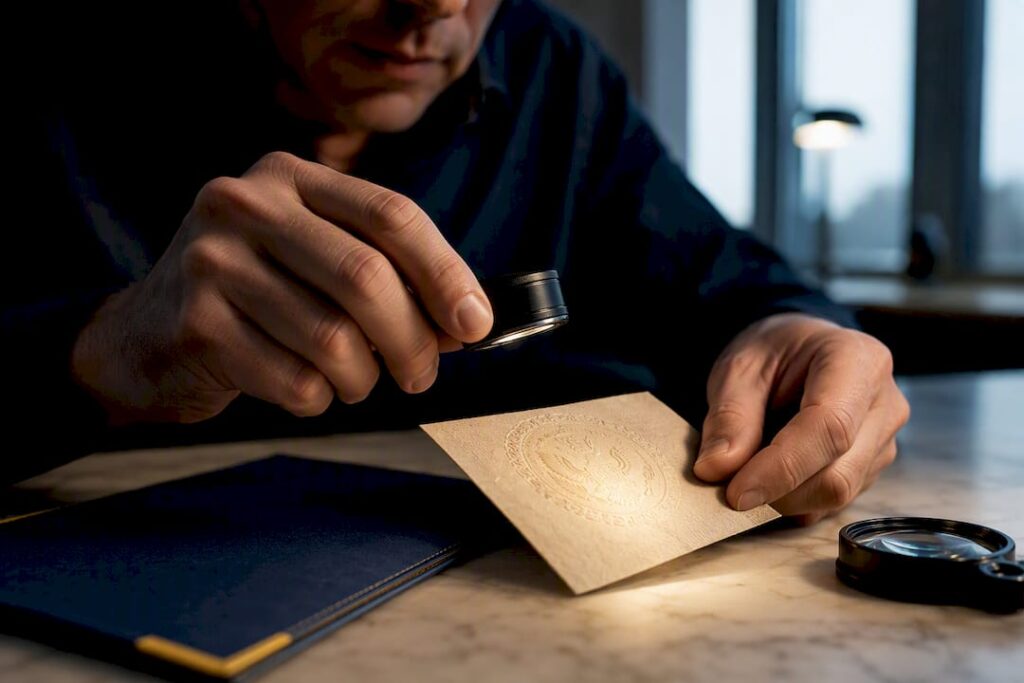
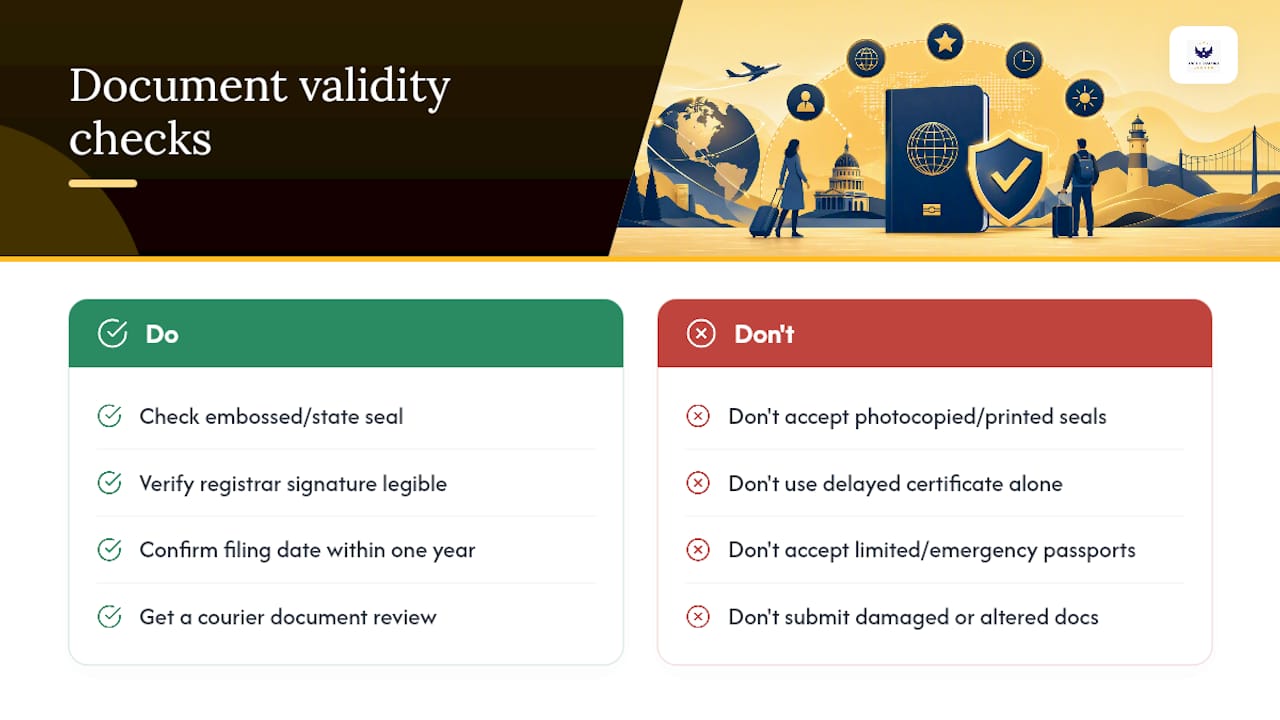
Authenticity comes down to matching your document against the specific criteria the government checks, not just whether it looks official. A birth certificate with a raised or embossed seal from the issuing state or county vital records office is the clearest sign it’s genuine. A photocopy of a seal, or a printed image meant to look embossed, won’t pass.
Check the registrar’s signature is present and legible, and that the filing date sits within one year of the actual birth date. A certificate filed years later is treated as a delayed record even if every other field looks correct, which means it needs secondary evidence to back it up regardless of how legitimate the birth itself was.
For passports, confirm the document is undamaged and was issued as a full-validity 10-year adult or 5-year minor passport, not a limited-validity emergency passport, which doesn’t qualify as standalone proof. Naturalization and citizenship certificates should carry the USCIS seal and a certificate number you can typically verify through USCIS directly if there’s any doubt.
If you’re unsure whether your specific document meets these standards, a document review from an experienced courier catches problems before they reach an agency window, where a rejection costs you days you may not have.
A Practical Take on DIY Filing vs. Courier Help
If you’re two or more hours from a regional agency and traveling inside four weeks, don’t gamble on the mail. A courier that catches document problems before submission is the safer bet every time.
— Andy Irons
Get Your Documents Right the First Time
Fast Passport Center exists for exactly the gap this article just walked through: travelers who discover an expired passport days before a trip, parents rushing a first-time child passport, or anyone whose birth certificate doesn’t quite meet the required fields. Unlike mailing your application and hoping nothing gets flagged, Fast Passport Center’s agents review your citizenship evidence before it ever reaches an agency window, catch missing seals or delayed filing dates early, and hand-deliver your paperwork as a registered U.S. State Department courier.
This service fits travel windows from two days out to four weeks out, covering lost or stolen passports, damaged documents, and urgent child passport requests. With more than 20 years of experience, an A+ BBB rating, and drop-off offices in 24 cities, including Tampa, Charlotte, Sacramento, Nashville, and Louisville, Fast Passport Center gives readers far from a regional agency a real alternative to a risky do-it-yourself mailing. Start your expedited passport service request today and get your documents reviewed before they become a problem.
Sources
FAQ
What can I use as proof of U.S. citizenship for a passport?
A U.S. birth certificate, a full-validity undamaged U.S. passport, a Consular Report of Birth Abroad, a Certificate of Naturalization, or a Certificate of Citizenship all qualify, according to the State Department.
What are three acceptable proofs of U.S. citizenship?
A U.S. birth certificate, an expired but undamaged full-validity U.S. passport, and a Certificate of Naturalization are three commonly used examples among the accepted primary documents.
Is a Social Security card proof of citizenship?
No. A Social Security card confirms your Social Security number, not citizenship, and the State Department does not accept it as proof of citizenship for a passport application.
How can I get proof of my U.S. citizenship if I don’t have a birth certificate?
Order a certified copy from your state or county vital records office, or gather secondary evidence like hospital birth records and school records paired with a notarized DS-10 affidavit if no certificate exists.
How fast can Fast Passport Center help if my passport application documents aren’t ready?
Fast Passport Center’s agents review your citizenship evidence for missing fields or seals before submission, which helps travelers with two days to four weeks before departure avoid preventable rejections.