
A second passport is a legal travel document issued by a second country that enables uninterrupted international travel when your primary passport is unavailable, restricted, or held by an embassy. Frequent travelers, business professionals, and anyone navigating complex visa requirements increasingly rely on this tool to stay mobile. Understanding how second passport prevents travel delays is no longer a niche concern. 66% of U.S. Gen Z and millennial travelers in 2026 want a second passport to secure global mobility amid geopolitical instability. That demand reflects a real and growing problem: one passport is often not enough.
How does a second passport allow uninterrupted travel during visa processing?
The most direct way a second passport prevents travel delays is by letting you submit one document to an embassy while traveling freely on the other. Embassies routinely retain your passport for weeks during visa processing. Without a second passport, your travel stops completely until the document is returned.

Consider a common scenario: you need a Chinese business visa, which can take two to four weeks to process. Your embassy holds your primary passport for the entire period. With a second passport in hand, you board your next flight without waiting. This is the core administrative advantage that shifts travelers from petitioners waiting for permission to proactive planners with more destination choices.
The same logic applies to travelers who need visas for multiple countries simultaneously. You can submit your primary passport to one embassy and your second passport to another, running two applications in parallel. That coordination alone can compress a multi-month visa queue into a few weeks of parallel processing.
- Your primary passport is held by an embassy for a Chinese, Russian, or Indian visa application.
- A sudden border closure or entry restriction applies specifically to your primary passport’s country of issue.
- Your primary passport is lost, stolen, or damaged abroad, and you need to continue traveling while a replacement is processed.
- You hold stamps from countries with diplomatic tensions, and border officers at your next destination scrutinize your travel history.
Pro Tip: Always check which passport you used to enter a country and exit on the same document. Mismatched entry and exit records trigger security flags that can delay future trips.
What are the timelines for obtaining a second passport in 2026?
Why second passport processing time matters is a question every traveler should ask before assuming they can get one quickly. The timeline varies dramatically depending on the pathway you choose.
Citizenship-by-investment programs process applications within 30–60 days under ideal conditions. These programs, offered by countries in the Caribbean and parts of Europe, require a qualifying financial contribution. The tradeoff is cost: citizenship-by-investment typically costs between $150,000 and $250,000 and can take 4–6 months in practice. Traditional residency pathways take 5–10 years, making them unsuitable for anyone with near-term travel needs.
| Pathway | Typical Timeline | Key Requirement |
|---|---|---|
| Citizenship by investment | 4–6 months (30–60 days best case) | Financial contribution ($150K–$250K) |
| Ancestry or descent | 6–24 months | Documented lineage proof |
| Naturalization via residency | 5–10 years | Continuous legal residency |
| Marriage to a foreign national | 2–5 years | Varies by country |
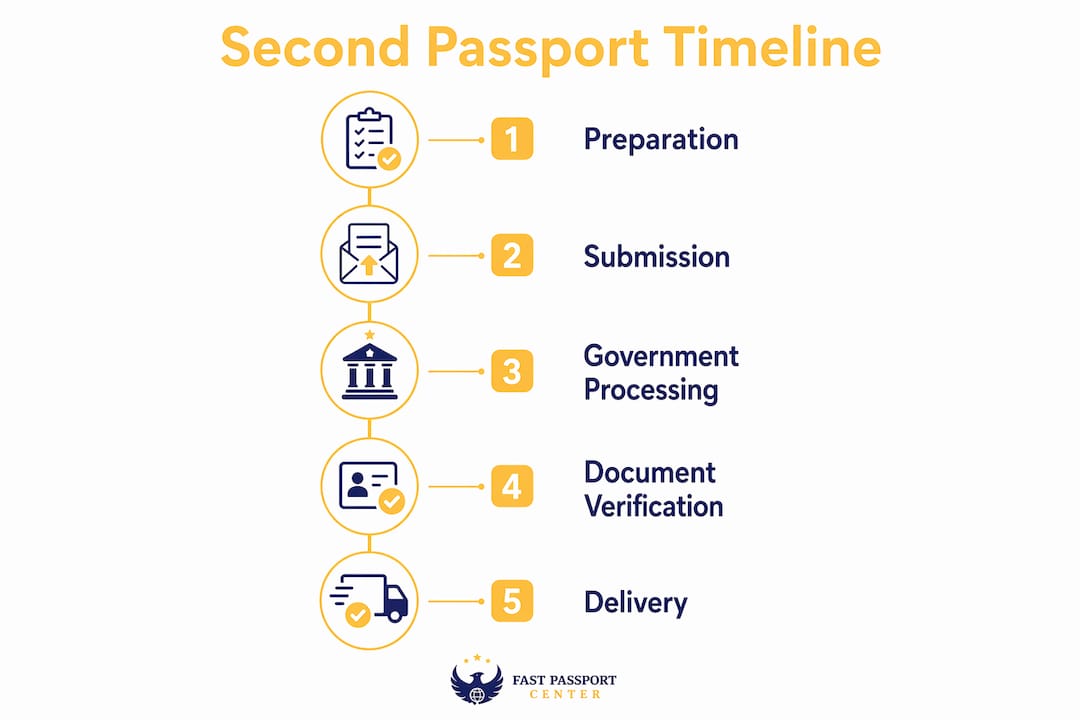
The biggest bottleneck is rarely government processing. Document preparation and verification cause the most significant delays in second passport applications, often before submission. Police clearance certificates, apostilles, and tax documents can each take weeks to obtain. Travelers who underestimate this phase routinely miss their target acquisition dates.
Pro Tip: Start gathering supporting documents at least three months before you plan to submit your second passport application. Police clearance certificates and apostilles are the most common sources of unexpected delays.
How does a second passport reduce trip cancellations from geopolitical changes?
A second passport functions as an insurance policy, mitigating the risk of being stranded during long visa processes or sudden geopolitical changes. This benefit goes well beyond visa logistics. Border closures, travel bans, and entry restrictions can materialize within hours of a diplomatic incident. Travelers holding only one passport from an affected country have no alternative.
The practical scenarios where this protection matters most include:
- A government imposes a sudden travel ban on citizens of your primary passport country. Your second passport from a neutral or allied nation lets you board your flight without disruption.
- Your primary passport carries stamps from countries considered adversarial by your destination. Border officers may deny entry or subject you to extended questioning. A clean second passport avoids that scrutiny entirely.
- A regional conflict closes airspace or land borders that your primary passport’s visa covers. Your second passport may grant access through alternative routes or neighboring countries.
- Your primary passport country loses visa-free access to a destination due to a policy change. Strongest passports provide access to upward of 190 destinations, and choosing a second passport from a high-mobility country expands your options significantly.
Second passports are increasingly viewed as strategic assets for political and travel risk mitigation rather than mere travel convenience. That shift in perception reflects a real change in the global travel environment. Travelers who planned trips months in advance have had those plans canceled by events entirely outside their control. A second passport gives you a structural alternative when your primary document becomes a liability.
What practical strategies help frequent travelers manage two passports effectively?
Holding two passports creates advantages, but it also creates responsibilities. Managing them poorly can produce the very delays you were trying to avoid.
The first rule is name consistency. Inconsistent name formats or discrepancies between your two passports trigger security system flags at borders, which can cause additional questioning or delays. If your legal name appears differently across documents, resolve that before you travel.
The second rule is electronic travel history awareness. Electronic travel history tracking can complicate entry even when you hold two valid passports. Border systems in many countries share data, and an inconsistent travel record across two passports raises questions. Careful trip planning and deliberate passport usage are not optional.
- Designate each passport for specific regions. Use your U.S. passport for countries where it provides visa-free access or favorable treatment. Use your second passport for regions where it offers better entry terms or a cleaner travel history.
- Track which passport you used to enter each country. You must exit on the same passport you used to enter. Failing to do so creates a record of an “overstay” that affects future applications.
- Store passports separately when traveling. Keep one in your carry-on and one in a secure location at your accommodation. Losing both simultaneously eliminates your backup entirely.
- Review the second passport application checklist for U.S. citizens before you apply to confirm your documents are complete and correctly formatted.
Pro Tip: Keep a simple log of which passport you used for each trip. A spreadsheet with destination, entry date, exit date, and passport used takes five minutes to maintain and can save hours of explanation at a border.
Key Takeaways
A second passport prevents travel delays by providing a legal backup document that keeps you mobile when your primary passport is unavailable, restricted, or under scrutiny.
| Point | Details |
|---|---|
| Core travel delay prevention | Submit one passport for visa processing while traveling freely on the other. |
| Processing time reality | Citizenship-by-investment takes 4–6 months; document prep is the biggest bottleneck. |
| Geopolitical protection | A second passport from a neutral country bypasses sudden travel bans and border closures. |
| Name and history consistency | Mismatched names or travel records across two passports trigger border security flags. |
| Parallel visa applications | Running two visa applications simultaneously compresses multi-month queues significantly. |
Why I think every serious traveler needs a second passport before 2027
I have watched the calculus around second passports change completely over the past five years. What used to be a planning luxury for the ultra-wealthy is now a practical necessity for anyone who travels more than six times a year. The travelers I see caught off guard are not reckless. They are simply working with one document in a world that increasingly demands flexibility.
The scenario that sticks with me is the traveler who had a critical business trip canceled because their passport was sitting in an embassy in Beijing during a visa application. They had planned the trip months in advance. The delay was not a surprise. It was entirely predictable, and a second passport would have resolved it before it started.
What I find underappreciated is how much of the second passport advantage is administrative rather than political. You do not need to be fleeing instability to benefit. You just need to be someone who cannot afford to have their travel stopped by a bureaucratic queue. Owning a second passport allows travelers to act proactively, choosing safe and open destinations instead of reacting to restrictions.
My honest advice: start the process earlier than you think you need to. The document preparation phase alone takes most travelers by surprise. And if your U.S. passport needs expediting while you plan your second citizenship strategy, do not attempt that process without professional help. The margin for error on passport applications is zero.
— Andy Irons
Fast Passport Center can help you move faster on passport documents
If you are managing urgent travel timelines while planning for a second passport, the U.S. passport side of that equation does not have to slow you down. Fast Passport Center is a U.S. State Department-registered courier with over 20 years of experience and drop-off offices in 24 cities across the country.
Travelers in cities like Tampa, Charlotte, Nashville, and Sacramento who live more than two hours from a regional passport agency rely on Fast Passport Center to handle expedited applications without an in-person agency visit. Whether you need a second passport expedited or your primary passport renewed quickly before a trip, Fast Passport Center’s agents handle every detail. The service has earned an A+ rating from the Better Business Bureau and over 14,000 positive reviews. Learn more about the passport expediting service and get your documents moving today.
FAQ
What is a second passport and how does it prevent travel delays?
A second passport is a valid travel document issued by a second country that lets you travel while your primary passport is held by an embassy or restricted by a travel ban. It prevents delays by giving you a legal alternative document to use for entry and exit.
How long does it take to get a second passport in 2026?
Citizenship-by-investment programs can process applications in 30–60 days under ideal conditions, though 4–6 months is more realistic. Traditional residency pathways take 5–10 years, making them impractical for urgent travel needs.
Can I use two passports at the same time legally?
Yes. Many countries, including the United States, permit dual citizenship. You can legally hold and use two passports, but you must enter and exit each country on the same passport to avoid creating conflicting travel records.
What is the biggest bottleneck in getting a second passport?
Document preparation, including police clearance certificates, apostilles, and tax records, causes more delays than government processing itself. Starting document collection at least three months before your planned submission date reduces this risk significantly.
Does a second passport help if my primary passport has problematic stamps?
Yes. A second passport from a different country provides a clean travel history for destinations where certain stamps, such as those from countries with diplomatic tensions, could trigger additional scrutiny or denial of entry.