
A second passport is defined as an additional valid U.S. passport issued to travelers who face legitimate travel conflicts, including overlapping visa applications or entry denials caused by incompatible visa stamps. This second passport conflicting visa stamps guide covers everything you need: who qualifies, how to apply, how to separate sensitive travel histories, and how to avoid the mistakes that trigger secondary screenings at the border. The U.S. State Department authorizes these documents for documented needs, and Fast Passport Center helps travelers navigate the process without delays or guesswork.
Who qualifies for a second passport and how to apply
U.S. citizens qualify for a second passport when they have documented, legitimate travel needs that a single passport cannot accommodate. The most common qualifying reasons are overlapping visa applications, where one country holds your passport while you need to travel on it, and geopolitical conflicts, where stamps from one country cause entry denial in another.
The most important thing to understand about eligibility is that the U.S. State Department requires proof. A personal statement alone rarely succeeds. Employer letters are the strongest evidence you can submit, and they should document exactly why your travel schedule requires two valid passports simultaneously. Personal justification statements support the case but do not replace employer documentation.
The second passport carries a validity of up to 4 years, compared to the standard 10-year primary passport. That shorter window reflects its purpose as a supplemental document, not a replacement. You will need to renew it more frequently, so factor that into your travel planning if you rely on it regularly for business travel applications.
Required documentation typically includes a completed DS-11 application form, proof of U.S. citizenship, a valid government-issued photo ID, a recent passport photo, the applicable fee, and a supporting letter explaining your need. If your employer is sending you to countries with conflicting entry policies, that letter should name the countries, the travel dates, and the business purpose explicitly.
Pro Tip: If you travel frequently between countries with known geopolitical tensions, keep a copy of your employer letter updated every six months. Border officers and passport adjudicators both respond better to current, specific documentation than to vague or outdated letters.
You can review the full second passport application checklist to confirm you have every required document before submitting.
How to identify and resolve conflicting visa stamps
Conflicting visa stamps occur when entry records from one country create a legal or political barrier to entering another. The most widely known example involves Israel and several Arab nations. An Israeli entry stamp, or even evidence of travel to Israel, can result in entry denial in countries including Kuwait, Lebanon, and Saudi Arabia. The reverse is also true in some cases. Geopolitical tensions cause entry denial when stamps from certain countries appear in your passport, making a second passport the practical solution.

Overlapping travel dates create a separate but related problem. Immigration officers use passport stamps to reconstruct your travel history. If stamps suggest you were in two countries at the same time, or that you exited one country after you entered another, those inconsistencies raise immediate red flags. Overlapping stamps trigger secondary screenings even when the traveler has a truthful explanation, because the burden of clarification falls entirely on you at the border.
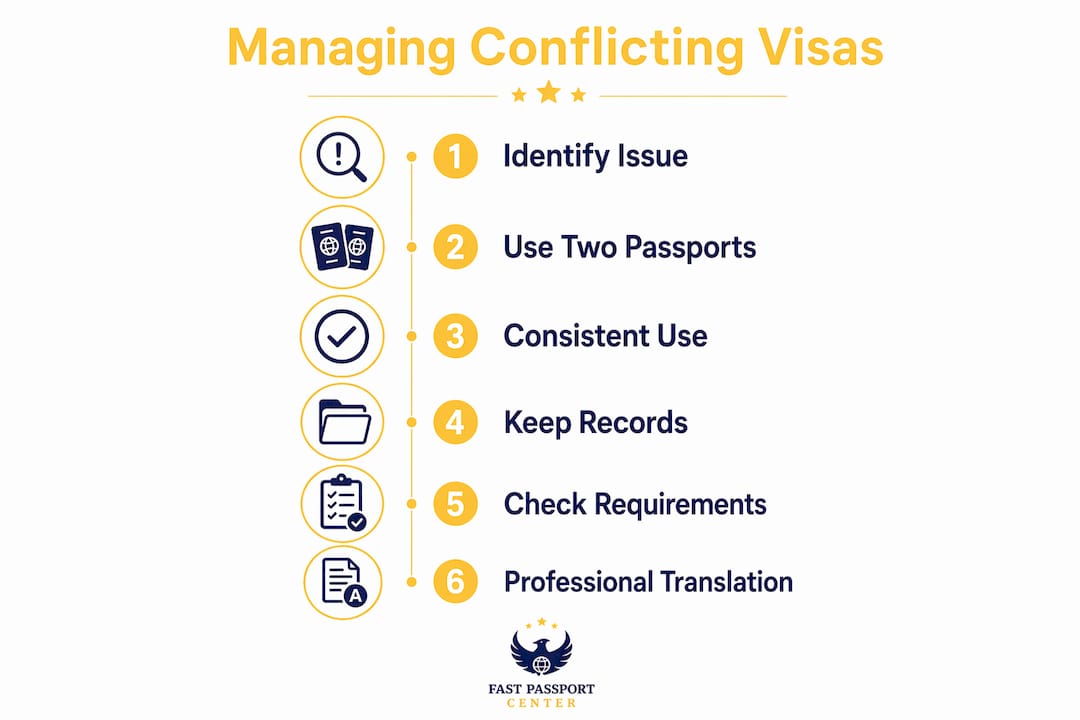
The practical solution is to use each passport consistently for its designated travel region. Assign one passport to countries where sensitive stamps may appear and keep the other clean for regions where those stamps would cause problems. This separation protects both travel histories and prevents the kind of inconsistencies that invite scrutiny.
Accurate record keeping matters more than most travelers realize. Keep a personal travel log that notes which passport you used for each trip, the entry and exit dates, and the countries visited. This record helps you spot potential overlaps before they become a problem at the border. It also supports your case if an immigration officer asks you to account for your travel history.
Pro Tip: Before any trip involving two passports, check the entry requirements for your destination using both passport nationalities. The passport entry requirements for your destination may differ significantly depending on which document you present.
If your documents include foreign-language visas or immigration records, professional translation supports your case. The immigration document translation process is worth completing before you travel, not after a border officer flags an untranslated stamp.
Best practices for traveling with two passports
The single most important rule for dual passport holders is to exit every country on the same passport you used to enter. Mismatched entry and exit records can result in fines, travel delays, and complications on future trips. Immigration databases in many countries now cross-reference entry and exit data, so a mismatch is not a minor clerical issue.
When choosing which passport to present at any given border, select the one that gives you the best entry terms. Dual nationals present the passport that grants the easiest access, the longest permitted stay, and any available e-gate privileges. This is not about deception. It is about exercising the rights each citizenship grants you.
Airline bookings require careful coordination. Book your ticket using the passport you plan to present at your destination. Airlines transmit passenger data to destination countries before departure, and a mismatch between your booking document and your entry document can create problems at check-in or the gate. Carry both passports with you, but present the correct one at each stage of travel.
The table below summarizes the key decision points for dual passport holders at each stage of travel.
| Travel stage | Recommended practice |
|---|---|
| Booking flights | Use the passport accepted by the destination country |
| Airline check-in | Present the passport matching your booking |
| Border entry | Present the passport with the best entry terms |
| Border exit | Use the same passport you used to enter |
| Visa in expired passport | Carry both old and new passports together |
The Visa in Other Passport (VIOPP) rule is relevant if you hold a valid visa in an expired passport. A valid visa in an expired passport remains usable alongside your new passport, provided your name and personal details are consistent across both documents. A name change invalidates the old visa, and you will need a new one. Always carry both passports together when relying on VIOPP, and be prepared to explain the situation to the airline and border officer.
For travelers managing multiple trips across regions, keeping a written record of which passport was used for each journey prevents the kind of confusion that leads to costly errors.
Common mistakes and how to avoid them
The most damaging mistake dual passport holders make is switching passports mid-trip. Entering a country on one passport and exiting on another creates an immigration record that looks like an unexplained disappearance or an unauthorized overstay. Inconsistent passport presentation at boarding, entry, or exit increases the risk of secondary inspections and can affect future visa applications.
Unauthorized souvenir stamps are a less obvious but serious problem. Some border crossings, tourist attractions, or novelty services offer decorative stamps as keepsakes. Unauthorized stamps can damage a passport’s validity by obscuring official markings or the machine-readable zone. A passport with a compromised machine-readable zone can be rejected at check-in or by automated border systems.
Failing to provide adequate justification during the second passport application is another common error. The State Department does not issue second passports automatically. Vague applications without specific travel evidence, employer letters, or documented conflicts are routinely denied. If your application lacks detail, rewrite it before submitting.
Name changes in old passports require attention. If you changed your name after obtaining a visa, that visa is no longer valid under VIOPP rules. You need a new visa in your current name before traveling. Carry legal documentation of the name change if you are in a transitional period between documents.
Inconsistent or missing passport stamps also raise concerns with U.S. immigration, potentially causing visa or adjustment process delays. If you are adjusting your immigration status or applying for a new visa, your travel history must be complete and consistent across all documents you submit.
Key Takeaways
Managing conflicting visa stamps requires a second passport, consistent document use at every border crossing, and strong written justification for the application itself.
| Point | Details |
|---|---|
| Qualify with documentation | Employer letters and specific travel evidence are required to obtain a second U.S. passport. |
| Shorter validity period | Second passports are valid for up to 4 years, not the standard 10, so plan renewals accordingly. |
| Separate sensitive travel histories | Use each passport consistently for its designated region to prevent geopolitical entry conflicts. |
| Exit on the same passport | Always leave a country on the passport you used to enter to avoid mismatched immigration records. |
| Avoid unauthorized stamps | Decorative or souvenir stamps can damage your passport’s machine-readable zone and void its validity. |
What I’ve learned from years of second passport cases
By Andy Irons
The travelers who run into the most trouble are not the ones with complicated travel histories. They are the ones who underestimate how carefully immigration systems track document consistency. I have seen applications denied because the employer letter was too vague, and I have seen border delays caused by a single decorative stamp from a tourist attraction that obscured an official entry mark.
The geopolitical dimension surprises people. Most travelers know about the Israel and Arab nations conflict in a general way, but they do not realize how many other regional tensions create similar problems. Countries in parts of Africa, the Middle East, and Asia maintain entry restrictions based on travel history, and those restrictions are enforced at the border, not announced in advance on a government website.
My strongest advice is this: treat your second passport as a dedicated tool, not a backup document. Assign it a specific purpose, keep your travel records organized, and never improvise at the border. The travelers who manage two passports well are the ones who planned their document strategy before they booked their flights.
Fast Passport Center handles second passport applications regularly, and the cases that move fastest are the ones where the traveler arrives with a complete employer letter, a clear explanation of the conflict, and a realistic timeline. If you are within 2–4 weeks of travel and need a second passport, a courier service is the right path. A post office submission will not meet your deadline.
— Andy Irons
How Fast Passport Center handles second passport applications
Travelers dealing with conflicting visa stamps often face a tight window between discovering the problem and their departure date. Fast Passport Center works directly with the U.S. Department of State as a registered courier, which means your application moves faster than standard mail submissions.
Fast Passport Center’s agents review your documentation before submission, catching errors that would otherwise cause delays or denials. For travelers with overlapping travel dates, sensitive stamp conflicts, or urgent business travel needs, the passport expediting service is built for exactly this situation. With an A+ rating from the Better Business Bureau and over 14,000 positive reviews, Fast Passport Center has the track record to back up that confidence. If your travel falls within the next 2–4 weeks, contact Fast Passport Center now to confirm your timeline and get your second passport application moving.
FAQ
What is a second passport and who qualifies?
A second passport is an additional valid U.S. passport issued to travelers with documented needs such as overlapping visa applications or conflicting entry stamps. The U.S. State Department requires proof of necessity, typically including an employer letter and a personal justification statement.
How long is a second passport valid?
A second U.S. passport is valid for up to 4 years, compared to the standard 10-year validity of a primary passport. Plan your renewal timeline accordingly if you depend on it for regular international travel.
Can I use a visa from an expired passport with a new one?
Yes, under the VIOPP rule, a valid visa in an expired passport remains usable alongside a new passport if your name and personal details are consistent across both documents. A name change invalidates the old visa, and you will need a new one.
What documents do I need for a second passport application?
You need a completed DS-11 form, proof of U.S. citizenship, a valid photo ID, a passport photo, the applicable fee, and a detailed employer letter or personal statement explaining your travel conflict. Vague applications without specific evidence are routinely denied.
What happens if I enter and exit a country on different passports?
Mismatched entry and exit records create an immigration flag that can result in fines, travel delays, and complications on future visa applications. Always exit on the same passport you used to enter, without exception.