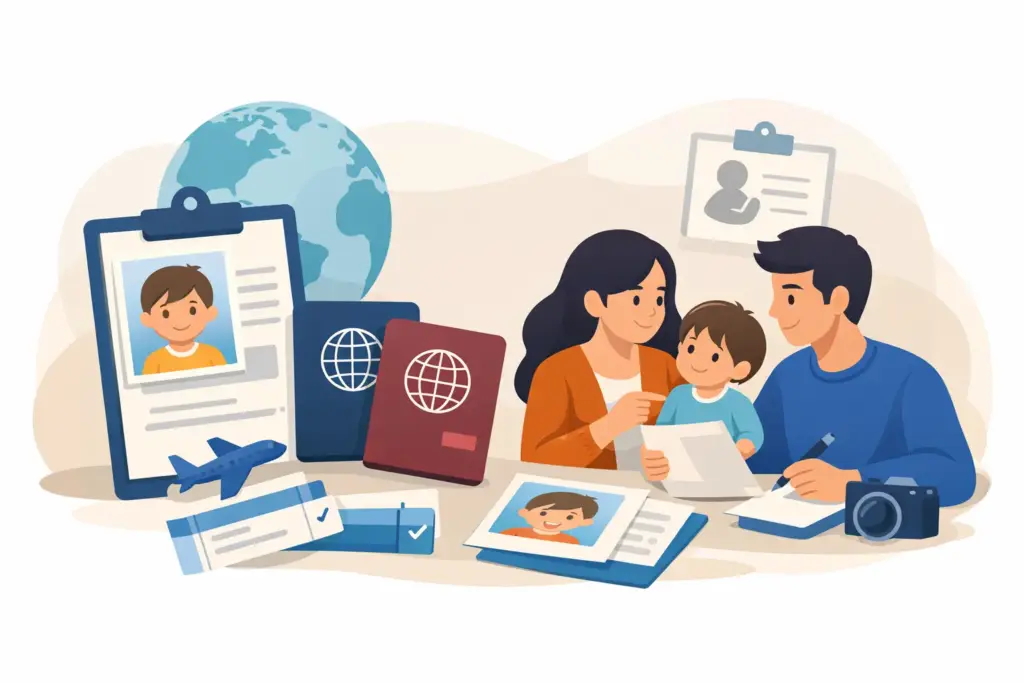
A child’s passport application can stall over one missing photocopy, an expired parent ID, or a consent form signed incorrectly. This guide to child passport documents is built to help parents prepare the correct materials before an appointment or expedited submission, so travel plans stay on track.
For children under age 16, passport rules are more involved than adult renewal rules. A child must apply in person, and both parents or legal guardians generally need to participate. The good news is that the process becomes much more manageable when you organize each document by purpose: the child’s citizenship, the parent-child relationship, parental consent, and identity.
Child Passport Documents: What You Need
A first-time passport for a child under 16 requires Form DS-11, Application for a U.S. Passport. Do not sign the form before the acceptance agent instructs you to do so. The child must appear in person with the parent or parents who are applying.
You will also need evidence of the child’s U.S. citizenship. For most families, this is an original or certified U.S. birth certificate. It must show the child’s full name, date and place of birth, the names of at least one parent, the date the certificate was filed with the registrar’s office, and the issuing authority’s seal or other official certification.
If a birth certificate is not available or does not establish citizenship, other evidence may be accepted, depending on the child’s circumstances. Examples can include a Consular Report of Birth Abroad, a Certificate of Citizenship, or a previously issued full-validity U.S. passport. Requirements can differ based on the document, so do not assume a copy or hospital record will be enough.
Along with citizenship evidence, bring a photocopy of the citizenship document. The copy should be clear and readable. Preparing this ahead of time prevents a last-minute scramble at the acceptance facility.
Proof of Your Relationship to the Child
The document used to prove citizenship often also proves the parent-child relationship. A birth certificate listing the parent or parents applying is the most common example. If names have changed since the document was issued, bring the legal name-change evidence that connects the names, such as a marriage certificate or court order.
For adopted children, guardians, or families with more complex custody arrangements, the required evidence can vary. Adoption decrees, court orders, or other legal documents may be necessary. This is one area where a document review before submission can help identify gaps before they create a delay.
Parent or Guardian Identification
Each applying parent or guardian must present valid identification. A current driver’s license, government employee ID, military ID, or previously issued U.S. passport may be accepted. Bring the original ID and a legible photocopy of the front and back.
If your ID was issued in a different state from where you apply, the acceptance facility may ask for an additional form of identification. If your address, name, or appearance has changed substantially, it is smart to bring supporting documentation rather than leaving the decision to the day of your appointment.
Both Parents Usually Need to Appear
For a child under 16, both parents or legal guardians generally must appear with the child to show consent for the passport issuance. This requirement is designed to protect children and reduce the risk of international parental child abduction.
When both parents can attend, the process is straightforward: bring the child, the completed DS-11, citizenship and relationship evidence, parent IDs and copies, and the passport photo. The acceptance agent will witness the signatures and administer the oath.
Real life is not always straightforward, especially when a parent travels for work, lives in another state, or is unavailable on short notice. In those cases, the right solution depends on the legal and family circumstances.
If One Parent Cannot Attend
If one parent or guardian cannot appear, the attending parent typically needs a completed Form DS-3053, Statement of Consent. The absent parent must sign the form in front of a notary, and the form should be submitted with a photocopy of the front and back of that parent’s ID used during notarization.
Pay close attention to timing. A notarized consent form has a limited validity period, so do not prepare it too far ahead of the application date. Also, a scanned signature, an informal letter, or a text message granting permission will not replace the required consent form.
If the attending parent has sole legal authority to apply, bring the original or certified documentation that proves it. Depending on the situation, this may be a court order granting sole custody, a birth certificate listing only one parent, an adoption decree, or a death certificate for the other parent.
When the other parent cannot be located or consent cannot be obtained, Form DS-5525, Statement of Special Family Circumstances, may be required. This is not a shortcut. Provide as much specific information and supporting evidence as possible, because the State Department reviews these cases individually.
The Passport Photo Must Meet Strict Rules
A child passport application needs one recent color photo that is 2 inches by 2 inches. The photo should be taken within the last six months and show the child clearly against a plain white or off-white background.
Infant photos can be challenging, but the standard still applies. The child should face the camera with eyes open when possible, and no other person should appear in the image. A parent’s hand, a car seat, toys, shadows, filters, and busy backgrounds can cause the photo to be rejected.
Avoid sending a favorite snapshot that has been cropped to size. Passport photos have detailed technical requirements, and a rejection can delay the application even when every other document is correct.
Prepare the Application Without Signing It
Form DS-11 asks for details about the child, parents, travel plans, and contact information. Complete it carefully and make sure the names, dates, and places of birth match the supporting documents exactly.
Do not sign the DS-11 at home. The parent or guardian must sign in front of an authorized passport acceptance agent. Signing too early can mean completing a new form and restarting part of the process.
If your child has had a passport before, bring it with you. Passports issued to children under 16 cannot simply be renewed by mail. The child must apply in person again, even if the prior passport is still in your possession.
A Practical Document Checklist Before You Leave
Before your appointment, place all originals and copies in one folder. You should have the completed but unsigned DS-11, the child’s citizenship evidence and photocopy, proof of parental relationship if needed, each parent’s valid ID and photocopy, one compliant passport photo, and the appropriate consent or custody documentation.
Also confirm your payment method with the acceptance facility. Government passport fees and acceptance fees may be paid separately, and payment rules can vary by location. If you are requesting faster processing, verify the current expedited service option and any supporting travel documentation that may be required for urgent international travel.
When You Need the Child’s Passport Fast
A family trip, school program, medical need, or unexpected international obligation leaves little room for paperwork errors. Expedited service can help, but speed does not overcome an incomplete application, improper consent form, or rejected photo. The fastest path is a clean, complete submission from the start.
Fast Passport Center provides document pre-check and review for families who need additional guidance. Its authorized courier network works through official government-recognized channels with limited in-person passport office submission availability, helping eligible travelers move forward with professional support rather than guessing at each requirement.
Do not wait until the final week before travel to gather birth certificates, custody orders, or a notarized consent form. Some documents take time to replace, and a missing original can become the real bottleneck. Start with the child’s citizenship document, confirm who must appear, and keep every supporting paper together. That preparation gives your family the best chance of receiving the passport without an avoidable delay.