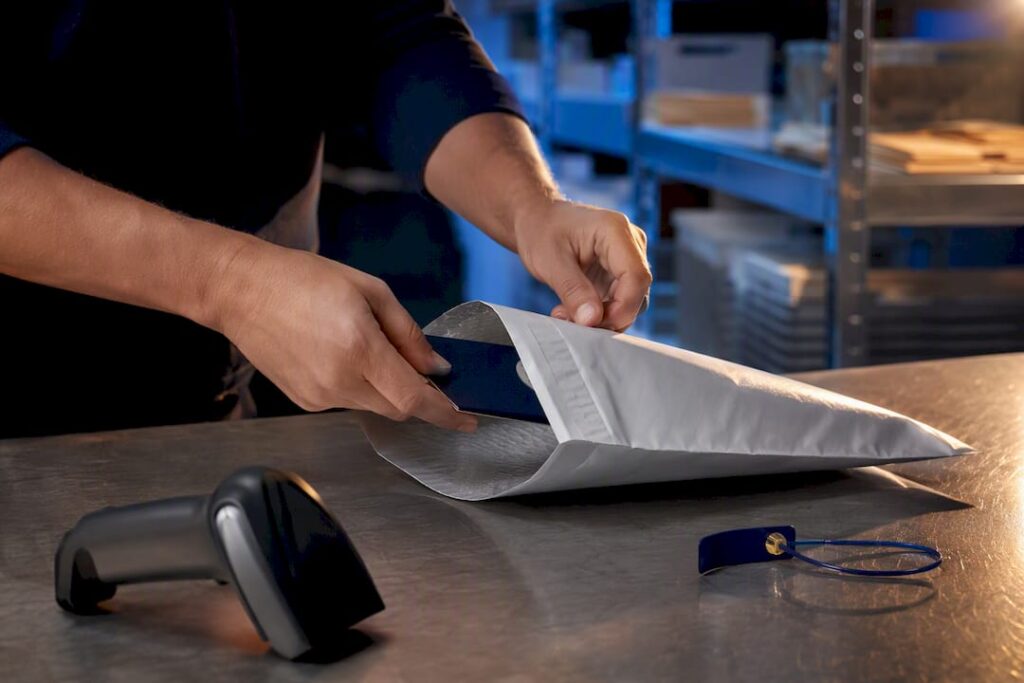
Use a trackable USPS service, either Priority Mail Express or Registered Mail, and rigid tamper-evident packaging. Write your tracking number directly on your passport application, and request signature confirmation whenever your timeline allows. That combination is what the State Department itself recommends, and it remains the safest way to move a passport through the mail in 2026.
TL;DR:
- Priority Mail Express is ideal for urgent applications within a few weeks, offering full tracking, insurance, and a money-back guarantee.
- Registered Mail provides the strictest chain-of-custody, with documented handling and coverage for high-value shipments, but it is slower than express options.
- When shipping internationally, tamper-evident, rigid packaging with waterproof sleeves and cardboard backing ensures protection against water and bending.
- For timelines under two weeks, a registered courier that hand-delivers and monitors progress can be more reliable than standard mail options.
- Always verify the receiving office’s acceptance rules and request signature confirmation to prevent theft or misdelivery at the final stage.
Table of Contents
- Quick Checklist: Best Shipping Choices and When to Pick Each
- When to Use Each Method: Timelines and Acceptance Rules
- How to Package a Passport for Secure Shipping
- Tracking, Signatures, and Chain-of-Custody Best Practices
- Insurance, Claims, and What to Do if a Shipment Is Lost
- Common Packaging and Shipping Mistakes to Avoid
- When to Choose a Registered Courier or Expediter
- Security Protocols Utilized by USPS and Couriers During Passport Shipment
- Recommended Methods to Verify Courier Authenticity and Avoid Scams
- Handling Passport Shipments During Unexpected Delays or Disruptions
- Why This Matters More for Readers Far From an Agency
- Get Your Passport Moving Without the Guesswork
- Sources
- FAQ
Quick Checklist: Best Shipping Choices and When to Pick Each
Not every situation calls for the same service. Here’s how to match your timeline and risk tolerance to the right carrier option:
- Priority Mail Express — the fastest USPS-backed option with full tracking, a money-back guarantee, and $100 of built-in insurance. Best for anyone shipping an application within the next few weeks.
- Priority Mail with signature — a solid choice for routine renewals where you have more breathing room but still want proof of delivery.
- Registered Mail — the strictest chain-of-custody option USPS offers, with documented handling at every stop and coverage for high-value shipments. Slower, but built for security over speed.
- Private couriers (FedEx, UPS, DHL) — appropriate mainly for international returns or when a consulate specifically names them. Confirm acceptance before you ship, since many U.S. passport offices only take incoming applications through USPS.
If you’re staring down a trip within a few weeks, a registered courier service that hand-delivers to the agency often beats waiting on any mail option at all.
When to Use Each Method: Timelines and Acceptance Rules
Your shipping choice depends less on preference and more on math: courier transit time plus the government’s own processing window.
- Routine timeline (4+ weeks out). Standard Priority Mail is usually enough. If you want faster return shipping once your passport is ready, upgrade to Priority Mail Express on the return leg.
- Expedited timeline (2 to 4 weeks out). Expedited processing at the State Department typically runs 2 to 3 weeks, and mailing adds up to two weeks each way on top of that. This is the window where Priority Mail Express or a registered courier makes the real difference.
- Emergency timeline (under 3 days). An in-person visit to a regional passport agency is the only path built for genuine life-or-death travel emergencies. Outside that narrow case, a registered courier that can hand-deliver documents is the practical alternative to a same-day agency appointment you may not even qualify for.
One acceptance rule trips up a lot of people: many application intake points only process incoming mail sent through USPS, not FedEx or UPS. Confirm the receiving office’s rules before you drop off anything with a private carrier.
How to Package a Passport for Secure Shipping
Good packaging prevents two things: bending and water damage. Both can delay processing or get an application bounced back to you.
- Use a rigid envelope or a small box, never a soft paper mailer.
- Never fold the passport, even along an existing crease.
- Slide the passport into a waterproof sleeve, then add a layer of thin cardboard backing.
- Pad the interior with bubble wrap if you’re using a box, so nothing shifts in transit.
- Seal every seam with packing tape, and skip writing “PASSPORT” anywhere on the outside of the package.
- Follow any labeling instructions the State Department lists for your specific expedited mailing method, and include only the documents your application actually requires.
DHL’s own shipping guidance backs this same approach for international document shipments: tamper-evident, rigid, and unmarked.
Pro Tip: Record your tracking number on the application itself wherever the form requests it. If your passport gets separated from its paperwork somewhere in a sorting facility, that number is how a processing office reconnects the two.
Tracking, Signatures, and Chain-of-Custody Best Practices
The final mile is where most document theft happens, not the cross-country transit in between. An unattended porch drop-off is a far bigger risk than a truck getting delayed.
- Request signature confirmation or restricted delivery so the package can’t be left unattended.
- Write the tracking number on your form or consulate submission wherever instructed.
- Choose Registered Mail when you want the most heavily documented chain-of-custody, even though it’s slower than Priority Mail Express.
- Check tracking daily. If scans stop updating for more than 24 to 48 hours, contact the carrier before assuming the worst.
Signature requirements and documented handoffs are the primary defense against misdelivery for a document as valuable as a passport. Speed matters, but an unsigned-for delivery sitting on a stranger’s porch defeats the purpose of paying for expedited shipping in the first place.
Insurance, Claims, and What to Do if a Shipment Is Lost
Priority Mail Express automatically includes $100 of insurance, which rarely covers the real cost of a lost or stolen passport once you factor in replacement fees and delayed travel. Buy additional insurance at the counter if your shipment carries real value.
- File a USPS claim online with your original receipt, tracking number, and proof of value; USPS claims guidance lists the exact documents required.
- Claims typically need to be filed within a set window after the mailing date, so don’t wait to gather paperwork.
- If your application itself was in the lost package, contact the State Department promptly. A lost application can restart your processing clock, which changes your entire timeline.
Common Packaging and Shipping Mistakes to Avoid
Small errors here cause outsized delays. Watch for these:
- Folding the passport or shipping it in a soft, unpadded mailer.
- Forgetting to write the tracking number on the application form.
- Using a carrier the receiving office doesn’t accept for incoming mail, since many application processes require USPS specifically.
- Tossing in unrelated items or cash, which can trigger customs holds or inspection delays, especially on international returns.
- Submitting your own pre-paid return envelope. The State Department explicitly advises against this because it complicates their return process.
When to Choose a Registered Courier or Expediter
Timeline decides this one. If your trip is more than four weeks away, USPS handles it fine. If you’re 2 days to 4 weeks out, a courier or expediting service is the sensible middle ground. Inside 3 days, an in-person regional agency visit is the only option built for that window, and it’s reserved for genuine emergencies.
A registered courier does things USPS can’t: hand-delivery straight to the passport agency, a real review of your forms before submission, a monitored chain-of-custody the whole way through, and daily status updates so you’re not guessing. That’s exactly the gap Fast Passport Center fills for travelers who can’t get to an agency window in time.
- Registered U.S. Department of State courier status
- 20+ years in operation with drop-off offices in 24 cities
- High customer satisfaction reflected in numerous positive reviews
Pro Tip: If you live two or more hours from your nearest regional agency, a courier that hand-delivers your documents removes the drive entirely, along with the appointment scramble.
Security Protocols Utilized by USPS and Couriers During Passport Shipment
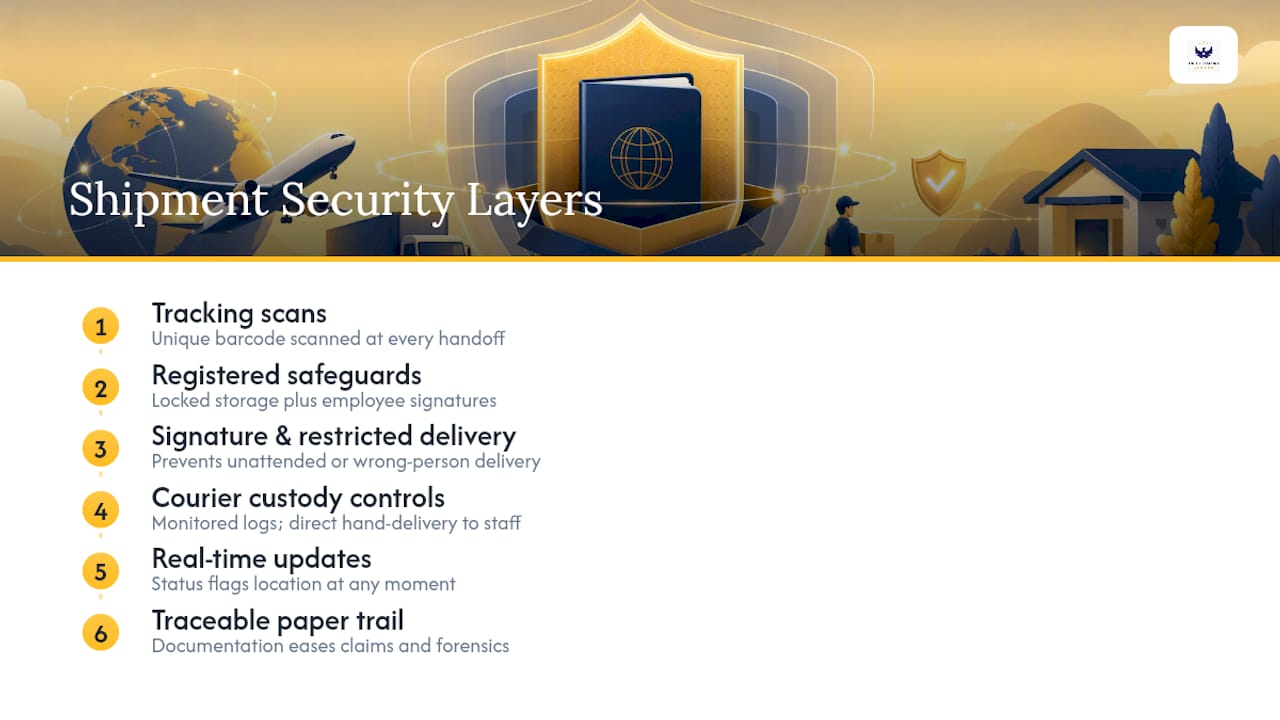
USPS builds security into several layers of the shipping chain. Priority Mail Express and Registered Mail both generate a unique tracking barcode scanned at every facility handoff, creating a documented trail from drop-off to delivery. Registered Mail goes further: it’s kept under lock in a secured cage or safe at each processing point and requires a physical signature from every employee who handles it, which is why it’s the gold standard for high-value mail.
Signature confirmation and restricted delivery add a final layer at the receiving end, preventing the package from being left unattended on a porch or handed to anyone other than the named recipient. Registered couriers operating alongside these USPS services add their own protocols on top: monitored custody logs, direct hand-delivery to agency staff rather than a mail slot, and real-time status updates that flag exactly where a document sits at any given moment.
None of these protocols eliminate risk entirely. Weather delays, staffing gaps, and human error still happen inside even the most secure systems. What they do is create enough documentation and enough friction that theft, tampering, or misdelivery becomes far harder to pull off and far easier to trace if something does go wrong. That paper trail is often what makes the difference in a USPS claims investigation or a courier’s own internal tracking response.
Recommended Methods to Verify Courier Authenticity and Avoid Scams
Passport season brings out scam operators who prey on urgency. A few checks separate a legitimate courier from a risky one.
Start with registration status. A legitimate expediting courier should be able to state plainly that it’s registered to work directly with the U.S. Department of State, not just claim generic “expedited service” with no specifics. Ask directly, and expect a clear answer, not a vague deflection.
Check third-party verification next. A Better Business Bureau rating and a substantial volume of verifiable customer reviews are reasonable signals of a company’s track record. A brand-new website with no review history and no verifiable business registration is a red flag, especially if it’s asking for payment through an unusual channel like a wire transfer or a gift card.
Look at how the company communicates about your documents. A real courier will walk you through form review, give you a tracking number you can independently verify, and provide status updates without you having to chase them down. If a company is vague about where your physical passport is at any point in the process, that’s a problem.
Finally, be wary of anyone promising same-day results for scenarios that don’t legally qualify for that speed, or asking you to send original documents to an address that doesn’t match their registered business location. When in doubt, verify a courier’s claims against your own research before handing over an original passport.
Handling Passport Shipments During Unexpected Delays or Disruptions
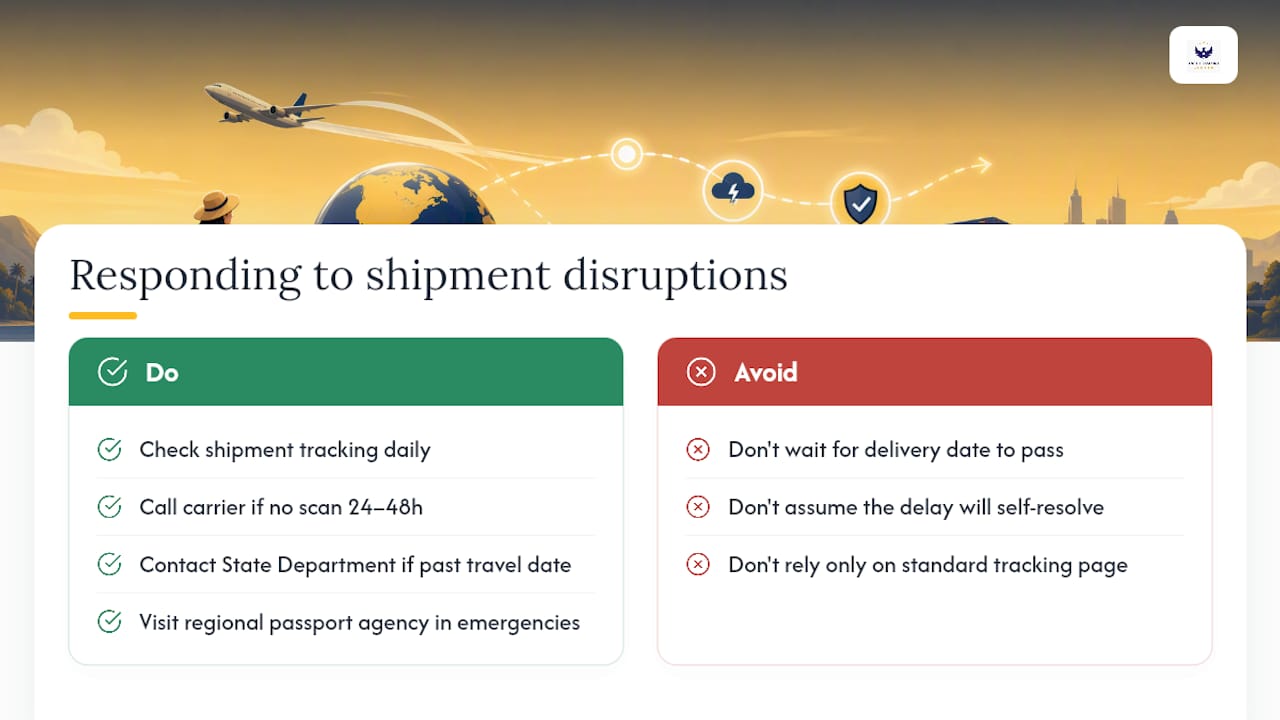
Winter storms, regional strikes, and carrier network disruptions can stall a shipment even when everything was packaged and mailed correctly. The first move is always to check tracking daily rather than waiting for the delivery date to arrive and pass. A shipment that hasn’t scanned in more than 24 to 48 hours warrants a direct call to the carrier, not just a refresh of the tracking page.
If a delay pushes you past your travel date, contact the State Department directly rather than assuming the situation will resolve itself. In genuine emergencies, such as a passport stuck in transit with travel now days away, a regional passport agency visit becomes the appropriate move even for readers who’d otherwise avoid that trip.
For travelers relying on a registered courier during a disruption, one advantage becomes clear: a courier monitoring the shipment can often reroute, escalate, or provide real-time updates in a way that a standard mail tracking page simply can’t. That responsiveness is part of why courier services exist for time-sensitive situations in the first place, particularly when the disruption hits during an already-tight expedited window. Weather and labor disruptions are unpredictable by nature, but how quickly you notice and respond to a stalled shipment is entirely within your control.
Why This Matters More for Readers Far From an Agency
If you’re two or more hours from a regional agency in a city like Tampa, Charlotte, Sacramento, Nashville, or Louisville, the packing checklist and monitoring steps above aren’t optional extras. They’re your entire safety net. When your travel date lands inside that 2-day to 4-week window, don’t default to a long drive and an uncertain appointment. Follow the timeline thresholds, pack rigidly, track daily, and lean on a courier when the calendar gets tight.
— Andy Irons
Get Your Passport Moving Without the Guesswork
Shipping your own application through USPS works fine when your travel date is a month or more away. When it’s not, Fast Passport Center is the alternative to a slow post-office queue: a registered U.S. Department of State courier that hand-delivers your documents, reviews your forms for errors before submission, and gives you tracking updates the whole way through, instead of a single tracking number and silence.
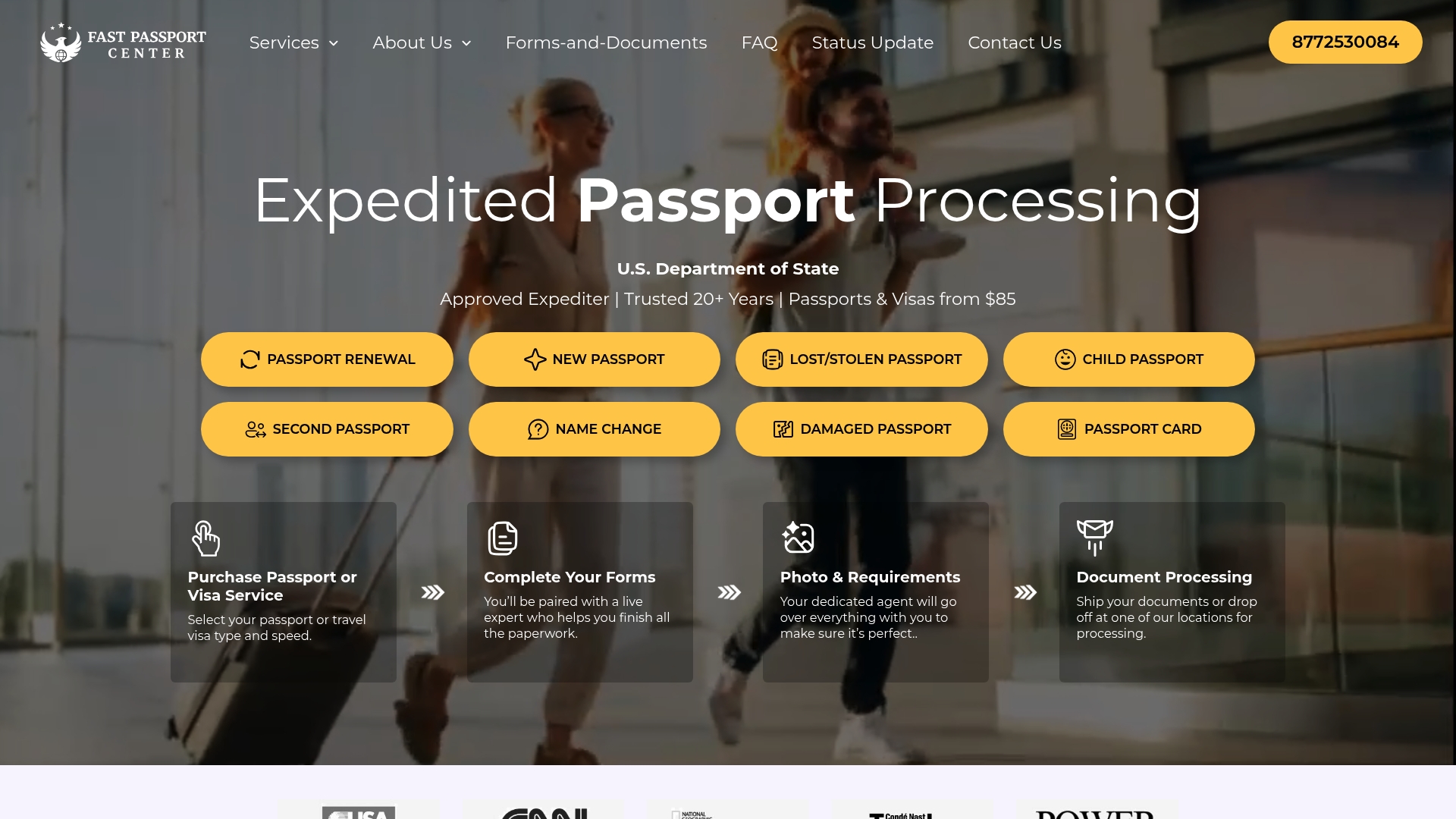
This matters most if you’re sitting in Tampa, Charlotte, Sacramento, Nashville, Louisville, or any city far from a regional agency, with a trip landing inside the next few weeks. Rather than driving hours for an uncertain appointment slot, you get expert guidance on which service fits your exact timeline, whether that’s a renewal, a new passport, or an emergency situation with days to spare. Start by requesting a quote through the expedited passport service page and get a clear answer on turnaround before you commit to anything.
Sources
- Get Your Passport Fast – Travel – State Department
- Top Tips for Sending Your Passport and Documents in 2026
FAQ
What Is the Safest Way to Ship a Passport?
The safest method is a trackable USPS service, Priority Mail Express or Registered Mail, combined with rigid packaging and signature-on-delivery. This gives you documented tracking, insurance, and a verified handoff at delivery, which together close the biggest gaps that lead to lost or stolen shipments.
Where Do U.S. Passports Get Shipped From?
Domestic passport applications and renewals are processed and shipped through State Department passport agencies and centers, typically returned to applicants via USPS. Expedited orders may also be hand-delivered by registered couriers like Fast Passport Center that work directly with issuing agencies.
Is It Safe to Send a Passport by Mail?
Yes, when you use a trackable, signature-required service and rigid, tamper-evident packaging. The main risks are an unattended delivery drop-off or a bent or water-damaged document, both of which the packaging and signature steps above are designed to prevent.
Is FedEx or UPS Better Than USPS for Passport Renewal?
Neither is generally better, because many receiving offices only accept incoming applications through USPS. Confirm acceptance rules before choosing a private carrier, and default to USPS Priority Mail Express unless a consulate or agency states otherwise.
Do You Need to Sign for Passport Delivery?
Signature confirmation isn’t always mandatory, but it’s strongly recommended for any passport shipment. It prevents an unattended drop-off, which is the point in transit where most document theft actually happens.
When Should I Use a Courier Instead of USPS?
If your travel date falls between 2 days and 4 weeks out, a registered courier is usually the more practical choice over standard mail. Services like Fast Passport Center hand-deliver documents directly to the agency and monitor the process, which matters most for travelers who live far from a regional office.