
Form DS-3053, officially titled the Statement of Consent: Issuance of a U.S. Passport to a Child, is the notarized document the U.S. Department of State requires when one or both legal parents or guardians cannot appear in person with a child applying for a U.S. passport. The child passport parental consent form DS-3053 is not optional — without it, the acceptance facility will turn you away. Here is what you need to do right now:
- Download the official DS-3053 PDF from eforms.state.gov. Do not use any other source.
- Do not sign the form until you are standing in front of a notary public or passport-authorizing officer.
- Bring your government-issued photo ID to the notary and attach a clear photocopy of the front and back of the same ID to the completed form.
- Submit the original notarized DS-3053 with Form DS-11 within 90 days of the notarization date.
- Gather supporting documents: original DS-3053, ID photocopy, Form DS-11, proof of U.S. citizenship, evidence of relationship, parental IDs, and a passport photo.
Key Takeaways
Form DS-3053 must be notarized, submitted within 90 days, and accompanied by a front-and-back photocopy of the ID the consenting parent showed the notary — errors on any of these three points are the leading causes of child passport delays.
| Point | Details |
|---|---|
| Official form source | Download DS-3053 only from eforms.state.gov or travel.state.gov. |
| Do not sign early | The consenting parent must sign only in front of a notary or passport officer. |
| Attach the ID photocopy | Include a front-and-back copy of the exact ID shown to the notary. |
| 90-day validity window | Submit within 90 days of notarization or restart the entire process. |
| Fast Passport Center | Offers document review, courier delivery, and expedited filing for travel within 2–4 weeks. |
This article is general information, not a substitute for advice from a qualified lawyer. Consult a qualified legal professional about your own circumstances before acting on anything here.
Table of Contents
- What is Form DS-3053 and when do you need it?
- Where do you get the official DS-3053 form?
- How do you complete DS-3053, step by step?
- What are the notarization requirements for DS-3053?
- What documents do you submit with Form DS-11?
- What if you can’t get the other parent’s consent?
- Common mistakes that cause delays
- How does the 90-day validity rule affect your timeline?
- How Fast Passport Center helps with child passport applications
- Why getting DS-3053 right the first time matters more than you think
- Fast Passport Center: expert help when your child’s passport can’t wait
- Sources
- FAQ
What is Form DS-3053 and when do you need it?
Form DS-3053 is the U.S. Department of State’s official mechanism for obtaining the non-applying parent’s or guardian’s consent when they cannot stand beside the child at the passport acceptance facility. Every child under 16 applying for a U.S. passport must have both parents’ or guardians’ consent — either in person or through this notarized form.
The most common scenario is straightforward: one parent takes the child to the acceptance facility while the other parent, unable to attend, completes and notarizes DS-3053. But the form also applies when a third party (a grandparent, aunt, or legal guardian) is submitting the application on the child’s behalf, or when both parents are absent and a legal guardian is acting alone.
Two related forms are worth knowing. Form DS-11 is the actual U.S. passport application for the child — DS-3053 travels with it, never replaces it. Form DS-5525 (Statement of Exigent/Special Family Circumstances) is the alternate path when the non-applying parent’s consent genuinely cannot be obtained. If the absent parent is abroad and a local notary is not accepted in that country, the U.S. embassy or consulate provides notarial services and may require DS-3053 to be executed there.
Where do you get the official DS-3053 form?
The only authoritative source is the U.S. Department of State’s own forms portal. Download the official DS-3053 PDF directly from eforms.state.gov or through travel.state.gov. Third-party versions circulate online, and some are outdated — using one risks an immediate rejection.
Printing rules matter. Print single-sided only; a double-sided printout is a common and entirely avoidable rejection trigger. Use black ink, and either type directly into the fillable PDF or print legibly by hand. The physical notarized page is the “original” — scanned or photocopied versions of the completed form are generally not accepted except in emergency travel situations. If you are applying through a courier service, confirm the document-handling requirements before you mail anything.
Pro Tip: Print two blank copies before you start filling in the form. If you make an error on the first, you have a clean backup ready — the instructions are clear that you must start fresh rather than cross out or correct any field.
How do you complete DS-3053, step by step?
The DS-3053 instructions divide the form into four sections. Complete them in order, and stop before you reach the signature line.
-
Section 1 — Child’s information. Enter the minor’s full legal name exactly as it appears on Form DS-11. Include the child’s date of birth and place of birth. Any mismatch between DS-3053 and DS-11 will flag the application for review.
-
Section 2 — Applying parent or guardian. Identify the adult who will appear in person with the child at the acceptance facility. This is the person who is not completing DS-3053.
-
Section 3 — Consenting parent or guardian. This is where the non-applying parent fills in their own name, address, phone number, and relationship to the child. They also indicate whether they are consenting to a passport book, a passport card, or both. If consent covers only a book, the card cannot be issued without a separate consent process, and vice versa.
-
Section 4 — Oath and signature. Stop here. The consenting parent must sign this section only in the physical presence of a notary public or passport-authorizing officer. The notary then completes the notarization block (sometimes labeled Section 5 on printed versions), entering their commission details and dating the form to match the signature date.
Pro Tip: Fill every field, even those that seem optional. Acceptance agents are trained to flag incomplete forms, and a blank field can prompt a request for clarification that delays your appointment.
What are the notarization requirements for DS-3053?
Notarization is where most DS-3053 problems originate. The rules are specific, and a notary who skips even one step can invalidate the entire form.
The consenting parent must sign Section 4 in the notary’s physical presence. The notary then completes the notarization block, affixes their seal, and dates the form. The date on the notarization block must match the date the affiant signed — a discrepancy, even by one day, is grounds for rejection. The notary cannot be related to the consenting parent.
ID photocopy requirement. After the notary witnesses the signature, attach a clear photocopy of the front and back of the same government-issued photo ID you presented to the notary. A driver’s license or U.S. passport works. This photocopy becomes part of the passport application record and allows the acceptance agent to verify the non-applying parent’s identity independently.

Electronic notarization is accepted, but only when it is valid under the law of the state where the notarization occurs. You must bring a printed copy of the electronically notarized form to the acceptance facility. Confirm acceptance with your specific facility before relying on this option — policies vary.
If the consenting parent is abroad, some countries require DS-3053 to be notarized at a U.S. embassy or consulate rather than by a local notary. U.S. embassies and consulates provide notarial services, and consular officers may request additional evidence if a local notary was used instead. When in doubt, use the embassy — it eliminates the risk of a rejected notarization entirely. For parents exploring remote notarization options, online notary services can provide guidance on whether electronic notarization meets your state’s requirements.
Pro Tip: Ask the notary to initial the ID photocopy at the time of notarization. When the acceptance agent reviews your packet, that initialed copy makes the identity verification immediate and unambiguous.
What documents do you submit with Form DS-11?
When you arrive at the passport acceptance facility, the applying parent must present a complete packet. Missing a single item typically means a second trip.
| Document | Notes |
|---|---|
| Form DS-11 (unsigned) | The child’s passport application; do not pre-sign |
| Proof of U.S. citizenship | Original birth certificate or naturalization certificate |
| Evidence of relationship | Birth certificate showing parental relationship, or adoption decree |
| Applying parent’s photo ID | Original plus front-and-back photocopy |
| Passport photo | Meets State Department specifications |
| Original notarized DS-3053 | Must be within 90 days of notarization |
| ID photocopy (non-applying parent) | Front and back of the ID shown to the notary |
When only one parent appears and DS-3053 is not available, the Department of State accepts specific alternatives: a death certificate for the absent parent, a certified court order granting sole custody, or Form DS-5525 for special circumstances. Each alternative must be an original or certified copy — photocopies of court orders are not sufficient. For a full breakdown of which passport form applies to your child’s situation, the DS-11 vs. DS-82 guide clarifies the distinction clearly.
What if you can’t get the other parent’s consent?
Not every family situation allows the non-applying parent to complete DS-3053 on schedule. The Department of State has structured pathways for each scenario.
- Sole custody. A certified court order explicitly granting one parent sole legal authority to apply for the child’s passport removes the need for DS-3053 entirely. Bring the original certified order, not a photocopy.
- Death of the absent parent. A certified death certificate substitutes for DS-3053. The certificate must be an official government-issued document.
- Unable to locate or contact the other parent. Complete Form DS-5525, which requires a detailed written statement of your efforts to reach the non-applying parent. Supporting evidence strengthens the application: incarceration records, restraining orders, documented attempts to contact, or a social worker’s statement.
- Exigent circumstances. DS-5525 also covers urgent travel situations where obtaining consent in time is genuinely impossible. The acceptance agent will review the circumstances and may request additional documentation.
The acceptance facility has discretion to ask for more evidence than you initially provide. Arriving with more documentation than you think you need is always the right call. For guidance on child passport requirements in special custody situations, Fast Passport Center’s resource page covers the most common scenarios in detail.
Common mistakes that cause delays
Most DS-3053 rejections trace back to a short list of preventable errors. Knowing them in advance is the simplest quality-control step available to you.
Signing before the notary is the single most frequent problem. The form is explicit: the consenting parent’s signature must happen in the notary’s presence. A pre-signed form is invalid, full stop. The notary cannot backdate the notarization to fix it.
Missing or mismatched ID photocopies are the second most common issue. The photocopy must be of the exact ID presented to the notary — not a different ID, not an expired one. If the ID shown to the notary was a driver’s license, the photocopy must be of that driver’s license, front and back.
Double-sided printing, an incomplete notarization block (where the notary omitted their commission number or seal), and submitting a scanned copy instead of the original round out the list. One more timing error deserves emphasis: an expired DS-3053. The form is valid for exactly 90 days from the notarization date. Acceptance facilities will reject a form older than 90 days, requiring the entire notarization process to start over.
How does the 90-day validity rule affect your timeline?
DS-3053 is valid for 90 days from the date of notarization. Plan your notarization date so the form remains valid through your expected submission date, with a buffer for any scheduling delays.
| Travel Timeline | Recommended Filing Path |
|---|---|
| Within 3 days | Regional passport agency (in-person appointment required) |
| 2 days to 4 weeks | Expedited courier service (e.g., Fast Passport Center) |
| 4+ weeks | USPS post office routine filing |
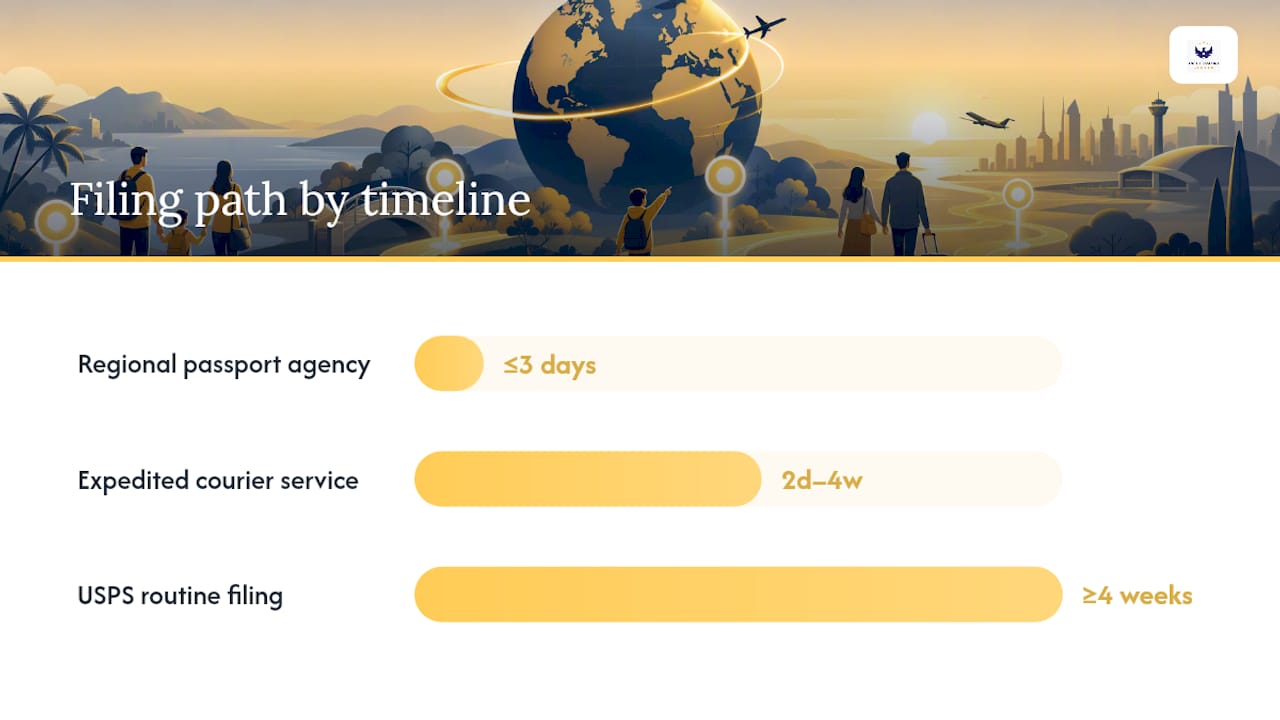
If your notarized DS-3053 expires before you submit the application — because of a scheduling delay or a document error that required correction — the non-applying parent must complete and notarize a fresh form. There is no grace period. For parents living in cities like Tampa, Charlotte, Sacramento, Nashville, or Louisville, where the nearest regional passport agency may be two or more hours away, a courier service is often the most practical option for the 2-to-4-week window. The child passport application process guide walks through the full timeline in detail.
How Fast Passport Center helps with child passport applications
Fast Passport Center is a U.S. Department of State-registered passport courier with over 20 years of experience, 24 drop-off offices nationwide, an A+ rating from the Better Business Bureau, and more than 14,000 positive reviews. For parents navigating DS-3053 for the first time, the practical support matters as much as the courier service itself.
- Document review. Agents review your DS-3053 packet before submission to catch notarization errors, missing ID photocopies, and incomplete fields — the exact mistakes that cause most child passport delays.
- Courier delivery. Fast Passport Center hand-delivers your application directly to a passport agency, bypassing the standard mail queue.
- Expedited filing. For travel within 2 to 4 weeks, expedited processing through a registered courier is the most reliable option for parents who cannot access a regional agency in person.
- Appointment and scheduling support. Agents guide you through the acceptance facility appointment process and confirm what to bring.
Parents more than two hours from a regional passport agency — and those with travel dates inside the next four weeks — get the most direct benefit from this service. The minor passport application guide explains exactly what the acceptance facility will check and how Fast Passport Center’s review process aligns with those requirements.
Why getting DS-3053 right the first time matters more than you think
The DS-3053 process looks simple on paper. One form, one notary, one photocopy. In practice, the margin for error is narrow, and the consequences of a mistake fall entirely on the child’s travel timeline.
What I see repeatedly is that parents treat the notarization as a formality — something to check off quickly at a bank or UPS store — rather than as the legally consequential step it is. A notary who does not complete their block fully, or a parent who signs the form at home before driving to the appointment, creates a problem that cannot be fixed at the acceptance facility. The form goes back. The notarization has to be redone. If the 90-day window is tight, the whole timeline collapses.
The parents who avoid this are the ones who treat the document review as seriously as the notarization itself. Verify the notary’s block before you leave the notary’s office. Confirm the ID photocopy matches. Check the date. These are 60-second steps that protect weeks of planning.
Fast Passport Center: expert help when your child’s passport can’t wait
When your child’s passport application is time-sensitive, the difference between a smooth process and a stressful one often comes down to whether your DS-3053 packet is complete before you walk into the acceptance facility.
Fast Passport Center’s expedited passport service gives parents traveling within 2 to 4 weeks a concrete alternative to the standard mail process. Experienced agents review your DS-3053 and supporting documents for errors before submission, courier your application directly to a passport agency, and keep you updated in real time. You pay the government fees separately; Fast Passport Center’s service fee covers the document review, courier delivery, and agent support that prevent the delays most families encounter on their own. Visit Fastpassportcenter to start your child’s passport order and get your documents reviewed by an agent today.
Sources
- Apply for a Child’s Passport Under 16
- STATEMENT OF CONSENT: U.S. PASSPORT ISSUANCE TO A CHILD (DS-3053)
- DS-3053 – U.S. Embassy & Consulates in India
FAQ
Where do I get the DS-3053 form?
Download the official DS-3053 PDF directly from eforms.state.gov or travel.state.gov. Do not use third-party sites, as outdated versions are common and will be rejected.
Can I fill out DS-3053 online and sign it digitally?
You can type into the fillable PDF, but you cannot sign it digitally for standard submissions. The consenting parent must sign in front of a notary; electronic notarization is accepted only when valid under state law, and a printed copy must be presented at the acceptance facility.
Do both parents need to sign for a child’s passport?
Both parents must provide consent, but only one needs to sign DS-3053. The applying parent appears in person with the child; the non-applying parent completes and notarizes DS-3053, or provides an accepted alternative such as a death certificate, sole-custody court order, or Form DS-5525.
How do I fill out DS-3053 correctly?
Complete Sections 1 through 3 with the child’s information, the applying parent’s name, and the consenting parent’s details and consent scope (book, card, or both). Stop at Section 4 and sign only in front of a notary. Attach a front-and-back photocopy of the ID you showed the notary, and submit the original within 90 days of notarization.
What happens if my DS-3053 expires before I submit the application?
The acceptance facility will reject a DS-3053 older than 90 days from its notarization date. The non-applying parent must complete and notarize a new form. If your timeline is tight, Fast Passport Center’s expedited service can help you submit quickly and avoid that window closing.