
Notarized parental consent documents prove that a parent actually authorized a minor’s travel, medical care, or supervised activity, and they are required or strongly requested by many airlines, hospitals, schools, and foreign border officials. The notarization itself does not create custody rights or validate legal authority; it simply provides authenticated proof that the signature is genuine, the signer was willing, and the act occurred on a specific date. Two steps to take right now: confirm what the receiving authority (airline, embassy, hospital, or school) specifically requires, and get the form notarized if there is any doubt.
Table of Contents
- When is notarized parental consent actually needed?
- Why notarization matters to schools, hospitals, and border agents
- What to include on a parental consent form
- Is notarization legally required, or just strongly recommended?
- How to get a parental consent form notarized
- When you need an apostille or additional legalization
- Common problems parents run into at airports, hospitals, and schools
- Key Takeaways
- When to err on the side of notarization
- Fast Passport Center helps when notarized consent meets urgent passport timelines
- Authoritative sources to check next
- FAQ
When is notarized parental consent actually needed?
The situations that call for a notarized consent form are more varied than most parents expect. Here are the most common ones:
- International travel with one parent absent. Many countries and airlines require written, notarized permission from the non-traveling parent before a child boards.
- A child traveling with another adult. When a grandparent, coach, or group leader accompanies a minor without either parent present, a notarized letter is frequently required at the border.
- Single-parent travel. Even when one parent has sole custody, border agents may request documentation proving it.
- School overnight trips and high-risk activities. Many schools and activity organizers request notarized forms to reduce institutional liability.
- Non-emergency medical care. Routine and elective pediatric procedures commonly require formal parental permission, and providers often prefer notarized forms to reduce liability.
- Temporary guardianship. When a child stays with relatives for an extended period, a notarized authorization allows the caregiver to make day-to-day decisions.
- Form DS-3053 for child passport applications. When one parent cannot appear in person at the passport acceptance facility, the U.S. Department of State requires DS-3053, a notarized Statement of Consent, to complete the application.
The practical dividing line is this: for routine domestic situations, a notarized form is often optional but advisable. For international travel and passport applications, it is frequently required, and arriving without one can mean a denied boarding or a turned-away child at the border.
Why notarization matters to schools, hospitals, and border agents
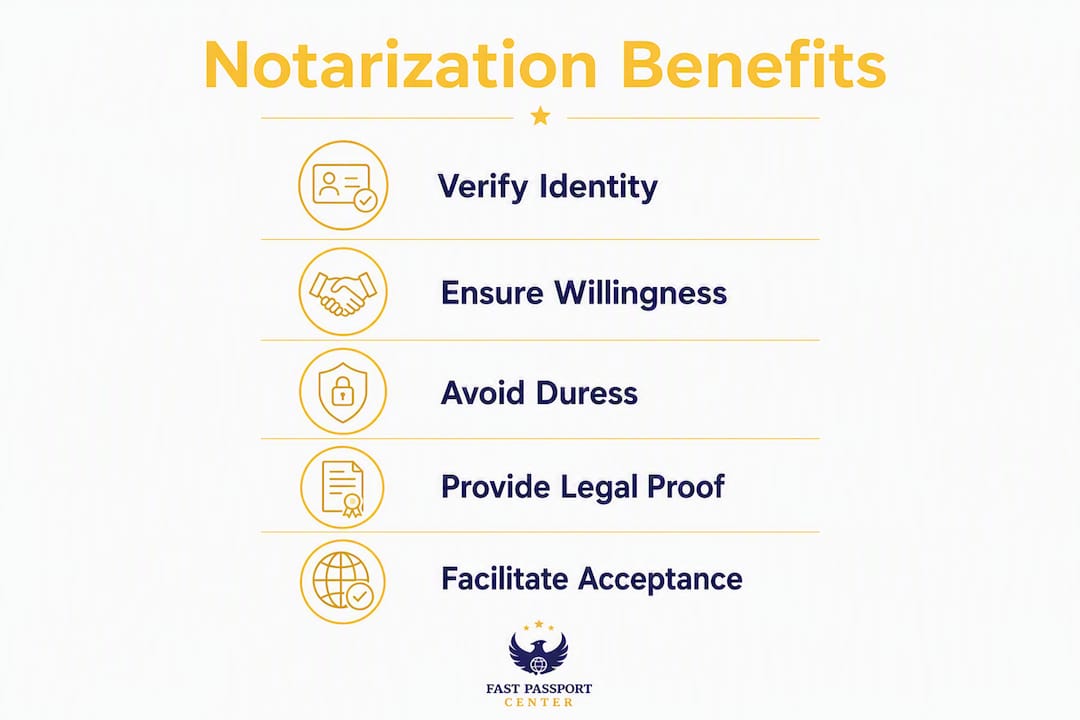
Notarization verifies three core pillars: the signer’s identity, their willingness to sign without duress, and their understanding of the document’s contents. The National Notary Association describes notarization as a fraud-deterrent process built on exactly those three checks. That framework is why a hospital administrator, school official, or border officer can accept a notarized document at face value without conducting their own investigation.

The evidentiary value is real and practical. A notarized consent form carries prima facie proof that the signature is authentic and that the act occurred on a recorded date. That makes it far easier for an institution to act quickly, which is why notarized documents reduce uncertainty and speed institutional acceptance in ways that a plain signature simply cannot.
One misconception is worth addressing directly. A notary’s seal does not validate the legal authority behind a signature. A non-custodial parent who signs a notarized consent form has still only provided an authenticated signature, not a legally enforceable custody grant. If custody or legal authority is genuinely in dispute, court orders or guardianship documents are what matter, and legal counsel is the right path forward.
Pro Tip: Carry the notarized original to every appointment. Border agents and hospital admissions staff can verify it in seconds, which often prevents the kind of hold-up that a plain photocopy or a digital scan cannot resolve on its own.
What to include on a parental consent form
A well-drafted consent form covers every detail the receiving authority needs to act without calling you. Use this checklist:
- Child’s full legal name and date of birth
- Full names, addresses, and contact information for both parents or guardians
- Full name and relationship of the authorized adult (the person traveling with or caring for the child)
- Specific permissions: travel dates and destinations, medical treatments authorized, or activities covered
- References to supporting documents: passport number, birth certificate number, or custody order case number
- Statement of consent scope and duration (e.g., “for the period of July 1 through July 15, 2026”)
- Signature blocks for each parent or guardian, with space for the notarial certificate and date
For travel, a sample consent statement might read:
For medical authorization, a short version works well: “I, [Parent Full Name], authorize [Authorized Adult’s Full Name] to consent to routine and non-emergency medical treatment for my child, [Child’s Full Name], DOB [DOB], during the period [Start Date] through [End Date].”
Attach copies of the child’s birth certificate, both parents’ government-issued photo IDs, and any relevant custody or court orders. The notary will not review those documents for legal sufficiency, but the receiving authority may ask for them.
Is notarization legally required, or just strongly recommended?
Notarization is not universally required under U.S. federal law for most domestic situations. For international travel and passport applications, however, it is effectively required in many cases. USA.gov recommends that consent letters be written in English and notarized, and U.S. Customs and Border Protection notes that certain countries require letters, “in some cases notarized.” The practical rule: treat notarization as mandatory for international itineraries and nearly mandatory for DS-3053 passport consent.
Before travel or a scheduled procedure, confirm requirements with each of the following:
- The airline. Call customer service and ask specifically about their policy for unaccompanied minors or minors traveling with one parent.
- The destination embassy or consulate. Requirements vary significantly by country; check the embassy’s official website or call directly.
- The school or activity organizer. Ask for their written policy on consent forms and whether notarization is required.
- The pediatrician or hospital admissions office. For non-emergency procedures, ask what form they use and whether they require notarization.
- Your state’s Secretary of State office. If you plan to use Remote Online Notarization (RON), confirm your state permits it and whether the receiving authority accepts electronically notarized documents.
| Authority | What to check |
|---|---|
| U.S. Department of State | DS-3053 requirements for child passport consent when one parent cannot appear |
| USA.gov | Recommends notarized letters in English for children traveling internationally |
| U.S. Customs and Border Protection (CBP) | Destination-country requirements; notes notarization required “in some cases” |
| Government of Canada | Strongly recommends a notarized letter for children entering Canada with one parent or a non-parent adult |
How to get a parental consent form notarized
You must appear before the notary (or use an approved RON platform) so the notary can verify your identity and witness or acknowledge your signature. Do not sign the form in advance unless the form uses an acknowledgment and your state permits prior signing under that act.
In-person notarization:
- Fill out the form completely but leave the signature line blank.
- Bring a valid government-issued photo ID for each signer (passport, driver’s license, or state ID).
- Bring any copies you want attached to the notarized document.
- Tell the notary which notarial act the receiving party requires. The form’s notarial block or the receiving party’s instructions control whether an acknowledgment or a jurat is needed; the notary can explain the difference but cannot choose for you.
- Sign in the notary’s presence, pay the notary fee, and receive the completed, sealed document.
Remote Online Notarization (RON):
- Confirm your state permits RON; rules vary by state, so check your state Secretary of State’s website.
- Choose a credentialed RON platform that meets your state’s technical requirements.
- Complete the platform’s identity-proofing steps, which typically include ID document scans and knowledge-based authentication questions.
- Conduct the notarial act via live video session with the notary.
- Receive an electronically notarized document or a printed version with the notary’s acknowledgment.
Pro Tip: Before relying on a RON document for international travel, confirm the airline, embassy, or border authority accepts electronically notarized forms. Some institutions still insist on an original ink-and-seal copy.
When you need an apostille or additional legalization
An apostille is required when the destination country is a member of the Hague Apostille Convention and needs official authentication beyond a notary seal. For countries outside the Convention, embassy legalization is the alternative process.
- Check the destination country’s embassy website to confirm whether an apostille or legalization is required, and whether it applies to parental consent letters specifically.
- Have the document notarized first; the apostille certifies the notary’s authority, not the document’s content.
- Submit the notarized document to your state’s Secretary of State office for an apostille, or to the U.S. Department of State Office of Authentications for federal-level legalization when required.
- Allow extra time: apostille processing can add several days to several weeks depending on the state and submission method.
Not every country or airline requires an apostille on a parental consent letter. Some accept a notarized document without further authentication. Confirm with the destination embassy before you start the apostille process, since the added time and cost are only justified when it is genuinely required.
Common problems parents run into at airports, hospitals, and schools
Most delays and denials trace back to a small set of avoidable mistakes:
- Unsigned or incomplete forms. A form missing a signature or a required field will be rejected outright.
- Missing supporting documents. Border agents and hospital admissions staff often ask for the child’s birth certificate and copies of parents’ IDs alongside the consent letter.
- Outdated forms. Notarial acts do not legally expire, but institutions commonly question documents older than 12 months due to changed circumstances. Refreshing consent forms annually is standard practice.
- Vague scope or missing dates. A form that says “permission to travel” without specifying destinations and dates gives border agents little to work with.
- Missing custody documentation. When a parent has sole custody or a court order governs travel, failing to carry that documentation alongside the consent form creates delays even when the notarized letter is present.
- RON documents rejected by the institution. Some embassies, airlines, and hospitals still require original ink-and-seal notarization and will not accept electronically notarized documents.
At airports, border agents may ask for a notarized letter even when the airline did not. Hospitals treating a child for non-emergency care will typically require parental permission; under federal EMTALA rules, emergency stabilization proceeds regardless of consent, but routine and elective procedures do not carry that exception. Schools and activity organizers running overnight trips or high-risk activities almost always require written permission and increasingly request notarization.
Pro Tip: Carry the original notarized document and keep a high-quality digital scan accessible on your phone. If the original is lost in transit, the scan gives you something to show while you resolve the situation. Update the form periodically to ensure it reflects current circumstances when your child travels regularly.
Key Takeaways
Notarized parental consent provides authenticated proof of a parent’s permission and is required or strongly recommended for international travel, child passport applications (DS-3053), and many non-emergency medical and school situations.
| Point | Details |
|---|---|
| Confirm requirements first | Check with the airline, embassy, hospital, or school before assuming notarization is optional. |
| DS-3053 is mandatory for child passports | When one parent cannot appear at the passport facility, the U.S. Department of State requires a notarized DS-3053. |
| Refresh forms annually | Institutions commonly reject consent documents older than 12 months; update them regularly. |
| RON acceptance varies | Confirm the receiving authority accepts electronically notarized documents before using RON for international travel. |
| Fast Passport Center for urgent timelines | If a notarized consent reveals a passport problem, use a courier/expediting service for travel 2 days–4 weeks out, or a regional agency only if departure is within 3 days. |
When to err on the side of notarization
Most parents underestimate how much institutional friction a notarized document removes. The question I hear most often is: “Do I really need to notarize this?” My honest answer is almost always yes, especially for international travel and for any medical procedure where another adult will be making decisions on your child’s behalf.
The legal threshold and the practical threshold are different things. A plain signature may technically satisfy the law in some domestic situations, but a notarized form is what actually gets a border agent to wave you through or a hospital administrator to proceed without a phone call to legal. That operational reality matters more than the fine print.
The timing piece is where parents most often get caught off guard. Discovering that your child needs a passport, or that the existing one is expired, after you have already arranged notarized consent is a stressful sequence. The smarter approach is to review both the consent documentation and the passport status at the same time, well before departure. If a passport issue surfaces, the timeline determines your options, and waiting rarely improves them.
Fast Passport Center helps when notarized consent meets urgent passport timelines
When a notarized consent form surfaces a passport problem, the clock matters as much as the paperwork. Fast Passport Center is a U.S. Department of State registered passport courier with extensive experience and multiple drop-off offices in cities convenient to parents who cannot easily reach a regional passport agency.
For parents who need a child passport alongside their notarized consent, Fast Passport Center handles DS-3053 document checks, courier hand-delivery to passport agencies, and expert form assistance so nothing gets sent back for a correction. The timeline guidance is straightforward: use a regional agency only if departure is within 3 days; use an expedited courier service for travel 2 days–4 weeks out; use USPS for travel more than 4 weeks away. If your trip falls in that 2-to-4-week window and you are not near a regional agency, Fast Passport Center is the practical solution. Visit FastPassportCenter.com to start your application and get your child’s passport moving today.
Authoritative sources to check next
Use these primary sources to confirm the specific rules for your situation:
| Authority | What to check on their site |
|---|---|
| U.S. Department of State | DS-3053 requirements and child passport consent rules |
| USA.gov — Travel Documents for Children | Recommended format for consent letters and apostille guidance |
| U.S. Customs and Border Protection (CBP) | Destination-country consent requirements for minors |
| National Notary Association (NNA) | Notary verification standards and fraud-deterrent framework |
| State Secretary of State office | Apostille processing and RON availability in your state |
| Destination country embassy or consulate | Whether an apostille or legalization is required for your consent letter |
For questions about which notarial act your form requires, a professional notary or document preparation service can review the form’s notarial block and guide you through the correct process before you sign.
FAQ
What is notarized parental consent?
Notarized parental consent is a written authorization from a parent or guardian, signed before a notary public, that grants permission for a minor to travel, receive medical care, or participate in a supervised activity. The notary verifies the signer’s identity, willingness, and understanding of the document.
Does a parental consent form need to be notarized?
Notarization is not required by U.S. federal law for most domestic situations, but it is required for Form DS-3053 in child passport applications and is strongly recommended or required by many airlines, foreign border authorities, and medical providers for international travel and non-emergency care.
What does a notary actually verify on a consent form?
A notary verifies three things: the signer’s identity through government-issued photo ID, that the signer is acting willingly and without duress, and that the signer understands the document being signed. The notary does not assess the legal authority behind the signature.
Can a notarized consent letter substitute for a custody order?
No. A notarized letter documents a parent’s statement but does not substitute for a court order or guardianship document. When custody or legal authority is in dispute, the correct route is legal counsel and official court documentation, not a notarized letter alone.
How long does it take to get a consent form notarized?
In-person notarization typically takes about 15 minutes once you have the completed form and valid photo ID. Remote Online Notarization (RON) can often be completed quickly through a credentialed platform, though you must first confirm your state permits RON and that the receiving authority will accept an electronically notarized document.
This article provides general information about notarized parental consent in the United States and is not legal advice. Requirements vary by state, institution, airline, and destination country. Confirm current rules with the relevant authority or a qualified legal professional before travel or a scheduled procedure.