The passport book page limitation means one thing in practical terms: once your visa pages are full, you cannot add more. The State Department eliminated page inserts effective January 1, 2016, and that rule has not changed. Your only options are to renew your passport or, in specific circumstances, apply for a second passport.
Here is where U.S. passport books stand right now:
- Legacy ePassport (pre-Next Generation): 28-page or 52-page books
- Next Generation Passport (current): 26-page or 50-page books
- Planned single-size book (next redesign): 38 pages only, per the April 2026 Federal Register notice
Key Takeaways
The U.S. passport book page limitation is fixed at issuance — you cannot add pages, and the State Department’s planned shift to a single 38-page book affects frequent travelers most.
| Point | Details |
|---|---|
| No page additions allowed | The State Department eliminated visa page inserts effective January 1, 2016. |
| Single 38-page book coming | The April 2026 Federal Register notice confirms a shift to one book size during the next redesign. |
| 92% choose the small book | Most applicants already use the standard size; frequent travelers are the minority affected. |
| Run out of pages? Renew or apply for a second passport | Options depend on timeline: same-day agency, 2–4 week courier, or 4+ week mail renewal. |
| Check pages before every trip | Count blank visa pages and verify destination requirements at least three weeks before departure. |
Table of Contents
- What the passport book page limitation actually means for travelers
- The 2026 State Department decision: one size for everyone
- Which pages in your passport actually count as visa pages?
- How blank-page requirements create real boarding risk
- What to do when you don’t have enough blank pages
- Processing timelines and fee categories at a glance
- A pre-travel checklist to avoid page problems at the airport
- Fast Passport Center can solve a page-limit problem quickly
- Sources
- FAQ
What the passport book page limitation actually means for travelers
U.S. passport books have been issued in two sizes for decades, but the page counts have shifted across generations. The legacy ePassport came in 28-page and 52-page formats. The current Next Generation Passport, which the State Department began issuing as part of a security and design overhaul, offers 26-page and 50-page books. Neither total includes only visa pages; a significant portion of each book is reserved for the data page, endorsement pages, and informational text.
In a 26-page Next Generation Passport, travelers typically have a moderate number of usable blank visa pages. The 50-page version provides a larger number of usable blank visa pages. Legacy 28-page books offered around 17 visa pages; the 52-page version offered around 36.
| Book Type | Total Pages | Approximate Blank Visa Pages |
|---|---|---|
| Legacy ePassport (small) | 28 | ~17 |
| Legacy ePassport (large) | 52 | ~36 |
| Next Generation Passport (small) | 26 | ~17 |
| Next Generation Passport (large) | 50 | 36 |
| Planned single-size (next redesign) | 38 | approximately 25 to 28 |
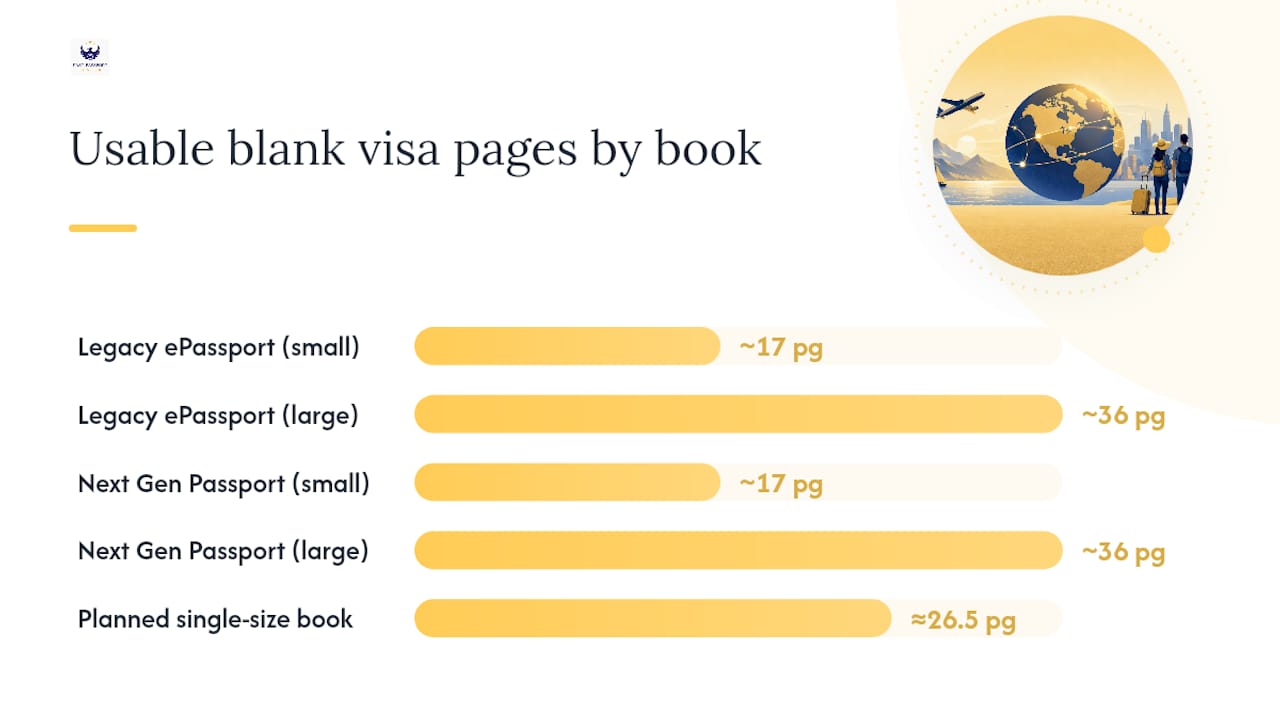
The April 2026 Federal Register notice confirms the Department plans to consolidate to a single 38-page book during the next passport redesign. That middle-ground size sits between the current small and large options.
Pro Tip: Always request the larger book when you apply or renew — there is no additional government fee, and the extra pages can save you from an early renewal if you travel internationally more than twice a year.
The 2026 State Department decision: one size for everyone
The Federal Register notice published April 20, 2026 announced that the Department of State will shift to a single 38-page passport book format during the next scheduled redesign. The rationale is straightforward: production efficiency and waste reduction. Manufacturing two book sizes requires separate production runs, additional inventory management, and more complex logistics at passport acceptance facilities.
The data behind the decision is telling. According to the Federal Register notice, about 92% of applicants request the standard small book, and the vast majority of passport holders use 17 or fewer visa pages across the entire life of their passport. The Department expects only a small fraction of applicants — primarily frequent international travelers, overseas citizens, and special-issuance holders — to notice any meaningful change.
Statistic: The Federal Register notice reports that almost all passport holders use 17 or fewer visa pages before renewal, meaning the 38-page single-size book will be sufficient for nearly all travelers.
For most people, the shift is a non-event. For frequent travelers who currently rely on the 50-page book, it means renewing sooner or leaning on the second-passport policy when pages run low.
Which pages in your passport actually count as visa pages?
Not every page in your passport is available for visa stamps or entry marks. Understanding the difference protects you from miscounting and arriving at a border with fewer usable pages than you think.

The data page (also called the biographical page) is the laminated page bearing your photo, name, date of birth, and machine-readable zone. ICAO Doc 9303 defines this page’s specifications and confirms it is not a visa page — it holds no stamps and cannot be used for entry marks.
Endorsement pages carry printed text from the State Department: legal notices, emergency contact instructions, and travel advisories. These are also not available for stamps.
To count your actual usable visa pages:
- Open your passport to the data page and note it as page 1.
- Flip through and identify all pages with pre-printed State Department text or endorsements — these do not count.
- Count only the completely blank, unlaminated pages remaining.
- Subtract any pages that already carry a visa sticker, entry stamp, or exit stamp.
In a 26-page Next Generation Passport, you will typically find roughly 17 blank visa pages after accounting for the data page and endorsements. A 38-page book will yield approximately 25–28 usable pages. You cannot legally add pages after your passport is issued — the book you receive is the book you keep until renewal.
How blank-page requirements create real boarding risk
Running low on visa pages is not just an inconvenience. It can get you denied at the gate before you ever reach customs.
Many countries require 2–4 completely blank visa pages as a condition of entry, and airlines are often required to verify this before boarding. The State Department FAQ confirms that some foreign destinations enforce blank-page minimums, and that airlines sometimes check compliance before allowing passengers to board. Countries like Brazil, China, and several African nations are known for strict blank-page requirements. Some also layer on a six-month passport validity rule, meaning your passport must remain valid for at least six months beyond your travel dates.
Before you travel, check the entry requirements for every destination on your itinerary. A passport with two blank pages may be perfectly legal in one country and grounds for refusal in the next. The State Department’s international travel advisories list destination-specific entry rules, including blank-page and validity requirements.
Waiting until you reach the airport to discover a page problem is one of the most avoidable travel emergencies. Airlines are not required to accommodate you, and border officers have no obligation to make exceptions. Check your page count and destination rules at least three weeks before departure.
For travelers applying for long-stay visas abroad, requirements can be even more demanding. Resources like the Spain digital nomad visa eligibility checker illustrate how specific visa categories can require multiple blank pages and extended validity windows.
What to do when you don’t have enough blank pages
Your options depend entirely on how much time you have before travel.
- Travel within 3 days or a family emergency: Go directly to a regional passport agency. Same-day and next-day appointments are reserved for imminent travel. Bring proof of travel (flight itinerary, hotel booking) and a completed DS-11 or DS-82 form.
- Travel in 2 days to 4 weeks: This is the window where an expedited courier service like Fast Passport Center is your most practical option. You avoid the agency appointment scramble and get expert form review, real-time tracking, and direct courier hand-delivery to the passport agency.
- Travel in 4+ weeks: A passport renewal by mail through USPS is viable, though routine processing currently runs 8–12 weeks. Expedited government processing cuts that to roughly 5–7 weeks, but timelines shift — always verify at Travel.
If your primary passport is being held by a foreign embassy for a visa while you need to travel, the second-passport policy may apply. The 2015 Federal Register final rule retained this option for travelers who genuinely cannot be without their passport during processing. A second passport is issued at the regular fee and requires documentation showing the need for concurrent travel documents.
Pro Tip: When applying for a second passport or an expedited renewal, bring your flight itinerary, hotel confirmation, and a letter explaining why you need the document urgently — agencies and couriers process these requests faster with complete supporting documentation.
Processing timelines and fee categories at a glance
Government fees and processing windows change periodically. Always verify current amounts at travel.state.gov before submitting an application.
| Service Type | Typical Timeline | Fee Categories |
|---|---|---|
| Routine renewal (mail) | 8–12 weeks | Government fee only |
| Expedited renewal (government) | 5–7 weeks | Government fee + expedite fee |
| Courier/expediting service | 2–4 weeks | Government fee + expedite fee + service fee |
| Regional agency (in-person) | Same day to 2 days | Government fee + expedite fee |
Track your application status through the State Department’s passport status portal once submitted. For travelers using Fast Passport Center, real-time order tracking is included in the service.
A pre-travel checklist to avoid page problems at the airport
Run through these steps at least three weeks before any international trip.
- Count your blank visa pages using the method in the visa-page section above.
- Check your destination’s entry requirements at travel.state.gov international travel advisories — confirm blank-page minimums and six-month validity rules.
- Verify your passport’s expiration date against both the six-month validity rule and your return travel date.
- If you have fewer than 3 blank pages, start a renewal immediately regardless of your expiration date.
- If you are within 1–2 years of expiration and low on pages, renew now rather than waiting — you will need to renew soon anyway.
Pro Tip: When renewing, always request the larger book if it is still available. There is no extra government fee, and the additional pages can defer your next renewal by years if you travel frequently.
If your timeline is under four weeks, contact Fast Passport Center or check appointment availability at your nearest regional passport agency based on how soon you depart.
Fast Passport Center can solve a page-limit problem quickly
When your passport is full and your trip is weeks away, the path forward depends on your timeline. For travel within 72 hours or a documented family emergency, a regional passport agency appointment is the right call. For everything between two days and four weeks out, Fast Passport Center is built for exactly this situation.
Fast Passport Center is a U.S. Department of State-registered passport courier with over 20 years of experience and drop-off offices in 24 cities, including Tampa, Charlotte, Sacramento, Nashville, and Louisville. If you live more than two hours from a regional agency, a courier is often your only realistic option for an expedited turnaround.
- State Dept-registered courier with direct hand-delivery to passport agencies
- Expert form review to catch errors before submission
- Real-time order tracking so you always know where your application stands
- Drop-off offices in 24 cities for in-person document submission
- 20+ years of experience handling urgent renewals, second passports, and replacement documents
- BBB A+ rating and over 14,000 client reviews
Whether you need a standard expedited renewal or a second passport for concurrent visa processing, Fast Passport Center guides you through every step. Start at FastPassportCenter.com to confirm which service fits your timeline.
The mistake most travelers make — and one habit that fixes it
The most common passport page problem is entirely preventable. Travelers check their expiration date before a trip but skip the page count. By the time they realize they are down to one blank page, they are three weeks from departure and scrambling for an expedited solution.
The habit that prevents this: every time you renew, request the larger book. And once a year, open your passport and count your remaining blank pages the same way you would check your car’s fuel gauge before a long drive. If you are under five blank pages and you travel internationally more than twice a year, start a renewal now, not when you book your next flight.
Sources
- Frequently Asked Questions about Passport Services
- ACTION: Final rule. (Federal Register final rule on visa page inserts, 2015)
- Machine Readable Travel Documents (ICAO Doc 9303)
- Travel
FAQ
Do U.S. passport books have 28 or 52 pages?
Legacy ePassports were issued in 28-page and 52-page formats; the current Next Generation Passport comes in 26-page and 50-page versions. The State Department plans to consolidate to a single 38-page book during the next redesign.
What happens if I run out of pages in my passport book?
You must renew your passport to get more visa pages — the State Department no longer adds pages to an issued passport. Depending on your timeline, you can renew by mail, use an expedited courier service, or visit a regional passport agency.
Does the U.S. passport have only 26 pages now?
The current Next Generation Passport is issued in either 26 or 50 pages. The 26-page version offers a moderate number of usable blank visa pages; the 50-page version offers a larger number of usable blank visa pages. A single 38-page book is planned for the next redesign.
How many blank pages do most countries require for entry?
Many countries require 2–4 completely blank visa pages as a condition of entry, and some also enforce a six-month passport validity rule. Check the State Department’s international travel advisories for your specific destination before traveling.
Can I get a second passport if my primary passport is full?
Yes, in limited circumstances. If your primary passport is held by a foreign embassy for visa processing and you need to travel concurrently, the State Department’s second-passport policy allows you to apply for an additional regular-fee passport with supporting documentation.