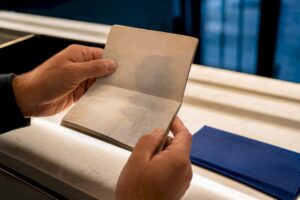
What is passport issuance history and what does it document?
Passport issuance history is the official record of every passport application and issuance tied to your name, maintained by the U.S. Department of State for passports issued since April 1925. Think of it as your passport paper trail: it confirms that a passport was issued to you, when it was issued, and under what application details. What it does not do is tell anyone where you traveled.
These records typically include:
- Full name at birth and any other names used
- Date and place of birth
- Passport number and issuance date
- Application type and submission details
- Identifying information from the original application
One misconception worth clearing up immediately: passport records do not include entry or exit stamps, visas, or residence permits. If you need proof of where you traveled, that information lives in separate border systems, not your passport issuance file.
How U.S. citizens can request their passport issuance records
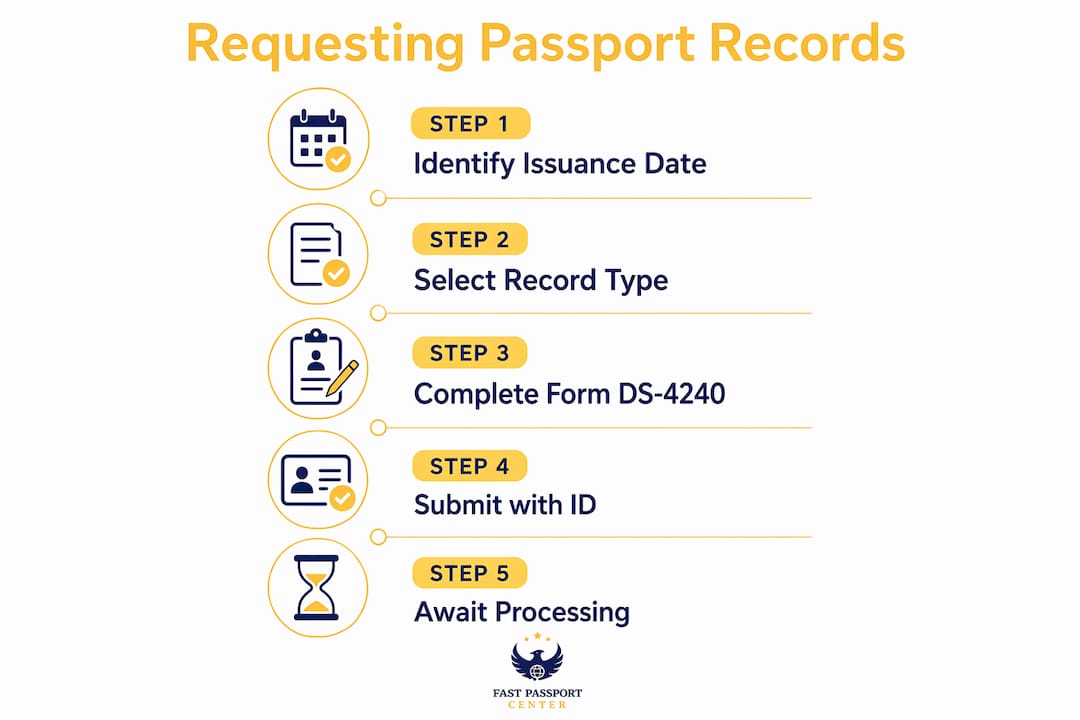
Requesting your passport issuance history is a straightforward process, but it requires the right documentation and a written request submitted to the correct agency.
For passports issued after March 1925, contact the U.S. Department of State’s Office of Records and Release Division in Sterling, Virginia. Your written request must include:
- Full name at birth and any other names used
- Date and place of birth
- Passport number and the date it was issued, if known
- Your signature, either notarized or accompanied by a Penalty of Perjury Statement
- Form DS-4240 if you are requesting records on behalf of another person
For passports issued before 1925, the National Archives and Records Administration (NARA) holds those records. Many have been microfilmed and digitized, making them accessible online and at NARA facilities nationwide.
Regarding fees: a standard copy of your passport records costs nothing. A certified copy carries a $50 fee as of 2026, payable by check or money order to “U.S. Department of State.” Certified copies are what courts, legal proceedings, and some official applications require, so know which type you need before submitting.
Processing times vary and are not publicly listed by the Department of State as a fixed window. Plan ahead and submit your request well before you need the records.
Pro Tip: Use Form DS-4240 and include a notarized authorization when requesting records for someone else. Missing either item is the most common reason requests are delayed or returned.
How U.S. passport recordkeeping evolved over two centuries
The U.S. passport system has a longer history than most travelers realize. Congress passed an act in 1856 giving the Department of State sole authority to issue passports, ending a fragmented era when states, cities, and even notaries public issued their own travel documents. Before that law, European countries sometimes refused to recognize American passports not issued by the federal government.

The volume of passport activity even in the 19th century was substantial. Records show that the State Department issued 130,360 passports between 1810 and 1873, and more than 369,844 between 1877 and 1909. By 1912–1925, that number had climbed to over 1,184,085. The U.S. Department of State reported 24.5 million passports and cards issued in 2024 alone.
The split in record custody reflects this history directly. NARA holds applications from October 1795 through March 1925. The Department of State holds everything from April 1925 forward. The 1920 League of Nations conference on passports advanced international standardization, influencing the booklet format and content standards that shaped the modern U.S. passport.
For genealogists, passport applications are a rich source of family detail: birth dates, occupations, physical descriptions, and the names of accompanying family members all appear in historical applications. NARA’s microfilmed indexes cover applications from 1795 onward, with many now digitized and searchable online.
What passport issuance records can and cannot tell you
This distinction matters more than most travelers expect. Passport issuance records verify that a passport document was created and issued to you. They confirm the date, the document number, and the application details. That is where their scope ends.
These records do not track your travel movements. Border crossings, entry and exit dates, countries visited, and visa endorsements are captured in separate government systems. The Department of State is explicit: passport issuance history is not a substitute for proof of travel destinations or timelines.
Here is where the confusion most often causes problems:
- Legal proceedings: If a court requires proof that you were in a specific country on a specific date, passport issuance records will not provide that. You would need border entry records or other documentation.
- Visa applications: Some foreign consulates ask for travel history. Passport issuance records confirm you held a valid passport but cannot confirm where you used it.
- Genealogy research: Issuance records confirm an ancestor applied for a passport and when. They do not confirm the ancestor actually traveled.
- Lost passport replacement: Issuance records can confirm prior passport details, which helps verify your identity during a lost passport replacement or replacement application.
If you need actual travel history for entry into the United States, the CBP I-94 system at i94.cbp.dhs.gov tracks arrivals and departures for air and sea travel. That is a separate record entirely.
Why passport issuance history matters when you need a passport fast
When you are facing a trip in two to four weeks and your passport is expired, lost, or damaged, every detail of your application history becomes relevant. Knowing your prior passport number and issuance date speeds up the renewal or replacement process because it confirms your identity and prior documentation to the reviewing officer.
Certified copies of passport records are sometimes required for legal proceedings, name change documentation, or official applications where proof of prior passport issuance is needed. Requesting those records proactively, before a deadline hits, puts you in a stronger position.
Privacy is also a real consideration. The Privacy Act of 1974 protects your passport records. Only you, your minor child, a legal guardian, or someone you have explicitly authorized using Form DS-4240 can request them. That protection matters, but it also means the process cannot be rushed informally.
For travelers who discover a passport problem close to their departure date, a registered passport courier like Fast Passport Center can help you move quickly. Fast Passport Center has worked directly with the U.S. Department of State as a registered courier for over 20 years, with expedited passport processing available for travelers with travel dates two days to four weeks out. If you are in Tampa, Charlotte, Sacramento, Nashville, Louisville, or one of the other 20+ cities with a drop-off office, you can hand your documents directly to an agent rather than waiting on mail.
Pro Tip: Before contacting an expediting service, gather your most recent passport number and issuance date. Having that information ready cuts down on back-and-forth and helps agents confirm your identity faster.
If your travel is within three days or involves a family emergency, a regional passport agency appointment is the right path. For everything else, Fast Passport Center’s expedited service is built for exactly the situation you are in.
Key Takeaways
Passport issuance history documents when and how a passport was issued to you, but it never records where you traveled.
| Point | Details |
|---|---|
| What it documents | Issuance dates, passport numbers, and application details — not travel activity or border crossings. |
| Record custody split | Department of State holds records from April 1925 forward; NARA holds records from October 1795 through March 1925. |
| Certified copy fee | A standard copy is free; a certified copy costs $50 as of 2026 and requires a written request with identity verification. |
| Travel history is separate | Entry and exit data lives in CBP systems like I-94, not in passport issuance records. |
| Expedited processing benefit | Knowing your prior passport number and issuance date speeds up renewal and replacement applications with a courier service. |
FAQ
What does passport issuance history actually include?
Passport issuance history includes your name, date and place of birth, passport number, issuance date, and application details. It does not include any record of travel, entry stamps, or visas.
Where do I request my U.S. passport issuance records?
For passports issued after March 1925, submit a written request to the U.S. Department of State’s Office of Records and Release Division. For passports issued before 1925, contact the National Archives and Records Administration (NARA).
How much does it cost to get a copy of my passport records?
A standard copy is free. A certified copy costs $50 as of 2026, payable to the U.S. Department of State, and is required for most legal or official proceedings.
Can passport issuance records prove where I traveled?
No. Passport issuance records confirm only that a passport was issued to you. Travel history, including entry and exit dates, is tracked separately through CBP systems and is not part of your passport file.
How does knowing my passport issuance history help with expedited processing?
Having your prior passport number and issuance date on hand confirms your identity and prior documentation, which speeds up the review process when applying for a renewal or replacement through an expediting service.
Recommended
- International Travel Tips for U.S. Passport Holders — Validity Rules, Visa Requirements & Emergency Guide | Fast Passport Center
- The 3-Month & 6-Month Passport Rule: What U.S. Travelers Must Know (2026) – Fast Passport Center
- Passport for Multiple Trips: What Frequent Travelers Need to Know
- Passport Entry Requirements for International Travel: 2026 Guide