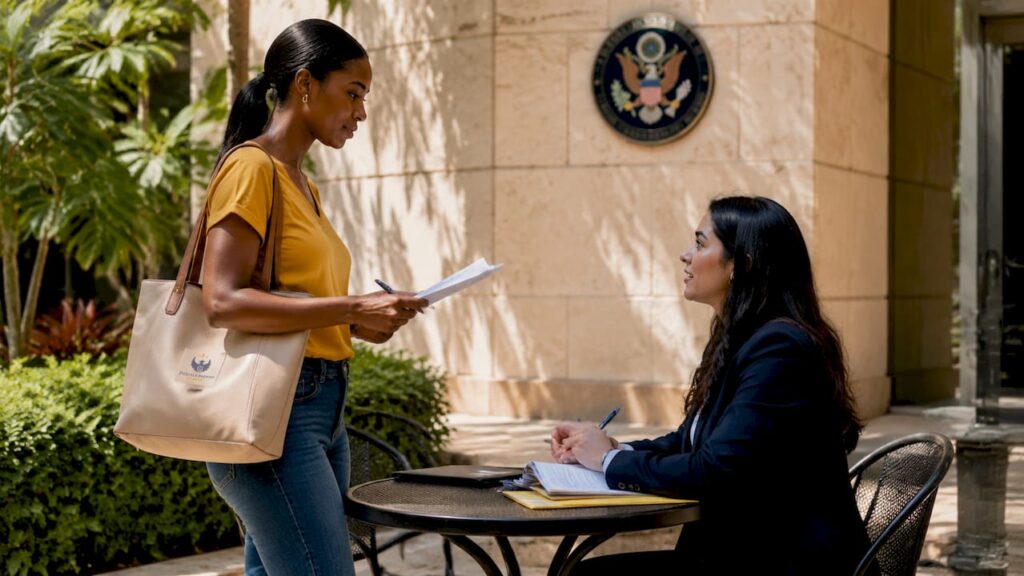
The U.S. Embassy is defined as the primary official resource for American citizens who lose their passport abroad, providing emergency passport replacement, consular guidance, and limited logistical support. Understanding the role of US embassy lost passport procedures is the first step toward getting home safely. The embassy issues emergency passports, typically within 1–2 business days, for a fee around $165, and guides you through every required form and document. What it cannot do is equally important to know: it will not pay your hotel bill, hire you a lawyer, or override local law. This guide covers the full process, the real limits of consular authority, and how to move efficiently from loss to replacement.
What is the role of US embassy for a lost passport?
The U.S. Embassy’s role in a lost passport situation is to replace your travel document and help you return home. Consular officers do not act as legal advocates or financial sponsors. They operate strictly within the host country’s laws and sovereignty, focusing on document replacement and facilitating your return travel.
The embassy can issue two types of passports in this situation. An emergency limited-validity passport gets you home fast. A full-validity replacement passport takes longer but functions like your original. Many travelers do not realize that emergency passports can be exchanged for full-validity ones within one year of issuance after returning to the U.S., at no additional fee.
Consular officers also perform welfare checks, connect you with local resources, and provide a list of local attorneys if you need legal help. They will not, however, choose or pay for that attorney. The distinction matters because many travelers arrive at embassies expecting far more intervention than consular law permits.
What immediate steps should you take after losing your passport abroad?
Speed and calm are both required after a passport loss. Remaining calm prevents the procedural errors that most commonly delay replacement, such as skipping the police report or arriving at the embassy without the right documents.
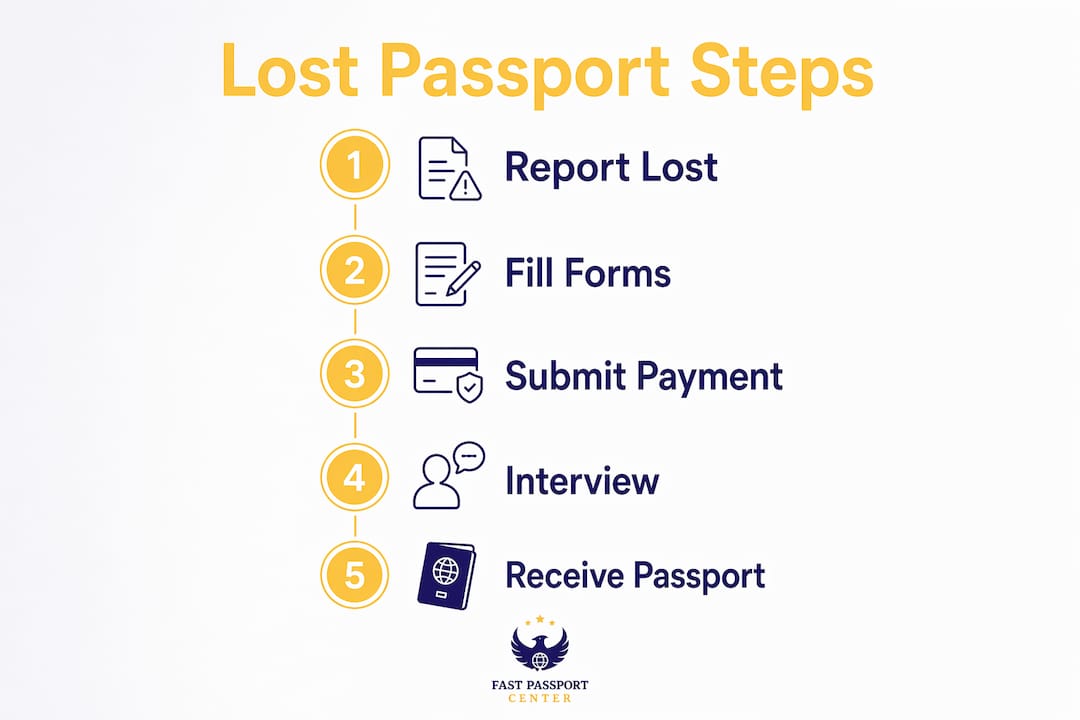
Follow these steps in order:
- File a police report. Many embassies require a local police report before processing your replacement application. Get it in writing and keep multiple copies.
- Contact the nearest U.S. Embassy or Consulate. Report the loss to the U.S. Department of State immediately, then call or visit the nearest embassy or consulate to schedule an appointment.
- Gather proof of citizenship and identity. A certified birth certificate, naturalization certificate, or expired U.S. passport all qualify as proof of citizenship. A government-issued photo ID, such as a driver’s license, establishes your identity.
- Secure digital copies. If you stored photos of your passport in cloud storage or email before traveling, retrieve them now. They speed up identity verification significantly.
- Notify your bank and travel insurance provider. A lost passport often accompanies lost cards or other documents. Your insurer may cover replacement costs and accommodation.
Pro Tip: Before any international trip, email yourself a photo of your passport’s data page and store a copy in a secure cloud folder. This single habit cuts embassy processing time and reduces stress considerably.
How does the U.S. Embassy process a lost passport replacement?
The embassy replacement process follows a structured sequence. Every step requires in-person attendance with a consular officer. You cannot complete this process remotely or through a third party at the embassy itself.
The required documents include:
- Form DS-64: The official form to report a lost or stolen U.S. passport. Submit it unsigned until instructed by the consular officer.
- Form DS-11: The standard passport application form, also submitted unsigned at the appointment.
- Proof of citizenship: Birth certificate, naturalization certificate, or a previously issued U.S. passport.
- Government-issued photo ID: Driver’s license or equivalent.
- Passport photos: Two photos meeting U.S. passport photo specifications.
- Police report: Required by most embassies and consulates.
- Pre-ordered courier waybill: Some embassies, including the U.S. Embassy in Bulgaria, require a pre-printed courier waybill for document delivery. Arriving without it can result in application rejection.
| Document | Purpose | Notes |
|---|---|---|
| Form DS-64 | Reports the lost passport | Do not sign before the appointment |
| Form DS-11 | New passport application | Do not sign before the appointment |
| Proof of citizenship | Verifies your U.S. nationality | Birth certificate preferred |
| Two passport photos | Required for new passport | Must meet U.S. specifications |
| Police report | Confirms the loss | Required by most locations |
| Courier waybill | Document delivery method | Required at select embassies |
The fee for an emergency passport replacement is approximately $165. Payment methods vary by location. Processing typically takes 1–2 business days for emergency passports. Full-validity replacement passports take longer and may require mailing your application to a U.S. passport facility.
Pro Tip: Call the embassy before your appointment to confirm whether a pre-ordered courier waybill is required at that specific location. This single call prevents the most common cause of same-day application rejection.
What are the real limits of U.S. embassy assistance?
The embassy’s authority is narrower than most travelers expect. Consular officers provide specific, limited services focused on documentation and safety checks. They do not perform legal or financial intervention.
The embassy cannot:
- Pay for your hotel, meals, flights, or any personal travel expenses.
- Provide legal representation or intervene in local law enforcement actions.
- Override foreign laws or court orders, even if you believe them to be unjust.
- Guarantee faster processing if local authorities are involved in your case.
- Provide unlimited consular protection to dual nationals.
Dual nationals face a specific limitation worth knowing. If you hold citizenship in both the U.S. and the host country, that country may treat you solely as its own citizen. In that case, embassy protection is significantly reduced. The State Department advises dual nationals to always enter and exit countries where they hold citizenship on their U.S. passport, which helps preserve consular access.
Understanding these limits is not discouraging. It is practical. Knowing what the embassy will not do helps you arrange the right support elsewhere, whether through travel insurance, a local attorney, or a professional expediting service.
How should you handle embassy security and appointment logistics?
Embassy visits require preparation beyond your documents. Security protocols at U.S. embassies prohibit phones, laptops, and most electronics inside the building. Most embassies do not offer secure storage for these items on-site.
Prepare for your visit with these points in mind:
- Leave all electronics at your hotel before traveling to the embassy.
- Arrive with your full document packet organized and ready to present.
- Bring the pre-ordered courier waybill if your location requires it.
- Confirm appointment requirements in advance. Some embassies accept walk-ins for emergency cases; most require a scheduled appointment through the embassy’s online portal.
- If you do not speak the local language, request a consular officer who speaks English. All U.S. embassies have English-speaking staff. For police reports, consider hiring a local interpreter or using a translation app to avoid errors in your official documents.
Pro Tip: Arrive at the embassy at least 15 minutes early. Security screening takes time, and a late arrival can result in a missed appointment slot, adding a full day to your timeline.
How can travel insurance and other resources help?
Travel insurance is one of the most underused resources in a lost passport situation. Many travel insurance policies cover hotel stays, meals, and replacement fees associated with a lost passport. Most travelers do not call their insurer promptly, which leads to unnecessary out-of-pocket expenses.
Call your insurer’s 24/7 assistance line as soon as you confirm the passport is gone. Do not wait until after the embassy appointment. The insurer can often coordinate logistics, pre-approve accommodation costs, and guide you on which receipts to keep for reimbursement.
Additional resources worth using:
- Digital passport copies: A photo stored in email or cloud storage speeds up identity verification at the embassy and can substitute for physical documents in some cases.
- U.S. Embassy emergency hotline: Available 24 hours a day for American citizens in distress abroad. The number is listed on every embassy’s official website.
- Lost passport affidavit services: Some situations require a notarized affidavit to support your identity claim. Understanding the lost passport affidavit process can prevent delays if a consular officer requests additional identity documentation.
- Professional expediting services: For travelers who need a full-validity replacement passport quickly after returning to the U.S., a registered passport expeditor can reduce processing time significantly compared to standard mail-in methods.
Key Takeaways
The U.S. Embassy issues emergency replacement passports within 1–2 business days and provides consular guidance, but it cannot pay personal expenses, provide legal representation, or override local laws.
| Point | Details |
|---|---|
| Embassy issues replacements | Emergency passports are typically ready within 1–2 business days for a fee around $165. |
| Required forms are specific | Submit DS-11 and DS-64 unsigned at your appointment, along with proof of citizenship and a police report. |
| Embassy authority is limited | Consular officers cannot pay your bills, hire lawyers, or override foreign laws on your behalf. |
| Dual nationals face extra limits | Host countries may treat dual nationals as their own citizens, reducing U.S. consular access. |
| Insurance and preparation matter | Travel insurance often covers replacement costs; digital passport copies speed up the entire process. |
What I’ve learned about lost passports and embassy expectations
By Andy Irons
After years of working with travelers in passport emergencies, the pattern I see most often is not the loss itself. It is the gap between what travelers expect the embassy to do and what it actually does. That gap causes more stress than the lost passport.
The embassy is not a rescue service with unlimited reach. It is a documentation office with consular authority. The officers there are professional, often genuinely helpful, and working within a framework that has real legal boundaries. When you walk in expecting them to call the police chief or book you a flight home, you will be disappointed. When you walk in knowing exactly what forms you need and what the process looks like, the whole experience becomes manageable.
The travelers who move through this process fastest are the ones who prepared before they left home. They have a photo of their passport in their email. They know their travel insurance number. They arrive at the embassy with every document organized. Preparation is not pessimism. It is the single most effective thing you can do for yourself before any international trip.
One more thing: if your travel timeline is tight and you need a full-validity passport quickly after returning to the U.S., do not assume the standard mail-in process will work. A registered expediting service can cut weeks off your wait. That is not a luxury. For many travelers, it is the difference between making a trip and missing it.
— Andy Irons
When Fast Passport Center can help after a lost passport
Losing a passport abroad is stressful, but the process does not end when you leave the embassy. Once you return to the U.S. with an emergency limited-validity passport, you still need a full-validity replacement, and standard processing times can stretch your plans considerably.
Fast Passport Center works directly with the U.S. Department of State as a registered passport courier, with drop-off offices in 24 cities and over 14,000 positive reviews. Whether you need to understand your expediting options after a loss abroad or want to replace your emergency passport before your next trip, Fast Passport Center’s experienced agents handle every detail. The service holds an A+ rating from the Better Business Bureau and guarantees faster processing than standard methods. Visit Fast Passport Center to get started.
FAQ
How quickly does the U.S. Embassy issue an emergency passport?
Emergency replacement passports are typically issued within 1–2 business days at a fee around $165. Processing speed depends on appointment availability and whether all required documents are submitted correctly.
What forms do I need to replace a lost passport at the embassy?
You need Form DS-11 (passport application) and Form DS-64 (lost passport report), both submitted unsigned, along with proof of citizenship, a government-issued photo ID, two passport photos, and a police report.
Can the U.S. Embassy pay for my hotel or flights after a passport loss?
The embassy cannot pay for personal travel expenses including hotels, meals, or flights. Many travel insurance policies cover these costs, so contacting your insurer immediately after the loss is the most direct path to financial support.
What happens to my emergency passport after I return to the U.S.?
An emergency limited-validity passport can be exchanged for a full-validity passport within one year of issuance after returning to the U.S., with no additional fee required for the exchange.
Do dual nationals get the same embassy protection when a passport is lost?
Dual nationals receive reduced consular protection in countries where they also hold citizenship, because the host country may treat them solely as its own citizen. The State Department advises dual nationals to always use their U.S. passport when entering and exiting such countries.