
Passport validity for international entry is defined as the minimum period your passport must remain valid beyond your planned travel dates before a foreign country will allow you to enter. Most countries enforce either a six-month or three-month rule, meaning your passport cannot simply be unexpired. It must have enough remaining validity to satisfy the destination’s specific requirement. U.S. Customs and Border Protection enforces a six-month validity requirement for travelers entering the United States unless a bilateral exemption applies. Understanding what is passport validity international entry means knowing that your expiration date and your eligibility to travel are two different things entirely.
What is passport validity for international entry, and how does it work?
Passport validity, in the context of international travel, refers to the length of time your passport must remain valid beyond your arrival or departure date. The standard industry terms are the “six-month rule” and the “three-month rule,” and which one applies depends entirely on your destination. Many countries require passports to be valid at least six months beyond the traveler’s date of departure or arrival, particularly across Asia, Africa, and the Middle East. The rationale is practical: if you overstay, get sick, or face an emergency, the destination country wants assurance your document remains valid throughout any extended stay.
The three-month rule applies primarily to the Schengen Area, which covers 27 European countries. The Schengen standard requires your passport to be valid for three months beyond departure and issued within the last 10 years. That second condition catches many travelers off guard. A U.S. passport issued 11 years ago might still have two years left before expiration, yet it would be rejected at a Schengen border. This issuance date rule is one of the most overlooked passport validity requirements in international travel.

Some countries, including Canada, Japan, and the United Kingdom, require only that your passport be valid for the duration of your stay. That sounds lenient, but airlines often apply stricter standards regardless of what the destination country officially requires. Checking the destination rule alone is not enough.
Pro Tip: Always verify passport validity requirements directly through the U.S. State Department’s country-specific information pages or the destination country’s official embassy website before booking any international travel.
Regional passport validity requirements at a glance
| Region | Validity required | Additional conditions |
|---|---|---|
| Schengen Area (27 countries) | 3 months beyond departure | Issued within last 10 years |
| Asia, Africa, Middle East | 6 months beyond arrival or departure | Varies by country |
| United States (inbound) | 6 months beyond intended stay | Bilateral exemptions apply |
| Canada | Valid for duration of stay | No additional buffer required |
| United Kingdom | Valid for duration of stay | No additional buffer required |
| Japan | Valid for duration of stay | No additional buffer required |
How do airlines and entry checkpoints enforce passport validity rules?
Airlines enforce passport validity checks before you ever reach a border official. Airline agents may deny boarding if a passport validity buffer is not met, regardless of border official flexibility, because carriers face direct financial liability if a passenger is denied entry and must be returned at the airline’s expense. This means an airline gate agent in Atlanta can refuse to board you for a flight to Bangkok even if Thailand’s official rule technically permits your passport. The airline’s internal policy often defaults to the six-month standard across the board.
Border officials at the destination country apply the rules of their own government. Their enforcement can be stricter or, in rare cases, more flexible than what is published. The practical risk is that you face two separate checkpoints: the airline at departure and immigration at arrival. Failing either one ends your trip.
The following scenarios represent the most common enforcement situations travelers face:
- Your passport has four months of validity remaining. You book a flight to Indonesia, which requires six months. The airline denies boarding at the gate.
- Your passport was issued 10 years and two months ago. You arrive at a Schengen border with two years left before expiration. Entry is denied because the issuance date rule is violated.
- Your passport has five months of validity. You fly to Canada, which requires only duration-of-stay validity. The airline still flags it because their internal policy requires six months.
- You travel to a country with a three-month rule. Your passport has four months remaining. You are admitted, but your return flight is delayed by two weeks, pushing you past the validity window.
Pro Tip: Maintain at least six months of passport validity at all times, regardless of your specific destination’s rule. This single habit eliminates the vast majority of boarding and entry problems travelers encounter.
How to determine the passport validity period needed for your trip
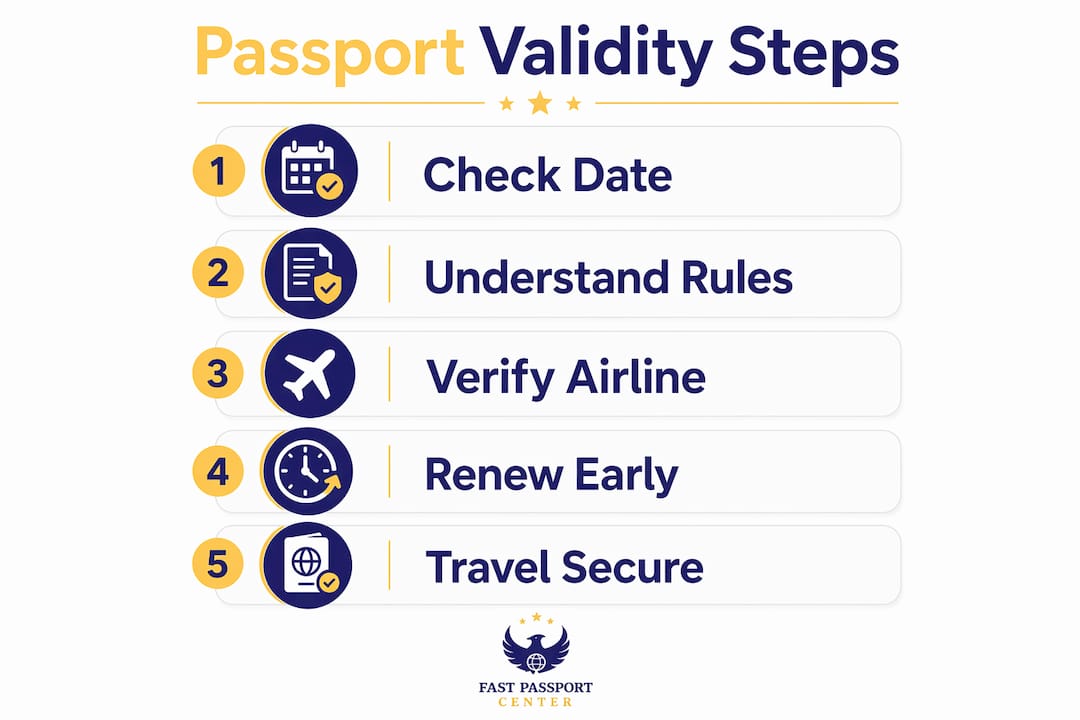
Calculating the correct passport validity requirement for your trip requires more than glancing at your expiration date. Validity requirements may count from entry date or departure date depending on the destination, and treating all requirements as starting from your departure date gives you the safest margin. Here is a reliable process for verifying your requirements before you book:
- Identify your destination country and any transit countries where you will have a layover of more than 24 hours.
- Visit the U.S. State Department’s official travel information page for each country at travel.state.gov to find the current entry requirements.
- Check the destination country’s embassy or consulate website directly, as requirements can change faster than third-party sources update.
- Calculate your passport’s remaining validity from your planned departure date, not your arrival date, to give yourself the maximum buffer.
- If traveling to a Schengen country, also check the issuance date on your passport and confirm it falls within the last 10 years from your arrival date.
- Verify the same requirements for your return journey if you are transiting through a third country on the way home.
Consider a concrete example. You plan to travel from Nashville to Thailand, departing on october 15 and returning on november 5. Thailand requires six months of validity from the date of entry. Your passport expires on march 20 of the following year. That gives you roughly five months and five days from your entry date. You would be denied entry. The fix is to renew before you travel, not after you book.
Passport validity requirements can also shift with little notice due to diplomatic changes or updated bilateral agreements. Booking travel six months out and checking requirements only once at booking is a common mistake. Recheck requirements 30 days before departure.
What should you do if your passport does not meet validity requirements?
The first step is knowing how long your current passport is valid. U.S. passports issued to persons 16 and older are valid for 10 years; passports issued to travelers under 16 are valid for five years. If your passport is within 12 months of expiration, renewing before your next international trip is the right call regardless of your destination’s specific rule.
Travelers who discover a validity problem close to their departure date have two realistic options based on their timeline:
- Travel within 2–4 weeks: An expedited courier service is your best option. Fast Passport Center works directly with the U.S. Department of State as an authorized courier and can process renewals significantly faster than standard mail-in methods. Their agents handle every detail, which removes the risk of application errors that cause further delays.
- Travel within 3 days or a family emergency: A regional passport agency appointment is required for same-day or next-day processing. Fast Passport Center can help you prepare your application and documents before that appointment.
- Travel 4 or more weeks out: Standard renewal through a USPS passport acceptance facility is an option, but expedited processing is still worth considering given current government processing times.
Renewing early is always preferable to renewing under pressure. Travelers who wait until their passport has less than six months of validity remaining often discover they cannot book certain destinations at all. The consequences of traveling with insufficient validity include denied boarding, denied entry at the destination, and in some cases, detention at the border while return travel is arranged.
Travelers who mistakenly believe passports can be used until expiration without checking destination rules face the highest risk. The expiration date printed on your passport is not a guarantee of travel eligibility. It is simply the outer limit of the document’s legal life.
Key Takeaways
Passport validity for international entry requires more remaining validity than your expiration date alone indicates, with most countries demanding three to six months beyond your departure date.
| Point | Details |
|---|---|
| Six-month rule is the global default | Asia, Africa, the Middle East, and the U.S. require six months of validity beyond arrival or departure. |
| Schengen Area has a dual requirement | Passports must be valid three months past departure and issued within the last 10 years. |
| Airlines enforce stricter checks | Carriers can deny boarding even when the destination country’s rule technically permits your passport. |
| Count validity from departure, not arrival | Treating your departure date as the start of the validity window gives you the safest margin. |
| Renew early or expedite when time is short | U.S. passports are valid 10 years for adults and 5 years for children; renewing before the 12-month mark avoids last-minute pressure. |
What I’ve learned after years of watching travelers get this wrong
Travelers consistently underestimate how different passport validity rules are from passport expiration. I have seen experienced international travelers, people who travel four or five times a year, get turned away at the gate because they assumed an unexpired passport was a valid passport. The two concepts are related but not the same.
The Schengen issuance date rule is the one that surprises people most. A traveler with a passport expiring in 2027 feels completely prepared for a trip to France. Then they find out their passport was issued in 2015, which puts it past the 10-year issuance limit for Schengen entry. That is a denied entry that no amount of arguing at the border will fix.
My consistent advice is to treat the six-month validity buffer as a non-negotiable personal standard, regardless of where you are going. Some destinations technically allow less. But policy changes happen quickly, airlines apply their own standards, and the cost of being wrong is your entire trip. The buffer costs you nothing if you plan ahead. It costs you everything if you do not.
The other mistake I see regularly is travelers who check requirements once at booking and never again. Entry rules change. A country that required only duration-of-stay validity last year may have updated its policy. Rechecking 30 days before departure takes five minutes and has saved more than a few trips.
— Andy Irons
Fast Passport Center can get your passport ready in time
If your passport does not meet the validity requirements for your upcoming trip, the window to fix it is shorter than most travelers realize. Fast Passport Center specializes in expedited passport processing for travelers who need a renewed or new passport fast, with personalized agent guidance and direct courier collaboration with the U.S. Department of State.

Fast Passport Center holds an A+ rating from the Better Business Bureau and has earned over 14,000 positive reviews from travelers across the country, including those in cities like Tampa, Charlotte, Nashville, and Sacramento who cannot easily reach a regional passport agency. Whether you need a passport renewal processed in days or guidance on meeting a specific country’s entry requirements, their experienced agents handle every step. Visit FastPassportCenter.com to get started before your departure date gets any closer.
FAQ
What does passport validity for international entry mean?
Passport validity for international entry means your passport must remain valid for a set period beyond your travel dates, not just be unexpired. Most countries require three to six months of remaining validity beyond your departure or arrival date.
How long does a U.S. passport stay valid?
U.S. passports issued to travelers aged 16 and older are valid for 10 years. Passports issued to travelers under 16 are valid for five years.
What is the six-month passport rule?
The six-month rule requires your passport to be valid for at least six months beyond your planned arrival or departure date. It applies to most countries in Asia, Africa, and the Middle East, as well as to travelers entering the United States.
Does the Schengen Area have a different passport validity rule?
Yes. Schengen countries require passports to be valid for three months beyond your departure date and issued within the last 10 years. Both conditions must be met for entry to be permitted.
Can an airline deny boarding even if my passport meets the destination’s rule?
Yes. Airlines face financial liability if a passenger is denied entry and must be returned, so they often apply a stricter standard than the destination country’s official rule. Maintaining six months of validity eliminates this risk entirely.