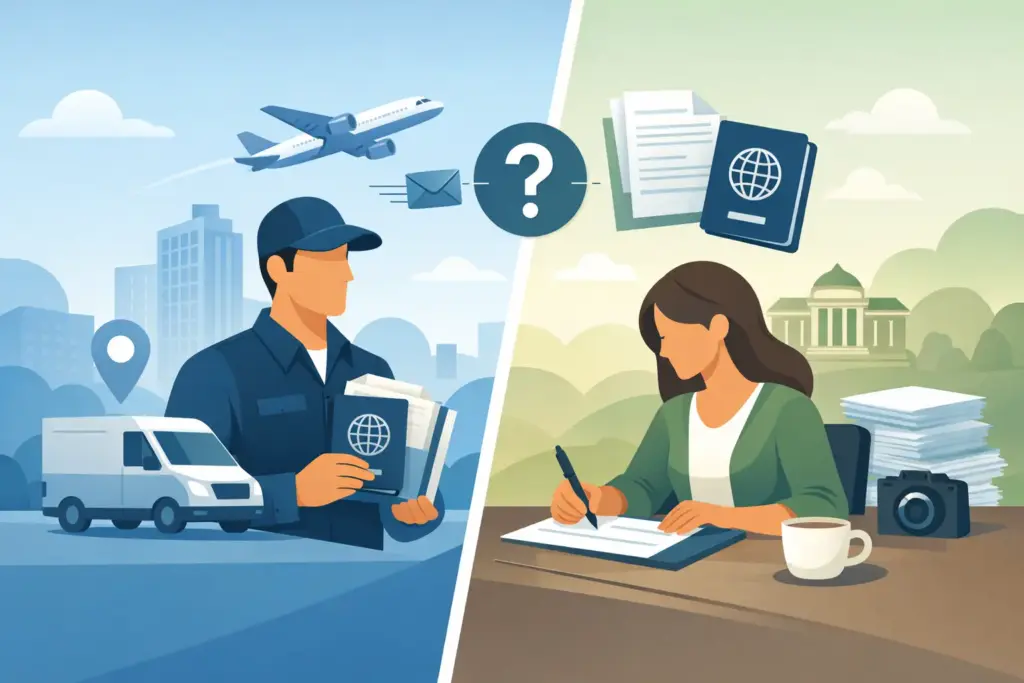
If your flight is close and your passport situation is not under control, the question is not abstract. Courier passport service vs DIY comes down to time, margin for error, and how much risk you can afford before departure. For some travelers, doing it yourself is perfectly reasonable. For others, one small mistake can turn a fixable task into a canceled trip.
This is one of those decisions where the cheapest path is not always the lowest-cost one. A missed form signature, the wrong photo, incomplete supporting documents, or a delayed appointment can cost far more than a service fee when hotels, airfare, or business travel are on the line.
Courier passport service vs DIY: the real difference
A DIY passport application means you handle the process yourself. You complete the forms, gather your proof of citizenship and ID, get passport photos taken, pay government fees, track requirements, and either mail your package or secure an appointment if your situation qualifies for urgent handling.
A courier passport service adds a professional layer between you and the process. That matters most when the service works through U.S. Department of State registered and authorized passport couriers who participate in the Passport Agency hand-courier program. These are federally vetted couriers with limited daily in-person submission privileges that the general public does not have. You are not paying for someone to simply stand in line. You are paying for access to an official courier network, expedited handling, and document support designed to reduce errors before submission.
That distinction matters because passport delays often come from avoidable issues. Many travelers do not realize how strict the standards can be until a package is rejected, a photo fails, or a required original document is missing.
When DIY makes sense
DIY can be a smart option if your timeline is comfortable and your case is straightforward. If you are renewing an eligible passport well ahead of travel, you are organized, and you are comfortable following government instructions carefully, there is nothing wrong with handling it yourself.
It can also make sense if cost is your top priority and you have room for delays. Standard processing may be enough if you are planning far in advance and do not mind managing the details on your own.
But DIY works best when nothing unusual is happening. The more complexity you add, the less forgiving the process becomes. First-time applications, child passports, lost or stolen passports, damaged passports, name changes, and urgent departure dates all raise the stakes.
When a courier passport service is worth it
A courier service becomes far more attractive when speed and certainty matter. If you have international travel approaching, cannot afford paperwork mistakes, or do not want to navigate agency rules alone, expert support can save time and stress.
This is especially true for travelers with less familiarity with passport rules. Many people assume the hardest part is filling out the form. In reality, the hard part is making sure every supporting item meets current requirements and that nothing creates a delay once the application is in motion.
A strong expediting service typically helps with form guidance, document review, photo requirement checks, shipping instructions, status tracking, and submission through an authorized courier channel when eligible. That kind of support is practical, not cosmetic. It helps prevent the errors that tend to surface at the worst possible moment.
Cost vs risk: what travelers often overlook
The DIY route usually looks cheaper at first because you are paying only government fees, plus any photo, mailing, or travel costs tied to your application. A courier passport service includes service fees on top of those government charges.
That price gap is real, but it should be weighed against what is at risk. If a mistake delays your passport and you miss a cruise, postpone an international meeting, or lose nonrefundable airfare, the financial difference changes quickly.
There is also the value of your time. Researching eligibility, reviewing form instructions, correcting mistakes, finding appointments, and tracking submission issues can take hours. For some travelers, that is manageable. For parents planning family travel, executives preparing for overseas meetings, or anyone already under deadline pressure, it may not be.
The right question is not only what the service costs. It is what your time, stress level, and travel plans are worth.
Speed is not the same for every case
One reason the courier passport service vs DIY debate is so dependent on circumstance is that not every passport situation moves at the same pace.
An uncomplicated renewal may be relatively predictable. A first-time passport is different because it often requires in-person execution. A child passport has extra parental consent rules. A lost or stolen passport can require additional statements and identity support. A damaged passport can trigger closer review. If you need a second passport for specific travel reasons, that process has its own documentation standards.
When your case is more complex, the chance of delay rises. That is where professional review has real value. Catching a problem before submission is almost always faster than fixing one after the government has already received your documents.
What authorized courier access actually means
This is one of the most misunderstood parts of the industry. A legitimate passport expediter does not replace the government and does not issue passports itself. The government still makes all approval decisions.
What an authorized courier service can do is facilitate expedited submission through the official hand-courier program, where eligible applications are presented by registered couriers with limited daily drop-off privileges. Those privileges are not open to the public. They exist within a recognized submission system governed by strict standards.
That is why legitimacy matters. If you are considering a service, look for clear language about authorized courier participation, document review, process transparency, and direct support. You want a structured process, not vague promises.
DIY has one major advantage: control
It is fair to say that some travelers simply prefer to handle everything themselves. They want direct control over documents, timelines, mailing, and communication. If that gives you confidence and you have enough time, DIY can feel cleaner and more economical.
But control has a trade-off. It also means full responsibility for every requirement, deadline, and correction. If something goes wrong, there is no built-in support team to flag the issue early or help steer the process back on course.
That trade-off is acceptable for some people. For others, especially those traveling soon, it creates more anxiety than savings.
How to decide between courier passport service vs DIY
The best decision usually comes down to four factors: how soon you travel, how complex your case is, how confident you are in handling the paperwork, and how costly a delay would be.
If your departure is still months away, your application is straightforward, and you do not mind managing details, DIY may be perfectly fine. If you are close to travel, applying for a child, replacing a lost passport, correcting a name, or simply want an expert to review everything before submission, a courier service is often the safer choice.
Many travelers wait too long because they hope the process will be simpler than it is. Then urgency arrives all at once. At that point, having one-on-one guidance, a document pre-check, and access to an authorized courier submission channel can make the situation feel manageable again.
For travelers who need a passport fast, that relief is not a small benefit. It is often the reason they choose a service in the first place. Companies such as Fast Passport Center are built around that exact need, combining expert review with authorized courier-backed processing for customers who cannot afford unnecessary delays.
The smartest choice is the one that matches your deadline honestly. If time is on your side and your application is simple, DIY may do the job. If the trip matters, the timeline is tight, or the paperwork feels too high stakes to gamble on, professional help can be the more practical decision.
Before you choose, be blunt with yourself about the real cost of being wrong. That answer usually tells you everything you need to know.