
A name correction fixes a mistake on a record you already have. A legal name change replaces your name entirely, through a court order, marriage, or divorce. That distinction determines everything else: which forms you file, whether you need a judge, and how long the whole thing takes.
- Typo on your birth certificate or passport? That’s a correction. Contact the issuing agency directly.
- Want an entirely new first or last name? That’s a legal change, usually requiring a court petition.
Before you file anything, call the agency that issued the flawed document. The Social Security Administration and other federal agencies handle corrections through their own administrative process, often without any court involvement at all.
Key Takeaways
A name correction fixes an error on an existing record administratively, while a legal name change creates a new legal identity through court order, marriage, or divorce, and confirming which one applies before filing anything saves the most time.
| Point | Details |
|---|---|
| Contact the agency first | Call the SSA, vital records office, or passport office before assuming you need a court order. |
| Corrections move faster | Administrative fixes often take days to a few weeks with the right certified evidence. |
| Legal changes require more proof | Court petitions can take weeks to months and may require a hearing or public notice. |
| Update SSA before DMV or passport | Most agencies cross-check Social Security records, so mismatched sequencing causes rejections. |
| Get help when travel is close | Fast Passport Center’s courier service expedites passport updates once your name change or correction is finalized. |
This article is general information, not a substitute for advice from a qualified lawyer. Consult a qualified legal professional about your own circumstances before acting on anything here.
Table of Contents
- What Is Name Correction vs Name Change, Legally?
- When Should You Use a Correction Instead of a Legal Change?
- How Do You Correct a Name on Official Records?
- How Do You Legally Change Your Name?
- Which Agencies Should You Update, and in What Order?
- How Long Does Each Process Take, and What Does It Cost?
- What Mistakes Cause Delays in the Correction or Change Process?
- Why Contacting the Issuing Agency First Actually Saves Time
- What Happens Legally If a Name Correction or Change Is Done Incorrectly?
- Does a Name Change Affect Your Will, Trust, or Property Title?
- How Do Name Change Rules Differ by State or Country?
- How Fast Passport Center Helps After a Name Correction or Change
- Sources
- FAQ
What Is Name Correction vs Name Change, Legally?
A name correction addresses an error someone else made when creating your official record: a misspelled surname, a transposed digit, a middle initial dropped by a clerk. You’re not changing who you legally are. You’re getting the paperwork to reflect who you’ve always been. Most vital records offices, the SSA, and the passport office treat this as a straightforward administrative fix once you show proof of the correct spelling.
A legal name change is different in kind, not just degree. You’re voluntarily adopting a new legal identity, and the law wants proof that you’re doing it for legitimate reasons. The most common legal bases include:
- A court order from a judicial name-change petition
- A marriage certificate, which automatically supports a surname change
- A divorce decree, often used to revert to a former name
- A naturalization certificate, when a new citizen formalizes a name at that stage
USA.gov notes that exact requirements and paperwork vary by agency and state, so the label “correction” or “change” on your specific form matters more than the general concept.
When Should You Use a Correction Instead of a Legal Change?
Corrections handle clerical damage. Think: your birth certificate reads “Jonh” instead of “John,” a hospital clerk dropped a hyphen from your surname, or your passport lists a middle name that was never yours. These are documented errors, and the agency that made the mistake usually has a streamlined path to fix it.
Legal name changes cover situations where you’re choosing something new. That includes adopting a spouse’s surname outside of marriage paperwork, picking an entirely different first name, updating your name and gender marker together during a transition, or standardizing a name that’s been inconsistent across every document you own for years.
Pro Tip: If you have an original document, like a hospital birth record or an old ID, that proves the correct spelling, lead with that. Agencies move faster on corrections backed by original evidence than on requests that require them to take your word for it.
How Do You Correct a Name on Official Records?
Administrative correction follows a predictable pattern across most agencies:
- Confirm the error by comparing your document against a reliable source, like your original birth certificate or an older ID.
- Gather supporting evidence: certified birth certificate, marriage or divorce certificate, or a government-issued photo ID showing the correct spelling.
- Contact the issuing agency and ask specifically what they classify as a “correction” versus a “change.”
- Submit your request with certified copies, not photocopies, since most agencies reject uncertified documents outright.
- Follow up and request a new certified copy once the correction posts.
Different agencies accept different proof:
- State vital records offices typically want the original certificate plus a sworn affidavit or hospital record.
- The Social Security Administration requires identity evidence and proof of the name event before issuing a corrected card.
- The U.S. Department of State distinguishes passport corrections from passport name changes and requires different forms for each.
- State DMVs generally accept a corrected Social Security record or birth certificate as backup.
If your evidence is thin or the agency suspects the discrepancy isn’t a simple clerical slip, expect them to ask for a court order instead.
How Do You Legally Change Your Name?
A legal name change runs through one of a few recognized paths: a judicial petition, a marriage certificate, a divorce decree, or naturalization paperwork. Each creates a new legal name that other agencies will then recognize as authoritative.
The judicial path, the most involved of the group, generally looks like this:
- File a petition for name change with your local court, usually in the county where you reside.
- Notify interested parties, which in some states means publishing notice in a local newspaper.
- Attend a hearing, where a judge reviews your reasons and confirms there’s no fraudulent intent.
- Receive the signed court order, which becomes your legal proof of the new name.
- Use certified copies of that order to update every downstream record.
Massachusetts’ state guide walks through this exact sequence, including when publication is required and how the court order gets used afterward to update identity documents. Courts review these petitions carefully because a name change can theoretically be used to dodge debt or evade prior records, so expect scrutiny even in routine cases. Naturalized citizens who need to correct or replace their certificate go through USCIS Form N-565 instead of a state court. Timelines vary by county and caseload, with less congested courts taking less time and busier courts possibly taking longer due to publication and hearing schedules.
Which Agencies Should You Update, and in What Order?
Update records in this sequence to avoid mismatches that stall later applications:
- Vital records or court order first. This is your foundational proof document.
- Social Security Administration next. Nearly every other agency checks your name against SSA records, so this step unblocks everything downstream.
- DMV or state ID office. Update your driver’s license once SSA reflects the new name.
- Passport. The State Department will ask for your updated ID and, depending on timing, proof of the correction or name change.
- Banks, employer, IRS, and voter registration. These typically require your updated Social Security card or driver’s license as the anchor document.
The IRS specifically flags name and SSN mismatches as a common cause of processing delays on tax returns, which is one more reason SSA comes early in the sequence. Veterans should also loop in the VA, which maintains separate name records tied to benefits and service history. Voteriders’ name-change checklist is a useful reference for voter registration specifically, since states vary on whether a mismatch invalidates your registration outright.
How Long Does Each Process Take, and What Does It Cost?
Administrative corrections tend to move in days to a few weeks. Vital records offices charge modest certified-copy fees that vary by state, and the SSA doesn’t charge for correcting your Social Security card, though you should still expect processing time rather than a same-day fix.
Legal name changes take longer and cost more. Court filing fees, publication costs where required, and certified copies of the final order add up, and the Massachusetts courts guide illustrates how multi-step the judicial process can be even in a straightforward case. Total timelines commonly stretch from several weeks to a few months, largely dependent on your court’s hearing calendar.
Passports add another layer. Correcting a clerical passport error uses a different form than applying for a passport under a legally changed name, a distinction the State Department spells out clearly. If you discover the problem with travel coming up fast, our guide to passport name-change supporting documents breaks down exactly what to bring so you’re not turned away for missing paperwork.
What Mistakes Cause Delays in the Correction or Change Process?
The single biggest mistake: assuming every mismatch needs a judge. Most people who walk into this process picture a courtroom, when in fact a certified birth certificate and a phone call often solve it. The second most common error is updating your driver’s license before Social Security, which frequently backfires since many DMVs cross-check against SSA records and will bounce your request if the systems don’t match.
Other frequent pitfalls include submitting photocopies instead of certified documents, and requesting only one certified copy of a court order when you’ll need several for different agencies.
- Contact the issuing agency before assuming you need a court order.
- Request at least three to five certified copies of any court order upfront.
- Check your specific state’s vital records rules, since requirements differ.
- Keep a written checklist of every agency you’ve updated and the date.
Pro Tip: Order extra certified copies the same day you receive your court order. Reordering later means another trip to the courthouse and another fee, and it always seems to come up right when you need the document fastest.
Why Contacting the Issuing Agency First Actually Saves Time
Skipping straight to a courthouse is one of the more expensive habits people fall into here, mostly out of assumption rather than necessity.
Many agencies run their own streamlined correction process for clerical errors, and it’s often faster and cheaper than a judicial petition. The catch is that each agency defines “clerical error” a little differently, so what qualifies at the SSA might not qualify at your state’s vital records office.
Before filing anything formal, check the agency’s own guidance. USA.gov’s name-change resource page is a solid starting point since it links out to state-specific rules. Ask the agency directly what proof they accept and how long their correction process typically runs. That one phone call can save weeks.
What Happens Legally If a Name Correction or Change Is Done Incorrectly?
Getting this wrong isn’t just an inconvenience. A botched correction or an improperly documented name change can create real legal friction down the line.
If you update one record but not others, you end up with conflicting identity documents, and that mismatch can trigger denials. A passport application gets rejected when your name doesn’t match your Social Security record. A tax return gets flagged when the name on file doesn’t match the SSN. A mortgage closing can stall when title documents and your driver’s license disagree on spelling.
There’s a fraud dimension too. Courts scrutinize legal name-change petitions partly because name changes have historically been used to dodge debt collection, evade a criminal record, or sidestep a restraining order. If a judge suspects that’s your motive, even an innocent request can get delayed or denied outright. This is part of why the judicial process, unlike a simple correction, involves a hearing and sometimes public notice.
There’s also a durability problem. A name correction made informally, without certified documentation, may not hold up if a future agency questions it years later. If you correct your name with the SSA but never obtain updated certified copies of the underlying birth certificate, you may find yourself repeating the entire evidence-gathering process the next time an agency asks for proof. Keeping certified paperwork, not just updated cards, is what protects you from having to redo this work.
Does a Name Change Affect Your Will, Trust, or Property Title?
Yes, and this is one of the more overlooked consequences of either process. Legal documents identify you by name, and a mismatch between your current legal name and the name on a will, trust, or deed can create real complications for whoever has to act on those documents later.

A will drafted under a prior name is still generally valid. Courts recognize that people change names and typically accept extrinsic evidence, like a marriage certificate or court order, to confirm the person named in the will and the current legal name are the same individual. But that’s an added burden on your executor at exactly the moment they’re least equipped to handle it. The safer move is updating your will and any beneficiary designations once your name change is final, rather than leaving that connection for someone else to prove.
Trusts carry similar risk, particularly revocable living trusts where you’re both grantor and trustee. If your name changes, the trust document should be amended to reflect it, especially if you’re actively transferring property into or out of the trust.
Property titles deserve the most attention because they involve the public record. If you buy a house before a name change and later sell it under a new name, title companies typically want documentation bridging the two identities, whether that’s a marriage certificate, divorce decree, or certified court order. Skipping this step doesn’t erase the property, but it can slow down or complicate a future sale.
How Do Name Change Rules Differ by State or Country?
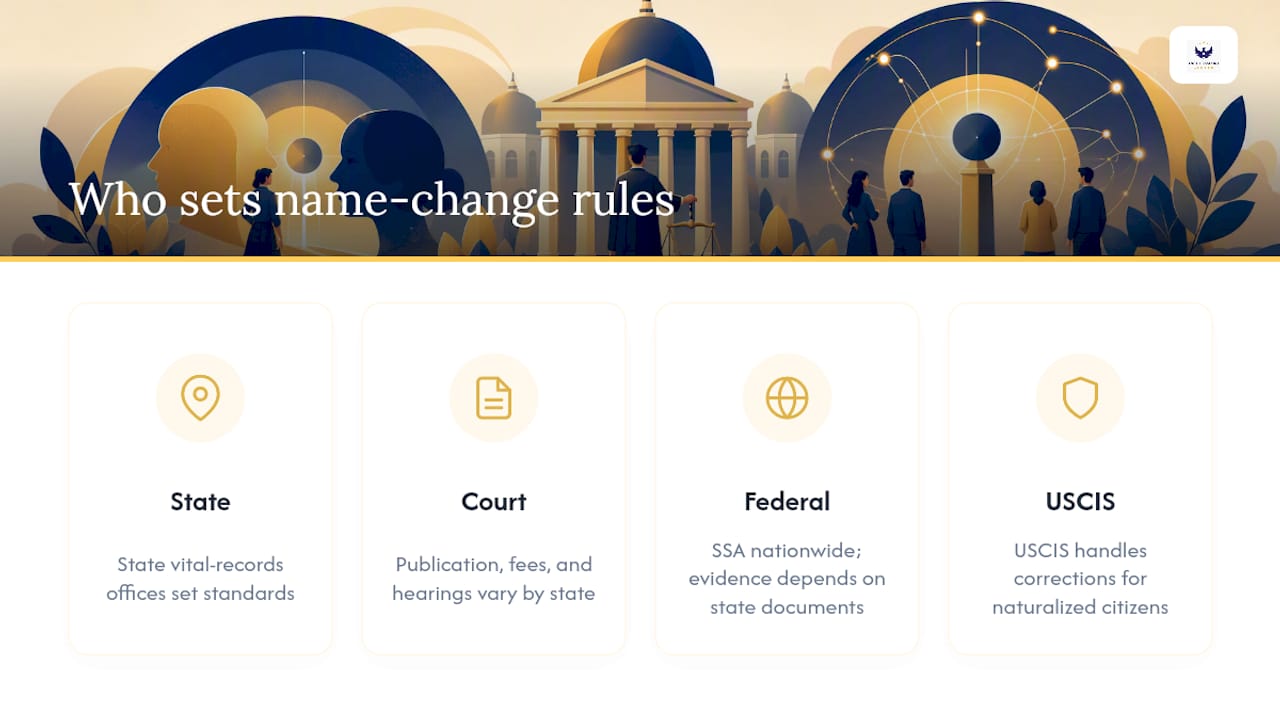
Name correction and legal name change rules aren’t uniform, and that catches a lot of people off guard. Within the United States, each state’s vital records office sets its own standard for what counts as a correctable clerical error versus what requires a court order. Some states allow administrative amendments to a birth certificate for a wide range of typos; others limit that authority narrowly and push more cases toward court.
Court-based name changes also vary by state in ways that matter practically. Some states require newspaper publication of your name-change petition, a holdover rule meant to give creditors or other interested parties notice. Others have dropped that requirement entirely or allow a judge to waive it, which matters if you have safety concerns about your new name becoming public record. Filing fees, waiting periods between filing and hearing, and whether a hearing is even required in uncontested cases all differ from one county to the next, let alone one state to the next.
Federal processes add another layer of consistency but not uniformity. The Social Security Administration and the State Department apply the same rules nationwide, but they interact with state law differently. The SSA’s evidence requirements depend partly on what your state’s marriage, divorce, or court documents look like, since state paperwork formats aren’t standardized either. If you’ve lived in multiple states, or your marriage and divorce happened in different states than where you currently reside, expect to gather documentation from more than one jurisdiction.
Naturalized citizens face yet another track entirely, routed through federal immigration law rather than state courts, which is why USCIS handles certificate corrections through its own separate process.
First-Person Scenarios: Which Path Fits Your Situation?
Picture finding a passport typo two weeks before a flight. That’s almost always an administrative correction, not a legal change, and it moves fastest through the right passport form. Now picture wanting to adopt a completely new first name with no marriage or divorce involved. That calls for a judicial petition, and you should plan around your court’s hearing schedule, not your travel dates.
If your documents are corrected or updated and travel is close, Fast Passport Center’s expedited options can help close the gap.
How Fast Passport Center Helps After a Name Correction or Change
Once your name is corrected or legally changed, the passport itself still needs updating, and that’s where timing gets stressful fast. If travel is more than four weeks out, the regular USPS-based passport process usually has enough runway. If you’re leaving within three days or facing a genuine family emergency, an in-person visit to a regional passport agency is your fastest option.
For everyone in between, roughly two days to four weeks out, a courier-based expediting service is the practical middle path, especially if you live in a city like Tampa, Charlotte, Sacramento, Nashville, or Louisville, where the nearest regional passport agency is a real trip rather than a quick errand. Fast Passport Center is a State Department registered courier with 20+ years handling exactly this kind of deadline, and drop-off offices in 24 cities mean you don’t have to gamble on the mail. Our passport name-change service handles the form selection, document review, and direct hand-delivery to the passport agency, so a corrected or newly issued name doesn’t turn into a missed flight. Start by checking your timeline against our expedited passport processing options and get your documents moving today.
Sources
- How do I change or correct my name on my Social Security number card?
- Change your name: Federal and state government resources
- Change or correct your passport
- Form N-565, Application for Replacement Naturalization/Citizenship Document
- Name Changes
FAQ
What’s the Difference Between a Name Change and a Name Correction?
A correction fixes a clerical error, like a misspelling, on a record you already have, while a name change creates a new legal name through a court order, marriage, or divorce.
What Is Correction in Name and Change in Name?
Correction means the underlying identity never changed, only the paperwork gets fixed to match reality; change means you’re legally adopting a name you didn’t previously hold.
What Counts as Proof of a Name Change?
Acceptable proof typically includes a certified marriage certificate, divorce decree, or court order, depending on which agency you’re updating and what created the new legal name.
Do I Need a Lawyer for a Legal Name Change?
Most states don’t require an attorney for an uncontested judicial name-change petition, though state court guides can walk you through filing it yourself.
How Fast Can Fast Passport Center Update My Passport After a Name Change?
Fast Passport Center’s courier service is built for travel two days to four weeks out, hand-delivering your corrected or updated application directly to the passport agency once your underlying name change is finalized.