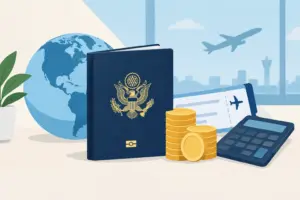
A passport concierge is a private service that helps you prepare and hand-deliver passport paperwork to government agencies, useful when you cannot reach a regional agency yourself or need to move quickly before a trip. It speeds up your personal logistics, not the government’s review. The main reason travelers hire one is practical: urgent travel timing or distance from an agency, not a shortcut around State Department rules.
TL;DR:
- Passport couriers cannot expedite the government’s review process or issue passports but are useful for handling paperwork errors, document checks, and urgent delivery within a few weeks.
- For travel more than four weeks away, the USPS post office route is sufficient; within two days to four weeks, a courier service is recommended; and for within 14 days or emergencies, an in-person appointment is necessary.
- Fees include the government’s $60 expedited processing fee, $22.05 for 1-3 day delivery, and separate courier charges, but private services cannot speed up official processing times.
- A reliable courier must be registered with the State Department, provide transparent pricing, and show proof of registration to avoid red flags like guaranteed issuance claims or unofficial branding.
- Immediate first-time applicants and children require in-person verification, and original documents plus ink signatures are mandatory; courier services cannot replace these legal requirements.
Table of Contents
- 1. What a passport concierge actually does for you
- 2. How concierges fit official timelines: courier, USPS, or agency?
- 3. Costs, limitations, and common misconceptions
- 4. How to choose a trustworthy passport concierge: checklist and red flags
- 5. Fast Passport Center as a working example of a registered courier
- 6. Quick takeaways for common traveler profiles
- 7. Start your passport application the right way
- FAQ
- Sources
1. What a passport concierge actually does for you
When you hire a passport concierge or courier, you are paying for hands-on help with the parts of the process that eat up your time and create costly mistakes. We think of it as logistical support layered on top of a government process that otherwise requires you to navigate every step solo.
A reputable courier typically handles:
- Reviewing your completed application and catching errors before submission
- Checking your documents against current form requirements so nothing gets rejected
- Picking up and hand-delivering your paperwork to a regional passport agency
- Collecting your finished passport so you do not have to travel to retrieve it
- Sending tracking updates so you know exactly where your application stands
What a concierge cannot do matters just as much. These services do not issue passports, and they cannot submit a first-time applicant’s Form DS-11 online on your behalf. If you are applying for the first time, you still need to appear in person at an acceptance facility to verify your identity and sign in ink, even if a courier later picks up the finished document. Couriers also cannot reorder how the State Department processes applications. Submitting through a courier does not place you ahead of anyone else in the queue.
Registration matters here. Courier companies must register with each passport agency where they plan to deliver or pick up applications. That registration is the difference between a legitimate operator and someone who simply claims access. Before you hire anyone, it is reasonable to ask for proof of registration at the specific agency they intend to use for your case. If you want a side-by-side look at how courier-assisted applications differ from a traditional agency visit, our breakdown of passport courier service versus agency processing walks through the operational differences step by step.
2. How concierges fit official timelines: courier, USPS, or agency?
Your timeline decides almost everything about which route makes sense, and the State Department’s own processing windows are the clearest way to think about it. Routine service takes 4 to 6 weeks, expedited service takes 2 to 3 weeks, and mailing your documents can add up to two weeks each way on top of that. If you are applying by mail through the standard post office channel, you need to build that full window into your plans.

The expedited processing fee is $60, with an optional $22.05 fee for 1 to 3 day return delivery. That figure comes directly from the State Department and applies regardless of who prepares your paperwork.
Urgent travel changes the calculation. If you are traveling within 14 calendar days, or within 28 days when a foreign visa is required, you qualify for an in-person appointment at a regional passport agency, but you must bring printed proof of your travel dates. For travelers near Tampa, Charlotte, Sacramento, Nashville, or Louisville, that appointment often means a multi-hour drive, which is exactly the gap a courier service is built to close.
A simple way to match your timeline to the right channel:
- Four or more weeks before travel: the standard USPS post office channel usually has enough runway for routine processing.
- Two days to four weeks before travel: a courier or expediting service gives you professional document handling without the drive to an agency.
- Within 14 days (28 with a visa) or a genuine family emergency: an in-person agency appointment is the only government-sanctioned path, and printed travel proof is mandatory.
Picture a few real situations. A parent discovers a child’s first passport application needs to go in six weeks before a family trip: there is time for careful preparation and a courier handles the paperwork cleanly. A traveler loses a passport ten days before departure: that sits inside the urgent appointment window, though a courier can still help assemble replacement documents quickly. A business traveler needs a renewal three weeks out: that is squarely in courier territory. Our guide on using a courier within the 2 to 28 day window walks through more scenarios like these in detail.
3. Costs, limitations, and common misconceptions
Courier and concierge fees sit on top of your government fees, never instead of them. You pay the State Department’s $60 expedited processing fee and, if you want faster return shipping, the $22.05 fee for 1 to 3 day delivery, and then you pay the courier separately for their labor and logistics. Anyone who implies their fee replaces a government charge is misrepresenting how the system works.
The biggest misconception we hear is that a courier makes the government move faster than an in-person agency visit would. It does not. A courier is a private company, not a government office, and it cannot bypass processing queues or compress review times beyond what you would get walking into an agency yourself. What it buys you is convenience: someone else handles the driving, the paperwork checks, and the pickup.
A few other limitations worth knowing before you commit:
- Original documents are required. Couriers cannot accept photocopies in place of your birth certificate or prior passport.
- Ink signatures are mandatory. Digital signatures do not satisfy State Department requirements.
- First-time DS-11 applicants must appear in person at an acceptance facility for identity verification. No courier can substitute for that visit.
- A courier charging you for the act of booking a government appointment is a red flag; the State Department does not charge for appointment bookings, and third-party bookings may not even be honored.
Understanding these boundaries up front saves you from assuming a concierge is a magic bypass. It is a practical convenience layer, not a different set of government rules.
4. How to choose a trustworthy passport concierge: checklist and red flags
Vetting a provider takes a few minutes and protects you from wasted money or a missed flight. Before you hand over documents or payment, work through a short checklist.
Look for:
- Verifiable registration with the State Department for the specific agency they plan to use
- Clear, itemized pricing that separates their service fee from government fees
- Documented insured courier handling for your original paperwork
- A Better Business Bureau rating or a track record of verified customer reviews
- A physical business address and a working phone number, not just a web form
- Written terms of service and a stated refund policy
Watch for these warning signs:
- Any claim to “guarantee” passport issuance; no private company controls government approval
- Charges for booking an official appointment, since the State Department never charges for this
- Use of government-style seals or logos designed to look official
- No willingness to show proof of courier registration when asked directly
- Pressure to pay through unusual methods like wire transfers or gift cards
Before hiring anyone, ask them directly which agency they are registered with, what happens if your application is rejected, and how they insure your original documents in transit. A legitimate operator answers all three without hesitation.
Pro Tip: Ask to see a provider’s State Department courier registration confirmation before you send original documents, not after.
5. Fast Passport Center as a working example of a registered courier
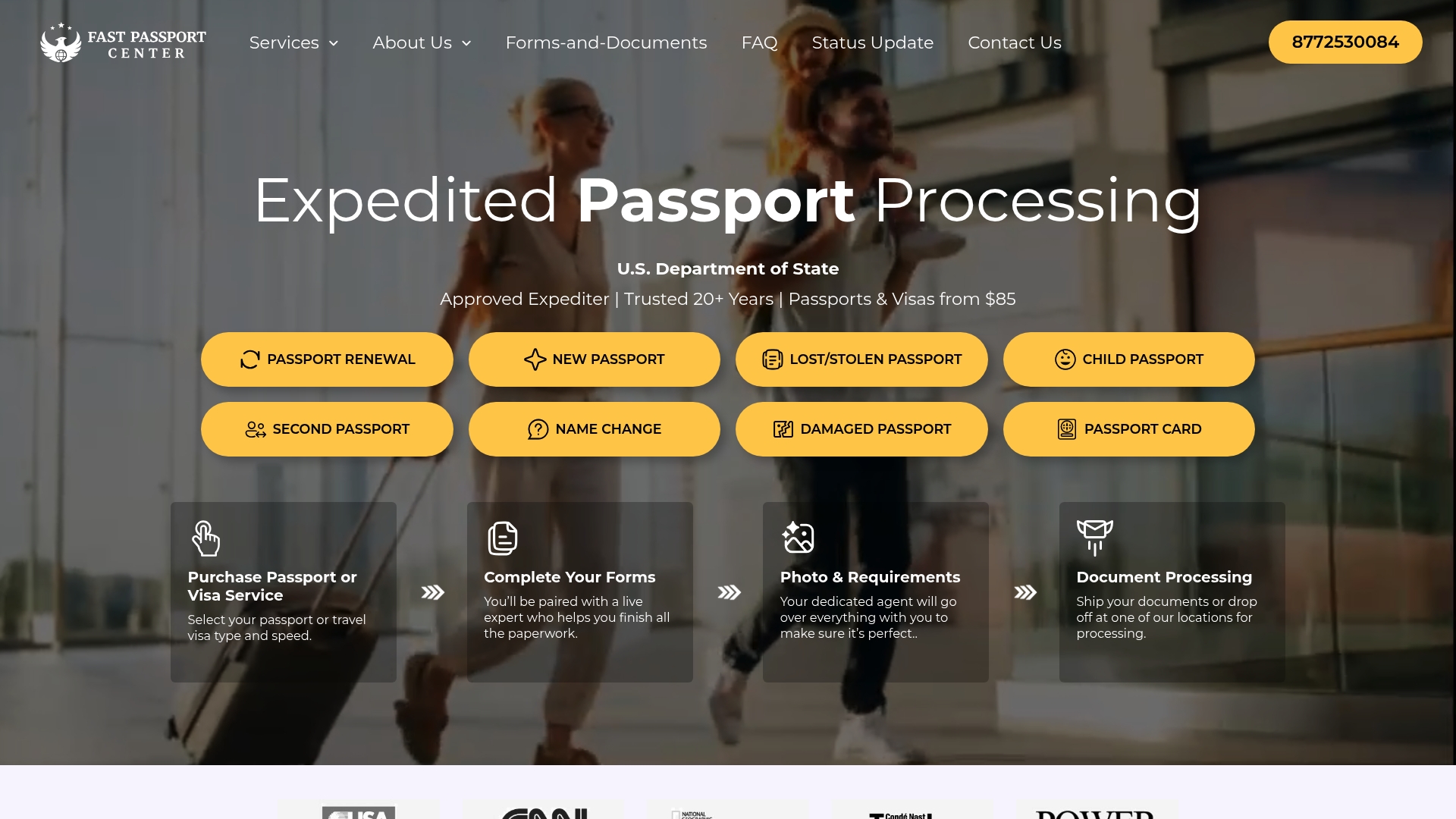
Seeing a real provider mapped against that checklist makes the standard concrete. Fast Passport Center operates as a registered U.S. State Department courier, has handled passport logistics for more than 20 years, and maintains drop-off offices in 24 cities, details, we encourage you to verify directly when comparing any provider.
If your travel falls two days to four weeks out, our Expedited Passport Service is built for that exact window, handling document review and hand-delivery so you do not need to drive to a regional agency. If you are closer to the urgent end of that range, our Urgent Passport and Emergency Passport services are structured around tighter deadlines. We also offer dedicated paths for Child Passport applications, Lost/Stolen Passport replacements, and Name Change requests, so you choose the service that matches your specific situation rather than a one-size-fits-all package.
We have received positive customer feedback and maintain a high rating with the Better Business Bureau, numbers we see as proof points, not a substitute for asking questions. Whichever provider you choose, request the same documentation we would expect you to ask us for: proof of registration, a written fee breakdown, and a clear refund policy. Readers organizing passports for a school or youth group trip may also find the student group passport playbook from Group Travel Network useful for coordinating multiple minors’ applications at once.

6. Quick takeaways for common traveler profiles
If you are two days to four weeks from travel and cannot reach a regional agency, a courier is the right call. That covers most readers in cities like Tampa, Charlotte, Sacramento, and Nashville, where a same-day agency visit simply is not realistic.
If you are inside 14 days of travel, or 28 days with a visa involved, or facing a genuine family emergency, an in-person agency appointment is the only government-sanctioned path, and no courier changes that math.
Parents handling a child’s first passport should start the moment travel plans firm up, since in-person identity verification cannot be delegated. Remote residents should treat distance from an agency as a timeline problem to solve early, not late. Business travelers juggling tight schedules benefit most from a courier’s document review, since a single error can cost another week.
— Andy Irons
7. Start your passport application the right way
We handle the parts of this process that cost you the most time: document review, error-checking, and hand-delivery to the right agency, so you can focus on your trip instead of a drive to a regional office.
Whether you need a renewal, a first-time passport, or an emergency replacement, visit our Passport or Visa Service page to pick the option that matches your travel date, and remember that government fees are billed separately from our service fee.
FAQ
What does “passport concierge” mean?
A passport concierge is a private service that helps prepare, review, and hand-deliver your passport paperwork to a government agency. It assists with logistics and document accuracy but cannot issue a passport or change how the State Department processes your application.
What is the fastest way to get a passport?
For travel within 14 days (28 days if you need a visa), an in-person appointment at a regional passport agency with printed travel proof is the fastest government-sanctioned path. For travel two days to four weeks out, a registered courier service handles your paperwork and delivery without requiring an agency visit yourself.
What does a black U.S. passport mean?
Special-issuance passports are used by government employees and certain contractors for official travel and are not available to the general public for personal trips. They are functional documents tied to government business, not a premium or status product.
What does a travel concierge do?
A travel concierge typically coordinates trip logistics like bookings and itineraries, while a passport concierge specifically focuses on application preparation and document hand-delivery for passport and visa paperwork. Both terms describe a white-glove service layer rather than a government function.
How much does expedited passport processing cost?
The State Department charges a $60 expedited processing fee, plus an optional $22.05 fee for 1 to 3 day return delivery. Courier or concierge fees are charged separately on top of these government amounts.