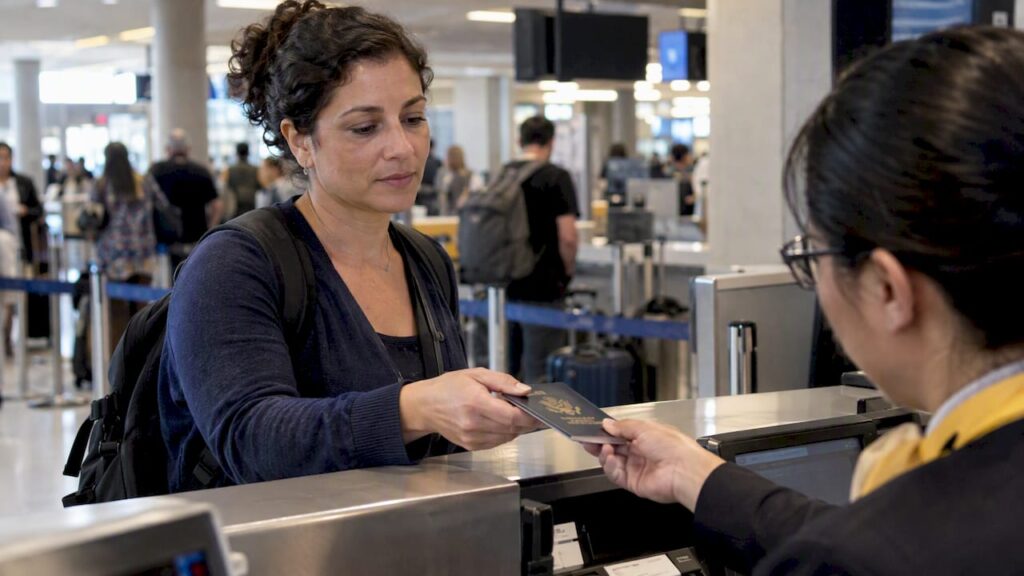
You cannot get a passport at the airport. Airports, airlines and TSA checkpoints do not issue, renew or replace U.S. passports. Only the State Department does that, through its passport agencies and centers. If you are reading this because your passport is expired, lost or missing days before a flight, the useful question is not what to do at the airport. It is which route gets a valid passport into your hands before you leave for it.
This guide covers both sides of the search: what you actually need to show at the airport, and how to get a passport quickly when the airport is already on your calendar.
TL;DR
- No airport issues passports. Fix the document problem before you travel, not at the terminal.
- U.S. citizens flying internationally need a valid passport book. A passport card does not work for international flights.
- Flying domestically, you need a REAL ID-compliant license or a passport. A passport alone satisfies TSA.
- Match your timeline to the route: a regional agency for travel within days or a family emergency, a registered courier for roughly 2 days to 4 weeks, and the post office for 4 weeks or more.
- Fast Passport Center is a State Department-registered courier that hand-delivers applications to passport agencies for travelers who live far from one.
Table of Contents
- What the airport does with your passport
- Flying within the U.S.: passport or REAL ID
- Why last-minute passport problems are so common
- Choose the route by your timeline
- Common airport scenarios and what to do
- What to carry to the airport once you have your passport
- Our perspective: the airport is too late
- Get a passport without a trip to an agency
- FAQ
- Sources
What the airport does with your passport
At the airport, your passport is a document to be checked, not obtained. Airline agents confirm it is valid for your destination, TSA confirms your identity at security, and Customs and Border Protection (CBP) inspects it when you re-enter the country.

For international flights, U.S. citizens must present a valid passport book. Passport cards and trusted traveler cards such as NEXUS or Global Entry are generally not accepted for international air travel, though a card can work at land and sea crossings. If you only hold a card, you will need a book before you fly abroad.
One detail travelers miss until check-in: the name on your ticket has to match your passport. CBP advises buying tickets in the exact name that appears on your passport or official ID. A mismatch can mean extra identity checks or a denied boarding. If you recently married, divorced or changed your name, resolve the passport first, then book.
Flying within the U.S.: passport or REAL ID
You do not need a passport for domestic flights, but you do need acceptable ID. Since May 7, 2025, TSA has required REAL ID-compliant identification, such as a REAL ID license or a U.S. passport, for adults boarding domestic flights. A standard, non-compliant license no longer works on its own.
That makes a valid passport the simplest backup. If your license is not compliant or you have misplaced it, a passport book or card gets you through the domestic checkpoint. TSA also offers a REAL ID readiness tool if you are not sure about your license.
If you arrive without acceptable ID
TSA ConfirmID is a last resort. It costs $45 and carries no guarantee that TSA can verify your identity. It is voluntary, and TSA recommends paying before you reach the airport so the process does not eat into your boarding time. It only verifies identity at the checkpoint. It does not replace a passport on an international trip.
Why last-minute passport problems are so common
Most airport passport emergencies share a few causes: a passport that expired without anyone noticing, one that was lost or stolen, one damaged by water or a washing machine, or a child who has never had a passport. Many countries also require several months of validity beyond your travel dates, so a passport that looks fine can still stop you at check-in. Check your destination’s entry rules and the expiration date months ahead.
The second cause is timing. The State Department currently lists 4 to 6 weeks for routine processing and 2 to 3 weeks for expedited processing, not counting mail time, which can add up to 2 weeks in each direction. Expedited service costs an additional $60 in government fees. If your flight is five weeks out and you mail a routine application, the math can already fail.
If a tax issue is part of why a passport application stalled, this overview of IRS passport revocation and a 30-day action plan explains that side of the problem.

Choose the route by your timeline
The right option depends almost entirely on how many days remain before you fly. Here is how we advise travelers to think about it.
Travel in 3 days or less, or a family emergency
The State Department’s regional passport agencies handle urgent cases, by appointment only. They accept appointments if you have urgent international travel within 14 days or need a foreign visa within 28 days. For a true crunch, with departure in a few days or a life-threatening emergency involving an immediate family member, the agency is the route, and it requires you to appear in person.
If you go, prepare. Agency buildings have airport-style security screening, require REAL ID-compliant identification to enter, and enforce prohibited-item rules. Our page on how a regional passport agency works walks through the timeline in more detail.
Be careful when booking. The State Department states that it does not charge fees for appointments and is not affiliated with third-party booking services. Anyone selling you an appointment slot should raise a flag.
Travel in 2 days to 4 weeks
This is where a registered courier earns its fee, especially if the nearest agency is two or more hours away. Cities like Tampa, Charlotte, Sacramento, Nashville and Louisville sit outside easy driving distance of an agency, and an appointment-only trip there means a day off work, travel costs and the risk of arriving with an incomplete application.
A courier removes that trip. Your application is reviewed by an agent, corrected before it is submitted, and delivered by hand to the agency. If you are somewhere in the 2-day to 4-week range, our overview of courier expediting for U.S. travelers explains what qualifies.
Travel 4 weeks or more away
If your trip is a month or more out and nothing is urgent, a routine or expedited application through a U.S. Postal Service acceptance facility is usually the practical choice. Build in the mailing time on both ends, and apply sooner than feels necessary. If your plans compress later, you can still move to a courier.
| Days until you fly | Typical route | Who it suits |
|---|---|---|
| Within 3 days, or family emergency | Regional passport agency, in person | Travelers who can reach an agency and meet the criteria |
| 2 days to 4 weeks | Registered courier | Travelers far from an agency who need a hand-delivered application |
| 4 weeks or more | Post office acceptance facility | Travelers with time to spare |
Common airport scenarios and what to do
Your passport expired and you found out before the trip
Do not wait for the airport to tell you. Check the date today. A renewal that is eligible for the mail-in process can be expedited, and if you are inside 14 days of travel you may qualify for an agency appointment. Our passport renewal service is built for exactly this case, and our guide to same-day passport renewal rules explains what is and is not possible in a single day.
You already applied and your trip is getting close
Your application’s locator number is useful. The first two digits identify which agency or center is handling your paperwork, which lets a customer service agent coordinate with that office. If you applied by mail and your departure is inside two weeks, read our page on how to expedite a passport after you have applied.
Your passport is lost, stolen or damaged
A damaged or lost passport is not valid, so treat it as a replacement case. That generally means a new application with the required forms and supporting documents. A courier can check those details before the application is submitted, which matters because a missing item is what turns a two-week wait into a four-week one. If you are overseas, your situation is different: a U.S. embassy or consulate handles replacements abroad.
Your child needs a first passport
First-time child applications have extra requirements, including parental consent. Most last-minute delays come from missing paperwork rather than government speed. Our rush child passport guide lists what parents should have ready.
You are a new citizen or need a second passport
New citizens often discover they need a passport quickly after the naturalization ceremony. Frequent travelers who need a second passport book for visa processing face a similar clock. Both can be handled through our new passport and second passport services.
What to carry to the airport once you have your passport
A passport in hand does not finish the job. Before you leave for the airport, run through a short checklist in your head: the passport book is signed and undamaged, the expiration date meets your destination’s rules, the name on your ticket matches it exactly, and you have a REAL ID or the passport itself for the domestic leg.
Keep the passport on your person, not in checked luggage. On the way home, remember that CBP requires you to declare more than $10,000 in cash or monetary instruments when entering the U.S. Failing to declare can lead to seizure and penalties. It is separate from passport inspection, but it happens at the same counter.
It is also worth protecting the document going forward. Our passport protection add-on is one option for travelers who have just been through a stressful replacement.
Our perspective: the airport is too late
In more than 20 years of working with urgent passport cases, the pattern has not changed. Travelers think about the passport last, and then the airport becomes the place where they find out something is wrong. By then, every option is narrower and more expensive.
The travelers who struggle most are not the ones with the toughest deadlines. They are the ones two or more hours from a regional agency, who assume the only choices are a long drive or a long wait. A registered courier changes that equation. We are a State Department-registered courier with drop-off offices in 24 cities, and our agents stay involved from the first form to the hand-delivery. We believe in matching the service to the timeline honestly: if you are inside 3 days and can reach an agency, that is the right path, and if you have four weeks or more, the post office may do. For everything in between, we are built for it.
One piece of practical advice we repeat often: do not wait for a perfect application. Have an agent look at it today, because the single most common reason urgent cases slip is a small error caught too late.
— Andy Irons
Get a passport without a trip to an agency
If your travel date is between a couple of days and four weeks away, Fast Passport Center can take on the process. You choose the service that fits your situation, from renewal to a child’s first passport to a replacement, and an experienced agent reviews your application for errors before it is delivered to the agency by courier. You get real-time order tracking and daily status updates, and you can drop off documents in person or ship them securely. Government fees are paid separately from our service fees. Start with our passport services page or go straight to our home page to begin an order.
If you live far from a major agency, our pages on a temporary U.S. passport and courier help and local offices such as El Paso and New York show how coverage works in your area.
FAQ
Can I get a passport at the airport?
No. No U.S. airport, airline or TSA checkpoint issues passports. Applications go through the State Department’s agencies and centers, or through a registered courier that delivers your application to an agency. If you have no valid passport and your flight is soon, start the process today rather than waiting for the airport.
Can I fly within the U.S. with only a passport?
Yes. A valid U.S. passport is one of the IDs TSA accepts, and it satisfies the REAL ID requirement for domestic flights. If your driver’s license is not REAL ID compliant, your passport can serve as your ID at the checkpoint.
How long is it taking to get a U.S. passport right now?
The State Department lists 4 to 6 weeks for routine service and 2 to 3 weeks for expedited service, plus mailing time. Those figures can change, so check the State Department’s processing time page before you book travel. If your trip falls inside those windows, a courier or agency appointment is the faster route.
What if I reach the airport without a passport or acceptable ID?
For international travel, you will not be able to board without a valid passport book. For domestic travel without acceptable ID, TSA ConfirmID is a paid, voluntary option that costs $45 and does not guarantee success. Paying before you arrive is strongly recommended.
Sources
- State Department: passport processing times
- State Department: make an appointment at a passport agency
- State Department: Honolulu Passport Agency visit requirements
- TSA: acceptable identification at the checkpoint
- TSA: REAL ID
- TSA: ConfirmID FAQs
- CBP: document requirements for air travel
- CBP: know before you go, traveling abroad
- CBP: applying for admission to the United States