If you take away one thing from this guide, take this: your passport and identification, your medications, and a working way to reach your embassy or consulate are the three items that matter most when travel goes wrong. If any one of them is missing or invalid right now, your next move is simple. Check your timeline against the sections below and act on the passport question first, since that clock moves the slowest.
TL;DR:
- Carry your passport, prescriptions, and a way to contact your embassy in your carry-on at all times, ensuring they are not in checked luggage or loose in your bag.
- Keep digital and physical copies of key documents separate from originals to speed up replacement processes if any are lost or stolen abroad.
- Pack enough medication for the entire trip, including buffers, and carry doctor’s notes with generic drug names to avoid customs issues.
- Enroll in STEP and store embassy contact information before departure to facilitate quick assistance during emergencies.
- Use expedited courier services like Fast Passport Center for passport issues within two weeks of travel, especially if regional agencies are far away or appointment availability is limited.
Table of Contents
- Packable Emergency Travel Checklist: Carry-On Go-Bag and Document Kit
- Documents and Identification Protocol: Copies, Storage, and Lost or Stolen Steps
- Medical Preparations and Prescription Guidance for Travelers
- Communications and Official Contacts for Emergencies Abroad
- Money and Financial Access if Something Goes Wrong
- Electronics, Batteries, and Airport Screening Rules
- Last-Minute Passport Solutions and Timelines That Actually Work
- Your 10-Minute Emergency Readiness Routine
- Tailoring Your Kit for Chronic Conditions or Destination-Specific Risks
- Transportation and Accommodation Backup Plans
- Finding Emergency Local Services and Healthcare Abroad
- Local Laws and Customs You Should Know Before an Emergency
- Why Documents and Medication Come Before Everything Else
- How Fast Passport Center Helps When Travel Is Already Close
- Sources
- FAQ
Packable Emergency Travel Checklist: Carry-On Go-Bag and Document Kit
Your emergency kit should live in your carry-on, never in checked luggage. If your bag is delayed or lost, you still need access to your documents, your medication, and a way to communicate. Build the kit around four categories: documents, first aid, survival basics, and comfort items, then organize everything so you can find what you need in seconds, not minutes with a recommended European Breakdown & Emergency Travel Kit.
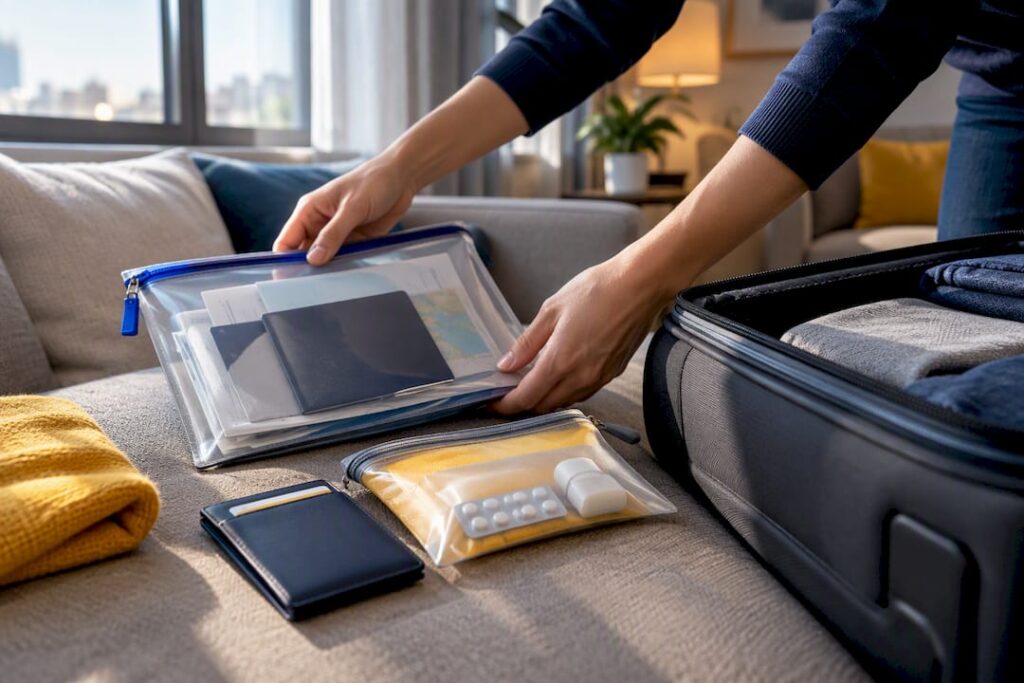
Start with what protects your ability to travel and prove who you are. Your passport, a printed copy of its data page, and a copy of any visa should sit in a dedicated pouch, not loose in a bag pocket. Add your prescriptions in their original, labeled bottles rather than a weekly pill organizer, since customs officers and pharmacists abroad need to see what the medication actually is. Bring your phone, a portable charger, a small amount of emergency cash in a second currency if you are heading abroad, and a backup payment card kept separate from your primary wallet.
- Documents pouch: passport, printed data page copy, visa copies, driver’s license copy, and travel insurance details.
- First aid basics: adhesive bandages, antiseptic wipes, blister treatment, an instant cold pack, and basic over-the-counter pain relievers.
- Allergy and chronic condition items: an EpiPen if prescribed, plus any daily medication with several days of buffer supply.
- Survival and comfort: a reusable water bottle, high-calorie nonperishable snacks, a flashlight or headlamp, a whistle, an emergency blanket, and a compact multi-tool.
- Backup access: encrypted cloud copies of your documents and offline screenshots saved directly to your phone in case you lose signal or Wi-Fi.
The American Red Cross recommends building a first aid kit around your trip’s length and destination, with core items like adhesive bandages, antiseptic wipes, pain relievers, and blister care, then tailoring the kit further for remote travel or chronic health needs.
Keep the whole system visible and simple. A clear plastic pouch for documents, a labeled zip pocket for medications, and a separate slim wallet for backup cash and cards mean you are not digging through a full suitcase during a stressful moment.
Pro Tip: Photograph the inside of your kit once it’s packed, so if a pouch goes missing you know exactly what to replace and in what order.
Documents and Identification Protocol: Copies, Storage, and Lost or Stolen Steps
Originals and copies should never travel in the same bag. Keep your passport on your person or in a secured hotel safe, while copies of the data page, any visas, your driver’s license, and a copy of your birth certificate stay in a separate waterproof pouch packed elsewhere in your luggage. Add a printed travel itinerary and your insurance policy number to that same pouch, and store encrypted digital copies in the cloud plus an offline screenshot on your phone as a final backup.
If a passport or ID goes missing, the sequence matters:
- File a police report immediately if your destination requires one for replacement purposes, and keep the report number or a scanned copy.
- Notify your airline if travel documents were in a stolen bag, since this affects your ability to board.
- Contact the nearest U.S. embassy or consulate as soon as possible. According to the U.S. Department of State, once you report your passport lost or stolen it is no longer valid for travel, and the embassy or consulate can often issue an emergency passport to get you home.
- Bring what the consulate will ask for: a passport photo, proof of citizenship such as a birth certificate copy, another form of photo ID, and your travel itinerary showing onward or return flights.
- A police report speeds this process considerably; consulates frequently request written proof of loss, so a scanned report or incident number in your documents pouch saves time at the appointment.
Read our full breakdown of how to replace a lost passport fast for a step-by-step walkthrough of this exact scenario, and see what qualifies as an emergency travel document if you need to travel before a full replacement can be issued.
Medical Preparations and Prescription Guidance for Travelers
Medication problems abroad are almost always preventable with the right packing and paperwork. The CDC recommends carrying enough medication for your entire trip plus several extra days in case of delays, and keeping every medication in its original, labeled container rather than a pill organizer, since customs and pharmacy staff need to verify what you’re carrying.
- Request a doctor’s note listing generic drug names, exact dosages, and a brief medical justification, especially for controlled substances or injectable medications.
- If you manage a chronic condition, the CDC Yellow Book recommends consulting a travel medicine specialist four to six weeks before departure to review vaccines, medication adjustments, and destination-specific risks.
- Keep all medications and medical devices in your carry-on, never in checked luggage, and follow TSA screening instructions for any device that requires special handling.
- Consider travel medical insurance that includes medical evacuation coverage, particularly for trips to remote areas or countries with limited hospital access.
Medically necessary liquids, medications, and creams over 3.4 ounces are allowed in carry-on bags, but they must be declared at the security checkpoint, according to the CDC. Declaring these items upfront avoids delays and prevents confiscation at screening.
Communications and Official Contacts for Emergencies Abroad
A communications plan is only useful if you set it up before you leave. Enroll in the Smart Traveler Enrollment Program, a free U.S. Department of State service that sends destination-specific alerts and makes it easier for a U.S. embassy or consulate to reach you if a crisis develops. Store your destination’s embassy and consulate contact information in your phone and on a printed card in your documents pouch.
- Enroll in STEP before departure so the State Department has your itinerary and contact details on file.
- Save the nearest embassy or consulate’s address and phone number, plus the State Department’s main emergency contact line.
- Build a compact emergency contact card listing a domestic emergency contact, your insurance provider, and your doctor.
- Prepare fallback communication options: a local SIM card, an offline map downloaded in advance, and a plan to use SMS over voice calls when signal is weak.
Money and Financial Access if Something Goes Wrong
A lost wallet or a frozen card should never leave you stranded. Split your money across at least two places: a small amount of hidden cash and a backup payment card kept separate from your primary wallet. If your main cards fail, you want a second option that doesn’t depend on the same bag or pocket.
- Keep a small cash reserve and one backup card physically separate from your everyday wallet.
- Identify a trusted contact at home who could send emergency funds through a transfer app if needed.
- Call your card issuers before you travel so international transactions aren’t flagged as fraud, and save their contact numbers where you can reach them without your phone.
- Look into travel insurance plans that include emergency financial assistance for situations like theft or medical costs.
Electronics, Batteries, and Airport Screening Rules
Battery rules catch travelers off guard more often than almost anything else at security. According to the TSA, power banks and spare lithium batteries must travel in carry-on baggage, never in checked luggage, and devices containing lithium metal or lithium-ion batteries fall under this same rule.
- Pack all power banks and spare batteries in your carry-on, and keep them in an easily accessible pouch so screening goes quickly.
- If you rely on a battery-powered medical device, confirm your airline’s policy in advance and bring any manufacturer documentation that explains the device.
- Keep chargers and an offline copy of your key documents in the same accessible pocket as your electronics.
- Label any spare SIM cards clearly and store adaptors somewhere they won’t get crushed or lost.
Last-Minute Passport Solutions and Timelines That Actually Work
How fast you can fix a passport problem depends entirely on how much time you have left before departure. The right path changes sharply depending on where that deadline falls.
- Within 3 days, or a genuine family emergency: a regional passport agency is your only realistic option, and it requires an in-person appointment with supporting documentation.
- Between 2 days and 4 weeks out: an expediting courier service becomes the practical choice, especially if you live hours from the nearest regional agency. A registered courier can hand-deliver your application with the required proofs, without you needing to travel to an agency in person.
- 4 or more weeks out: standard USPS processing works fine and costs less, since you have time to spare.
If you live in a city like Tampa, Charlotte, Sacramento, Nashville, or Louisville, the nearest regional agency may be hours away, which makes a courier the far more realistic path for anything inside that 2 day to 4 week window. Before submitting through any expedited channel, gather your current passport if you have one, a passport-style photo, proof of travel such as a flight itinerary, and any supporting paperwork your specific situation requires. Our guide on expedited passport requirements walks through exactly what couriers need from travelers in this window.
Your 10-Minute Emergency Readiness Routine
Run through this now, before you’re standing at a departure gate wondering what you forgot.
- Confirm your passport is valid for at least six months past your return date and locate your ID.
- Check that prescriptions are in original containers with enough supply for the full trip plus a few extra days.
- Charge your phone and pack a portable charger in your carry-on.
- Set aside emergency cash and a backup card separate from your main wallet.
- Save your embassy contact, STEP confirmation, and emergency contacts to your phone and a printed card.
- Photograph your passport, ID, and insurance card, then upload them to a secure cloud folder.
If you discover your passport is missing, expired, or damaged during this routine, call an expediting service immediately rather than waiting, since document processing time is the one thing you can’t compress at the last minute.
Tailoring Your Kit for Chronic Conditions or Destination-Specific Risks
A generic emergency kit isn’t enough if you manage diabetes, a heart condition, severe allergies, or another ongoing health need. Add a copy of your prescription list with generic drug names, your doctor’s contact information, and any device documentation you might need to explain to airport staff or a foreign pharmacist. The CDC Yellow Book recommends coordinating with both your primary clinician and a travel medicine specialist, ideally four to six weeks before departure, so any needed vaccines or medication adjustments happen with time to spare.
Destination matters just as much as your health history. Travel to a region with limited medical infrastructure calls for a larger medication buffer and a more detailed medical letter, while travel to an area with known disease risks may call for specific vaccines or preventive medication arranged well in advance. If your itinerary includes remote areas, altitude, or extreme climates, adjust your first aid kit accordingly and confirm your insurance covers evacuation from that specific location.

Transportation and Accommodation Backup Plans
A missed flight or a canceled reservation shouldn’t derail your entire trip if you’ve planned even one alternative in advance. Before departure, note a backup route or carrier for your most critical connections, and keep the booking confirmation for your accommodation saved offline in case Wi-Fi fails right when you need it.
For longer trips, identify at least one alternate way to reach your final destination, whether that’s a different airline, a train, or a rental car option, and know roughly what it would cost. If your accommodation falls through, having the name and address of a backup hotel or a short list of nearby options saved on your phone means you’re not searching blind at midnight in an unfamiliar city.
Finding Emergency Local Services and Healthcare Abroad
Knowing how to find help before you need it changes how a bad situation plays out. Before you leave, identify the nearest hospital or clinic to your accommodation and save its address and phone number. Many countries have a different emergency number than what you’re used to at home, so confirm the local equivalent for police, fire, and medical services as soon as you land.

Your embassy or consulate can often provide a list of local doctors, dentists, and hospitals that work with international travelers, which is worth requesting if you’re heading somewhere remote. Hotel front desks and travel insurance hotlines are also reliable resources for quickly locating urgent care that speaks your language or accepts your insurance.
Local Laws and Customs You Should Know Before an Emergency
What counts as a minor issue at home can carry serious consequences elsewhere, and this matters most in exactly the moments when you’re already stressed. Research your destination’s laws around medication, since some countries restrict drugs that are legal and common in the U.S., including certain prescription painkillers and stimulants.
Familiarize yourself with local customs around interacting with police and medical staff, including whether you’re expected to carry ID at all times or whether photography is restricted near government buildings. If you’re unsure whether something is permitted, your embassy or consulate can often clarify the governing rule for your situation rather than leaving you to guess.
Why Documents and Medication Come Before Everything Else
Every other item in your kit is a convenience. Your passport and your medication are the two things that can actually strand you if they fail, which is why they get first priority in every section of this checklist. Redundancy is not overpacking. It’s the difference between a stressful afternoon and a lost trip.
— Andy Irons
How Fast Passport Center Helps When Travel Is Already Close
If your passport problem falls inside that 2 day to 4 week window, an expediting courier is almost always your fastest realistic option, especially if the nearest regional agency is hours from home. Fast Passport Center operates as a courier with direct hand-delivery to passport agencies and offers services designed for urgent travelers, including expedited passport processing, emergency passport service, replacement for a lost or stolen passport, and child passport applications, with real-time order tracking and agent assistance.
Before you reach out, gather your current or damaged passport if you have one, a recent passport photo, proof of upcoming travel, and any supporting documents your specific case requires. Start your application through Fast Passport Center or review the expedited passport service page to see exactly what your timeline qualifies for.
This article is general information, not a substitute for advice from a qualified doctor. Consult a qualified healthcare professional about your own circumstances before acting on anything here.
Sources
- Traveling abroad with medicine | Travelers’ Health | CDC
- Lost or stolen passport abroad | U.S. Department of State
- External medical devices | TSA
- Travel first aid kit essentials | American Red Cross
FAQ
What is the most forgotten item when packing for vacation?
Travelers most often forget backup copies of their documents, whether that’s a printed passport data page or a photo saved offline. A missing backup rarely matters until an original is lost, at which point it becomes the item you wish you’d packed.
What are 10 items in an emergency go bag?
A solid emergency go bag includes your passport and ID copies, medications in original containers, a phone charger, emergency cash, a backup card, a basic first aid kit, a flashlight, a water bottle, an emergency blanket, and a multi-tool. The American Red Cross recommends tailoring the first aid portion to your trip length and destination.
What are 10 items I need for a trip?
Beyond clothing, prioritize your passport and printed copies, prescriptions in original bottles, a phone and charger, emergency cash and a backup card, travel insurance details, a compact first aid kit, and your embassy or STEP enrollment confirmation. These items cover the documents, medical, and communications priorities that matter most if something goes wrong.
What are the 5 most important things you should do before traveling?
Confirm your passport’s validity, pack medications in original labeled containers with extra supply, enroll in the Smart Traveler Enrollment Program, notify your card issuers of travel dates, and back up your documents to the cloud and offline. Each step protects a different point of failure, so skipping one leaves a real gap.
How quickly can I get a passport if my trip is in 2 weeks?
A trip two weeks out generally falls in the window where an expediting courier service is the fastest realistic path, since regional passport agencies require in-person appointments that can be hard to secure and reach on short notice. Services like Fast Passport Center specialize in this exact timeline for travelers who need a hand-delivered application.