
Yes, U.S. passport holders can apply for an India e-Visa entirely online through the official e-Visa portal. Before you fill out anything, confirm two things: your passport has at least six months’ validity from your arrival date, and you’re applying under the right visa category for your trip.
- Start at the official Government of India e-Visa portal, not a third-party site
- Confirm your passport meets the validity and blank-page rules
- If your trip is within the next few days and your passport is expired, damaged, or missing, your first move is fixing the passport, not the visa
Key Takeaways
U.S. citizens can complete an India e-Visa application entirely online in about 15 minutes, provided their passport meets the six-month validity and two-blank-page requirements.
| Point | Details |
|---|---|
| Apply at the official portal | Use indianvisaonline.gov.in exclusively; third-party sites can’t speed up approval. |
| Check passport validity first | You need six months’ validity and two blank pages from your arrival date. |
| Apply at least 4 days ahead | e-Tourist and e-Business need a 4-day minimum lead time; e-Visas aren’t extendable. |
| Fees are non-refundable | Seasonal 30-day fees run $10, plus roughly 2.5% in bank charges. |
| Fix passport problems fast | If your passport is expired or damaged with under 4 weeks until travel, Fast Passport Center’s courier service can get you travel-ready before you touch the e-Visa portal. |
Table of Contents
- India E-Visa USA: Which Categories Apply to You
- What Passport and Document Requirements You Need to Meet
- India E-Visa Processing Time and Fees You Should Expect
- How to Apply for an India E-Visa Step by Step
- How Long Does India E-Visa Processing Take?
- What Happens at Arrival With an India E-Visa?
- How to Avoid India E-Visa Scams and Third-Party Overcharges
- Do U.S. Consulates in America Process India E-Visas?
- When Passport Problems Threaten Your India Trip
- Transit and Layover Rules for the India E-Visa
- Why India E-Visa Applications Get Rejected
- Can You Extend or Convert an India E-Visa?
- Get Your Passport Trip-Ready Before You Touch the E-Visa Portal
- Timing Is Everything With India Travel Documents
- Sources
- FAQ
India E-Visa USA: Which Categories Apply to You
The e-Visa system covers several categories, and picking the wrong one is a common, avoidable mistake for U.S. applicants. The main options include:
- e-Tourist visa: sightseeing, casual visits to friends or family, short yoga programs
- e-Business visa: meetings, trade contacts, or setting up a venture
- e-Medical visa: treatment at a recognized Indian hospital
- e-Medical Attendant visa: for someone accompanying an e-Medical visa holder
- e-Conference visa: attendance at a specific conference or seminar
- e-Ayush visa: traditional Indian medicine treatment
Stay limits, entry counts, and permitted activities vary by category, and some (like e-Business) allow limited combined activities. Diplomatic and official passport holders, and anyone with a visa endorsed on a separate passport, fall outside the e-Visa system entirely.
What Passport and Document Requirements You Need to Meet
Your passport is the single biggest point of failure in this process, and the rules are specific. Follow these before you touch the application:
- Confirm your passport has at least six months’ validity from your date of arrival in India, plus two blank pages for stamping, as Government of India guidance requires.
- If your ETA was issued on a passport you’ve since renewed or replaced, carry both the old passport (with the ETA) and your new valid passport when you travel.
- Prepare a digital passport-style photo and the biodata page scan in the exact format and file size the portal specifies. Any supporting documents (invitation letters, medical referrals) should be in English or accompanied by a certified translation.
Skipping any of these three steps is the fastest way to get flagged for resubmission or denied boarding at the gate.
India E-Visa Processing Time and Fees You Should Expect
Fees change seasonally and by validity period, and every dollar you pay is non-refundable once submitted. Official Indian missions publish these figures directly:
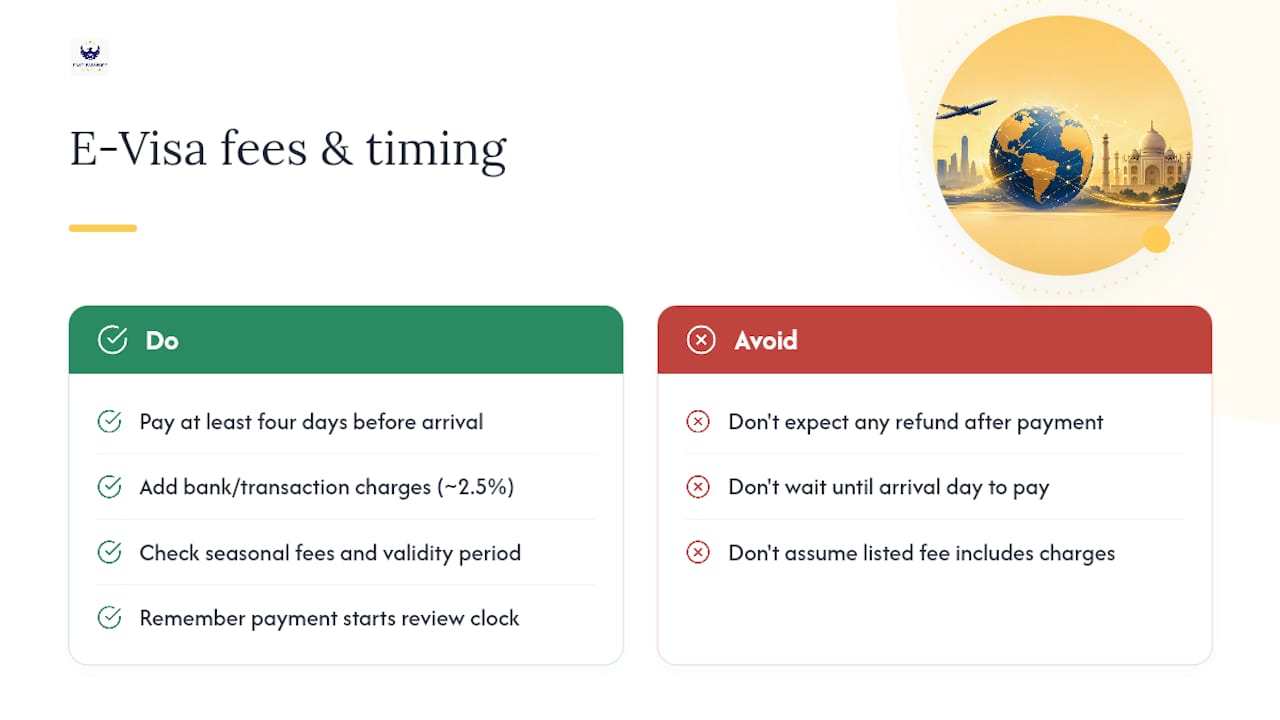
Bank and transaction charges (often an additional 2.5%) apply on top of the listed fee, according to the Consulate General of India, San Francisco. Pay at least four days before your scheduled arrival, since payment triggers the review clock, and there’s no refund path if your plans change or your application is rejected after payment clears.
How to Apply for an India E-Visa Step by Step
The application itself takes most travelers about 10 to 15 minutes once documents are ready, but rushing the upload step is where people stumble. Here’s the order that works:
- Go directly to the e-Visa portal and select “Apply for e-Visa,” then choose your category (Tourist, Business, Medical, and so on).
- Fill in your personal, passport, and travel details exactly as they appear on your passport. A single mismatched digit can delay review.
- Upload your photo and passport scan in the required specifications. If the system flags an image, official guidance recommends re-uploading corrected files within 24 hours rather than starting over.
- Save your progress if you need to step away. Partial applications can be resumed, which matters if you’re gathering documents on a deadline.
- Pay the visa fee online through the portal’s payment gateway. You’ll get a payment confirmation, and separately, an ETA (Electronic Travel Authorization) arrives by email once approved.
- Print your ETA. Airlines and Indian immigration both expect a physical or clearly displayed digital copy at check-in and arrival.
Pro Tip: Double-check your name, date of birth, and passport number against your passport before submitting. The portal won’t catch typos, and a mismatched application can mean starting the entire process over, which burns days you may not have.
How Long Does India E-Visa Processing Take?
The single biggest scheduling mistake U.S. travelers make is treating “processing time” as flexible. It isn’t. The rules break down by category:
- e-Tourist and e-Business: apply at least four days before your arrival date, per the Consulate General of India, New York.
- e-Medical and e-Conference: also require a four-day minimum lead time, but you can select an arrival date up to 120 days out, giving more scheduling flexibility for treatment or event planning.
- No extensions, no conversions: once issued, an e-Visa cannot be extended past its stated validity, and it cannot be converted into a different visa category while you’re in India.
Plan your trip dates around these fixed windows rather than assuming same-day or next-day approval is realistic.
What Happens at Arrival With an India E-Visa?
Landing in India with an e-Visa involves a few extra steps compared to a standard visa stamp, and skipping preparation here causes real delays at the airport.
- Print your ETA before you fly. Airlines routinely check it at check-in, and immigration officers require it at the border.
- Immigration will capture your biometric details (photograph and fingerprints) and stamp your passport at your designated port of entry.
- Restricted and protected areas of India require separate prior permission. An e-Visa alone doesn’t grant access to these zones.
- If your ETA is tied to an old passport, bring that passport along with your current one, since officials confirm mismatched documents are a frequent cause of boarding denial.
How to Avoid India E-Visa Scams and Third-Party Overcharges
Search results for India e-Visa applications are crowded with lookalike sites charging premium fees for a service the government provides directly. Protect yourself with a few checks:
- Confirm you’re on indianvisaonline.gov.in before entering any personal or payment information.
- No agent or intermediary can speed up government approval. Sites promising “express” or “guaranteed fast” e-Visas are typically just charging extra for form-filling you can do yourself, as the Embassy of India notes plainly.
- If you have questions about your application, go straight to the official helpdesk at indiatvoa@gov.in or the portal’s listed helpline.
Pro Tip: If a website’s URL has extra words, hyphens, or a different domain extension than the official portal, close the tab. Scam sites often mimic the layout almost perfectly, but the address always gives them away.
Do U.S. Consulates in America Process India E-Visas?
No. U.S.-based Indian consulates and the Embassy in Washington don’t process e-Visa applications, and reaching out to them for e-Visa status updates just wastes time you don’t have.
- Route all e-Visa questions to the central portal or the indiatvoa@gov.in helpdesk, never a regional consulate.
- Consulates handle regular paper visas, passport-related consular matters, and other non-electronic visa categories.
- Save consulate contact for issues unrelated to the online e-Visa system, such as document attestation or emergency consular services.
When Passport Problems Threaten Your India Trip
An e-Visa application means nothing if your passport itself isn’t travel-ready, and that’s where timing decisions matter most. Your best path depends entirely on how many days you have left:
- Under 3 days or a genuine emergency: an in-person visit to a regional passport agency is your only realistic option.
- 2 days to 4 weeks out: a registered courier and expediting service is the practical choice, since it avoids agency appointment backlogs entirely.
- 4 or more weeks out: a standard USPS passport application usually has enough runway to process normally.
Travelers in cities like Tampa, Charlotte, Sacramento, Nashville, and Louisville often sit two or more hours from the nearest regional passport agency. For them, a courier service isn’t a convenience. It’s the only way to meet a 2-to-4-week deadline without burning a full travel day on a drive.
Fast Passport Center is registered directly with the U.S. State Department, holds an A+ Better Business Bureau rating, and operates physical drop-off offices in 24 cities nationwide. Its simultaneous visa processing coordination means you can address a passport problem and prepare your India e-Visa documents at the same time, rather than solving one crisis before starting the next.
Transit and Layover Rules for the India E-Visa
If your flight to a final destination routes through an Indian airport, the rules depend entirely on whether you leave the airport transit area. A same-terminal or airside connection, where you never pass through immigration, generally doesn’t require an e-Visa at all. Airlines handle these passengers under standard international transit procedures.
The moment your itinerary requires you to clear immigration, even briefly, to switch terminals, collect checked luggage, or exit for a layover longer than a few hours, you need a valid e-Visa or another visa category before you land. There’s no separate “transit e-Visa” category listed among the standard e-Visa types (Tourist, Business, Medical, Medical Attendant, Conference, Ayush), so travelers needing to exit the airport during a layover should apply for the e-Visa category that matches the actual purpose of their stop, most often e-Tourist or e-Business.
Double-check your specific airline routing before assuming you’re covered. Layover lengths and terminal transfer requirements vary by airport and carrier, and immigration officers make the final call on whether your connection counts as “airside only” or requires clearance. If there’s any ambiguity, and especially if your layover exceeds a few hours or involves an overnight stay, apply for the e-Visa in advance rather than risk being denied boarding at your origin airport. Airlines routinely deny boarding to passengers without proper documentation, since they bear responsibility for return transport if a passenger is refused entry.
Build in the standard four-day minimum lead time for whichever category you apply under, the same rule that governs any other e-Visa application, regardless of whether your final destination is India itself or somewhere beyond it.
Why India E-Visa Applications Get Rejected
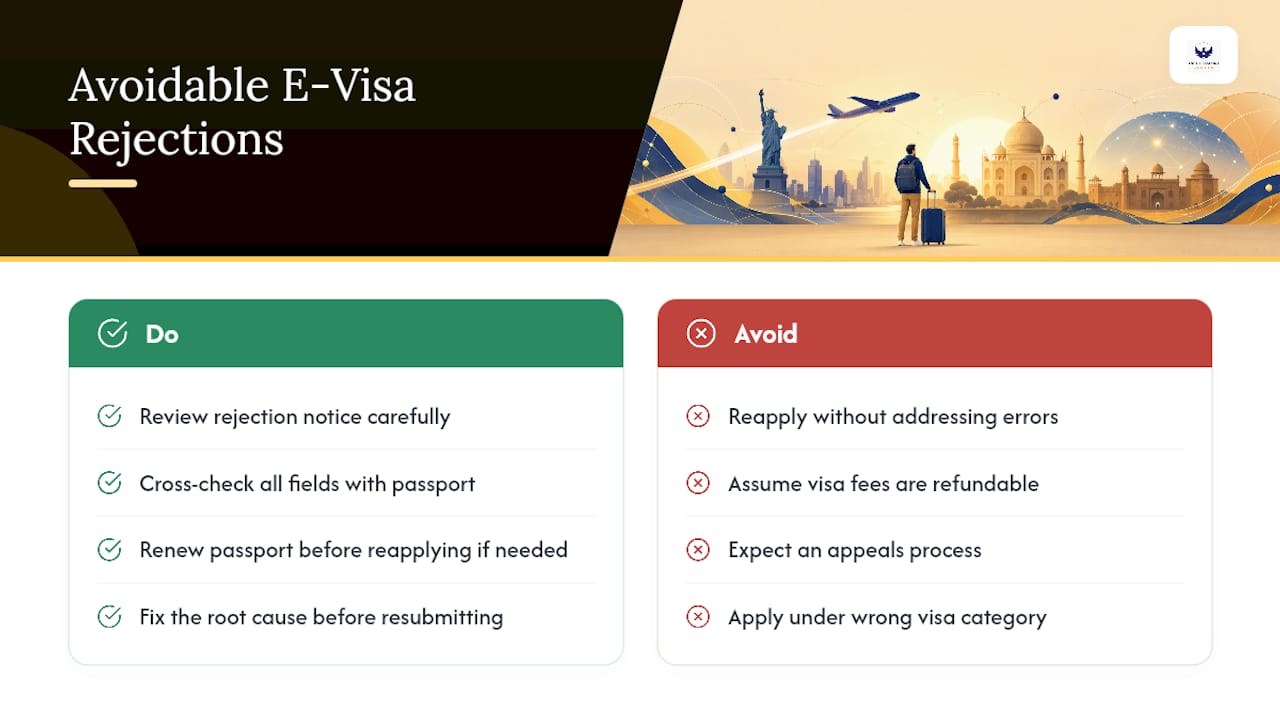
Rejections happen for reasons that are almost always preventable, and understanding them upfront saves you from repeating the same mistake on a second attempt. The most common triggers include mismatched information between your application and your passport, an unreadable or incorrectly sized photo upload, insufficient passport validity or blank pages, and applying under the wrong visa category for your stated purpose of travel.
A rejected e-Visa application doesn’t carry the same weight as a denied visa stamped in a passport. You’re generally free to reapply, but you’ll need to correct whatever caused the initial rejection and pay the visa fee again in full, since fees are non-refundable regardless of outcome, as the Consulate General of India, San Francisco states clearly. There’s no appeals process built into the e-Visa system the way there might be for a traditional consular visa denial.
Before you reapply, review the rejection notice carefully if one is provided, and cross-check every field against your current passport. If the issue was a passport validity problem, that’s not something you can fix through the visa portal at all. You’ll need to renew or replace your passport first, then submit a fresh e-Visa application against the new document. This is precisely the scenario where a compressed timeline gets dangerous: if your trip is three weeks out and you discover a passport validity issue only after a rejection, you no longer have time for standard mail-in renewal.
Reapplying multiple times without addressing the root cause doesn’t improve your odds. Each submission is evaluated independently, and the portal has no memory of “good faith” from a prior attempt. Get the passport and document details right before you submit again.
Can You Extend or Convert an India E-Visa?
The short answer is no, not in any meaningful way. Once issued, an e-Visa is fixed to its stated validity period and category, and India’s immigration framework doesn’t offer a path to extend an e-Visa’s duration or convert it into a different visa type while you’re in the country.
This is a firm limitation compared to some other countries’ visa systems, and it catches travelers off guard when plans shift mid-trip. If your e-Tourist visa’s 30-day validity is about to expire but you’d like to stay longer, or if you arrived on a Tourist visa but a business opportunity emerges requiring Business visa status, the e-Visa system offers no built-in mechanism to handle either scenario.
In genuinely exceptional circumstances, such as a medical emergency that prevents departure, travelers may need to work with India’s Foreigners Regional Registration Office (FRRO) or a similar local authority, though outcomes vary and aren’t guaranteed under standard e-Visa terms. This isn’t a routine extension process. It’s an exception handled case by case, and it shouldn’t factor into your planning.
The practical takeaway is to plan your trip dates conservatively from the outset. If there’s any chance your visit could run longer than expected, consider whether a different visa category with a longer built-in stay period fits your situation better before you apply, rather than assuming you can adjust later. Once you’ve submitted and received your ETA, your validity window and category are locked in for that trip.
Get Your Passport Trip-Ready Before You Touch the E-Visa Portal
An India e-Visa is only as good as the passport behind it, and that’s where Fast Passport Center steps in as the practical fix when you’re 2 to 4 weeks from departure and your passport is expired, damaged, or missing. Unlike a standard USPS renewal that can take weeks with no guaranteed timeline, Fast Passport Center works as a U.S. Department of State registered courier, hand-delivering your application directly to a passport agency.
With drop-off offices in 24 cities and over 20 years handling expedited documents, Fast Passport Center pairs real agents with your file instead of leaving you to guess at agency wait times. One honest limit worth stating plainly: expediting your passport doesn’t touch the e-Visa process itself. You’ll still complete that application separately through the official Government of India portal once your new passport is in hand. What Fast Passport Center solves is the document bottleneck that stops you from applying at all. If your passport won’t clear the six-month validity rule before your trip, start with the passport expediting service page to see how fast your specific timeline can move.
Timing Is Everything With India Travel Documents
Cutting it close on passport validity is the single most preventable reason U.S. travelers get denied boarding to India. If your timeline is tight, fix the passport first, verify your ETA status before you leave, and carry every relevant document. For anyone racing a deadline, reaching out to Fast Passport Center early is the more reliable move than hoping standard processing catches up.
— Andy Irons
Sources
- e-Visa
- Welcome to Embassy of India, Washington D C, USA
- E-Visa | Consulate General of India, San Francisco, USA
FAQ
Can I Get an India E-Visa From the USA?
Yes. U.S. citizens apply entirely online through the official Government of India e-Visa portal, with no need to visit a consulate in person.
How Long Does It Take to Get an Indian E-Visa From the USA?
Standard processing requires a minimum four-day lead time before arrival for e-Tourist and e-Business categories, though applying earlier gives you a buffer against document resubmission requests.
Can US Citizens Get an India Visa on Arrival?
No. India doesn’t offer visa-on-arrival for U.S. citizens; you must secure your ETA online before departure and present it printed at immigration.
Is India Issuing E-Visas Now?
Yes, the e-Visa system is fully operational for U.S. applicants across Tourist, Business, Medical, Medical Attendant, Conference, and Ayush categories through the official portal.
What if My Passport Won’t Meet the Six-Month Validity Rule in Time?
If your trip is 2 to 4 weeks away and your passport needs renewal, an expediting service like Fast Passport Center can get a valid passport in hand before you submit your e-Visa application.