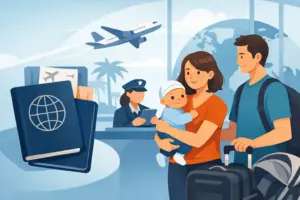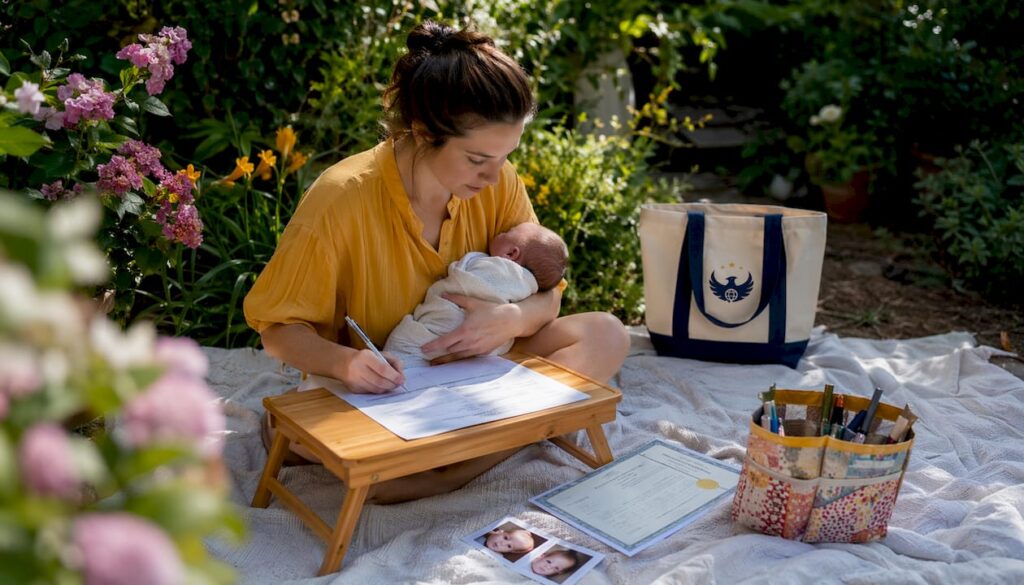
A newborn passport application is a formal U.S. State Department process that requires in-person submission, specific documents proving citizenship and parental identity, and compliance with Form DS-11 guidelines. Every child, regardless of age, needs a valid passport for international travel. There are no exceptions for infants or newborns. Understanding how the newborn passport application works before you schedule your appointment saves you from costly return trips and delays that could derail your travel plans.
What documents are required for a newborn passport application?
The foundation of a successful baby passport application is gathering the right paperwork before you ever step foot in an acceptance facility. Missing even one document means you leave without submitting anything.
Here is what you need to bring:
- Certified original birth certificate. This is your child’s proof of U.S. citizenship. A hospital-issued keepsake certificate does not qualify. You need the government-issued version with a raised seal from the vital records office in the state where your baby was born.
- Completed but unsigned Form DS-11. The DS-11 form is the standard first-time passport application. You fill it out in advance but leave the signature line blank until the acceptance agent instructs you to sign.
- Parental photo IDs and photocopies. Both parents must provide a government-issued photo ID. You also need a photocopy of the front and back of each ID on plain white paper.
- Two compliant 2×2 passport photos. A baby’s passport photo must be recent, taken within the last six months, with the face clear and centered against a plain white background. Non-compliant photos result in rejection at the appointment.
- Notarized Form DS-3053 if one parent is absent. If only one parent can attend, the absent parent must complete a notarized Statement of Consent. A travel affidavit for minors follows similar legal standards and can help you understand what this consent process involves.
- Social Security number or sworn statement. If your baby’s Social Security number is not yet assigned, you can submit a sworn statement in its place. Confirm this option with your specific acceptance facility before your appointment, since protocols vary by location.
Pro Tip: Start the birth certificate request 2–3 weeks before you plan to apply. Certified copies from state vital records offices typically take 5–10 business days to arrive.
How does the in-person appointment work for a newborn passport?
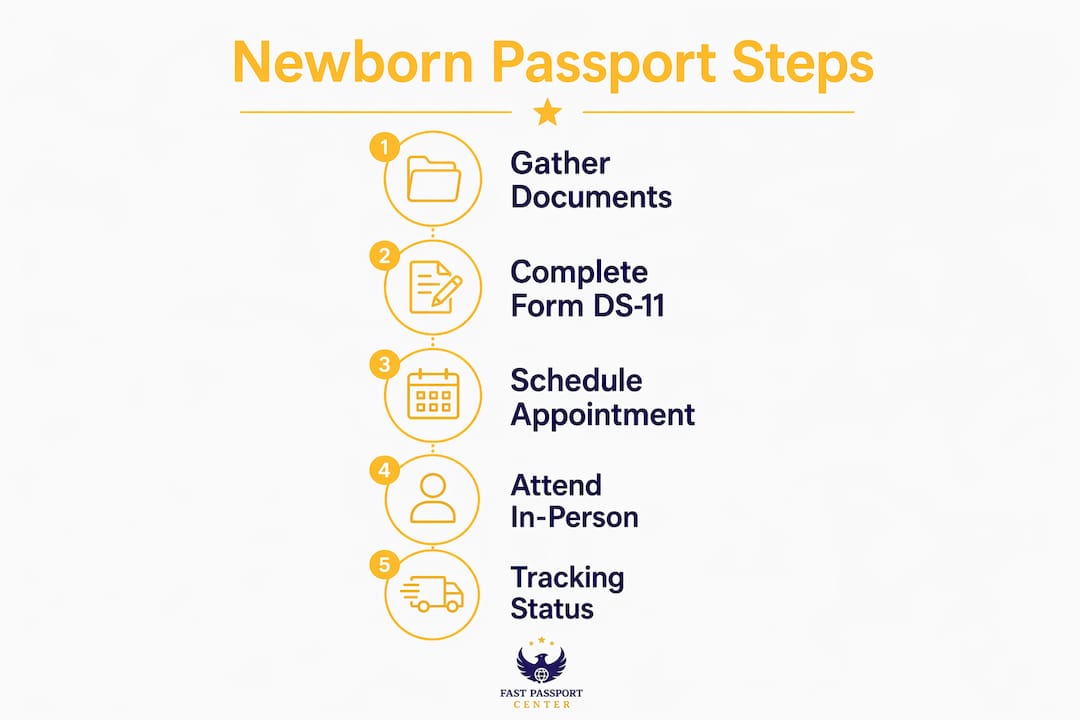
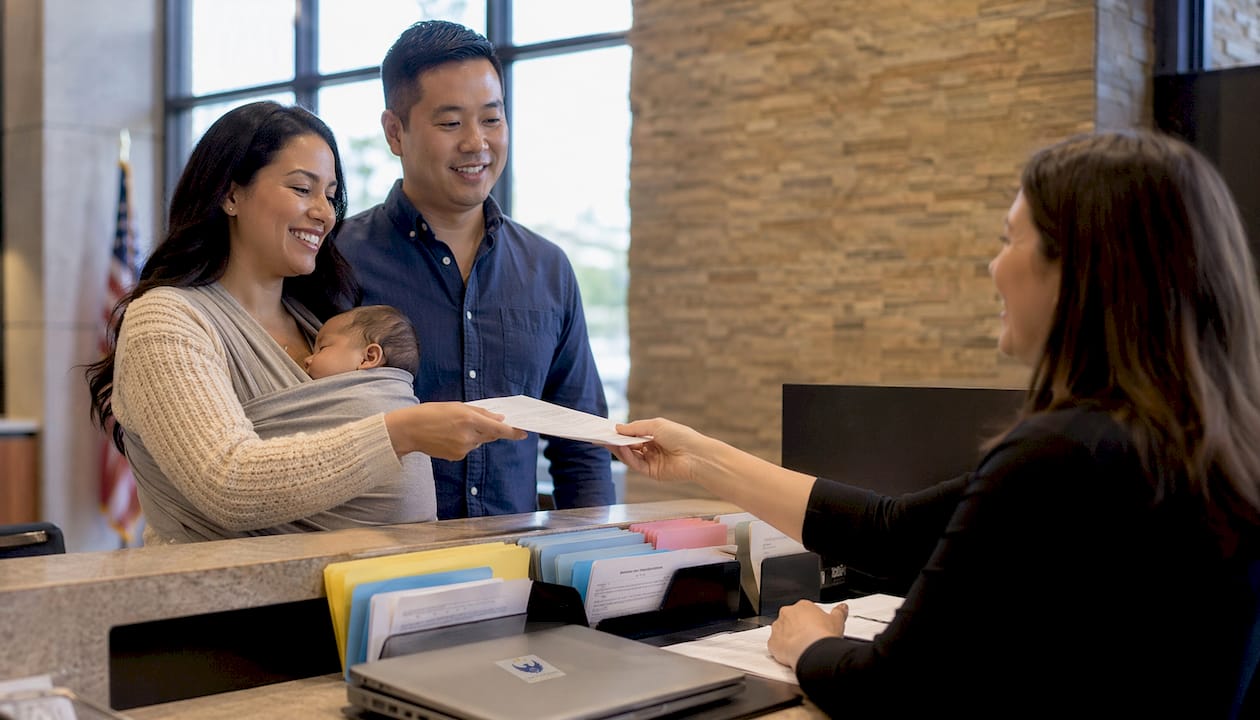
The in-person appointment is where the newborn passport process becomes official. First-time child passport applications for children under 16 must be submitted in person at an authorized acceptance facility, with both parents or guardians present.
Here is what to expect, step by step:
- Schedule your appointment in advance. Many post offices and acceptance facilities are appointment-only. Booking 2–4 weeks ahead is standard, and peak travel seasons push that window even further out. Walk-in availability is limited and unreliable.
- Arrive with all documents in order. Bring originals and photocopies of every required document. The acceptance agent reviews everything before the appointment proceeds.
- Do not sign Form DS-11 before the agent asks. The agent must witness your signature. Signing early is the single most common reason applications get rejected on the spot.
- Sign in front of the agent. Once the agent reviews your documents and confirms everything is in order, you sign the DS-11 in their presence. This is the legally required step.
- The agent staples photos to the application. Your two passport photos are attached to the form by the agent, not by you.
- Pay the applicable fees. Fees are paid at the acceptance facility. The agent then mails your application package directly to the U.S. Department of State.
If one parent cannot attend, the absent parent must provide a completed, notarized Form DS-3053. Without it, the application cannot proceed. Courts with sole custody orders can substitute that documentation for the consent form.
Pro Tip: Call your chosen acceptance facility the day before your appointment to confirm they have all required forms on hand and to verify any location-specific requirements.
What are the most common mistakes in a newborn passport application?
Most delays in the newborn passport process are avoidable. The errors parents make most often are predictable, and knowing them in advance puts you ahead.
- Signing DS-11 before the appointment. Premature signing invalidates the application and forces you to start over with a new form. Leave that signature line blank until the agent tells you to sign.
- Non-compliant passport photos. Photo compliance standards for infants are as strict as for adults. The baby must face the camera directly, eyes open, with no shadows on the face or background. Many parents underestimate how difficult it is to get a compliant photo of a newborn.
- Errors, white-out, or crossed-out text on DS-11. Acceptance agents reject forms with any handwritten corrections. If you make a mistake, print a fresh form. Do not attempt to fix it with white-out or a strikethrough.
- Bringing a hospital birth certificate instead of a certified copy. The decorative certificate from the hospital has no legal standing. Only the government-issued certified copy with a raised seal qualifies.
- Underestimating appointment lead times. Parents often assume they can walk in and apply. Most facilities require advance scheduling, and appointment slots fill quickly during spring and summer travel seasons.
- Forgetting photocopies of parental IDs. Originals alone are not enough. You need photocopies of the front and back of each ID on plain white paper. Facilities do not always have a copier available for applicants.
Pro Tip: Review the top reasons passports get rejected before your appointment. A five-minute review prevents a wasted trip.
How long does a newborn passport take, and what are your expediting options?
Processing time is one of the most urgent concerns for new parents planning international travel. The U.S. State Department offers two standard tracks for child passport applications.
| Processing Type | Typical Timeframe | Best For |
|---|---|---|
| Routine processing | 6–8 weeks | Travel planned well in advance |
| Expedited processing | 2–3 weeks | Travel within the next month |
| Courier expediting service | Days to 2 weeks | Urgent or last-minute travel needs |
Routine processing works if your travel is months away. Expedited processing, which carries an additional government fee, cuts the timeline significantly. For parents with travel coming up within 2–4 weeks, a registered courier service is the most reliable path to getting the passport in time.
One detail that surprises many parents: the birth certificate and passport arrive separately. The State Department returns the original birth certificate in a different envelope, often days before or after the passport itself. Do not panic if one arrives without the other.
Tracking your application is straightforward. The State Department provides an online status check tool at travel.state.gov using the applicant’s last name and date of birth.
For parents living more than two hours from a regional passport agency, such as those in Tampa, Charlotte, Sacramento, Nashville, or Louisville, a courier service fills a critical gap. Regional agencies require in-person visits and are not accessible to most families. Fast Passport Center works directly with the U.S. Department of State as a registered courier, handling the submission and follow-up so you do not have to make that trip. Their expedited passport service is built for exactly this scenario.
Pro Tip: If your travel is within three days due to a family emergency, contact a regional passport agency directly. For all other urgent timelines, a registered courier service is faster and more accessible than attempting an agency walk-in.
Key Takeaways
A newborn passport application requires in-person submission with Form DS-11, a certified birth certificate, compliant passport photos, and both parents present or a notarized consent form.
| Point | Details |
|---|---|
| Form DS-11 is required | Complete it in advance but never sign it until the acceptance agent instructs you to. |
| Certified birth certificate is mandatory | Hospital keepsake certificates are not accepted; request the government-issued version weeks early. |
| Both parents must appear | If one parent is absent, a notarized Form DS-3053 is required or the application cannot proceed. |
| Photo compliance is strict | Infant photos must meet the same standards as adult photos, including lighting, centering, and background. |
| Courier services fill the gap | Parents far from a regional agency can use a registered courier for expedited processing within 2–4 weeks. |
What I have learned after years of watching parents navigate this process
By Andy Irons
The newborn passport process is not complicated. What makes it stressful is the combination of sleep deprivation, unfamiliar government forms, and the pressure of an upcoming trip. I have seen parents arrive at acceptance facilities with every document except the one that matters most, usually the certified birth certificate, because they assumed the hospital copy would work.
The single most reliable thing you can do is treat this like a checklist exercise, not a judgment call. The rules are clear. The State Department does not make exceptions for good intentions or honest mistakes. If you sign DS-11 early, you start over. If your baby’s photo has a shadow across the face, you come back with new photos.
What I find most parents underestimate is the scheduling timeline. They think applying for a baby passport is like renewing their own. It is not. You need both parents present, a specific set of original documents, and an appointment at a facility that may only have slots available weeks out. Starting this process the moment you know you are traveling internationally is not overly cautious. It is the only approach that gives you a real buffer.
For families who live far from a regional passport agency, professional courier services are not a luxury. They are the practical solution. Fast Passport Center has handled thousands of child passport applications, and their agents catch the errors that cause rejections before the application ever leaves your hands. That kind of review is worth more than most parents realize until they have already made a costly mistake.
Plan early. Follow the instructions exactly. And if your timeline is tight, get professional help before you need it.
— Andy Irons
When Fast Passport Center makes the newborn passport process easier
New parents managing a tight travel timeline do not need added complexity. Fast Passport Center has over 20 years of experience as a registered U.S. State Department courier, with drop-off offices in 24 cities across the country.
For families in cities like Tampa, Nashville, or Sacramento who cannot easily reach a regional passport agency, Fast Passport Center’s passport expediting service provides a direct path to faster processing. Experienced agents review your documents before submission, catching errors that would otherwise cause rejections or delays. With an A+ rating from the Better Business Bureau and over 14,000 verified reviews, Fast Passport Center is the trusted choice for parents who need their child’s passport done right the first time.
FAQ
Does a newborn need a passport for international travel?
Yes. Every U.S. citizen, including newborns and infants, requires a valid passport for international travel. There are no age-based exemptions.
Can one parent apply for a baby passport without the other?
One parent can apply alone only if the absent parent provides a completed, notarized Form DS-3053. Without that form or a court order granting sole custody, the application cannot be accepted.
How long does a newborn passport application take?
Routine processing takes approximately 6–8 weeks. Expedited government processing takes approximately 2–3 weeks. A registered courier service can reduce that timeline further for urgent travel needs.
What happens if I sign Form DS-11 before the appointment?
Signing DS-11 before the acceptance agent witnesses it invalidates the form. You will need to complete a new form and resubmit, which delays your application.
Do the passport and birth certificate arrive together?
No. The birth certificate is returned separately from the passport and may arrive in a different envelope on a different day. This is normal and does not indicate a problem with your application.