
Extra pages in a passport are blank visa pages set aside exclusively for immigration stamps, entry permits, and visa stickers required by foreign governments. Without enough of these pages, you face denied boarding at the gate or refusal at the border. The U.S. Department of State issues passports in two sizes, and understanding the role of extra pages passport travelers carry is the difference between smooth travel and a costly disruption. This guide covers page structure, country requirements, and the strategies frequent travelers use to stay ahead of the problem.
What is the role of extra pages in a passport?
A U.S. passport book contains three types of pages: the data page, endorsement pages, and visa pages. The data page holds your photo and personal information. Endorsement pages carry legal notices and travel advisories. Visa pages are the only pages that count for stamps and visas.
Endorsement pages do not count toward your usable blank page total. Border officers and consular staff will not use them for official stamps, no matter how much space they appear to have. Travelers who count endorsement pages as available space make a serious miscalculation.

The standard U.S. passport book contains approximately 26–34 visa pages. The large book option provides roughly 50–54 pages at no extra cost. The physical size difference between the two books is minimal, which makes the large book the obvious choice for anyone who travels more than a few times a year.
| Passport Type | Total Pages | Usable Visa Pages | Extra Cost |
|---|---|---|---|
| Standard book | 28 pages | Approx. 17 | None |
| Large book | 52 pages | Approx. 40 | None |
| Passport card | N/A | No visa pages | None |
The passport card is valid only for land and sea travel between the U.S., Canada, Mexico, and the Caribbean. It carries no visa pages and cannot substitute for a passport book on international flights.
Why do countries require blank passport pages?
Countries require blank pages because every entry and exit generates a physical record. Immigration officers stamp your arrival date, visa type, and permitted length of stay directly onto a visa page. Without a blank page to stamp, an officer has no legal mechanism to admit you.
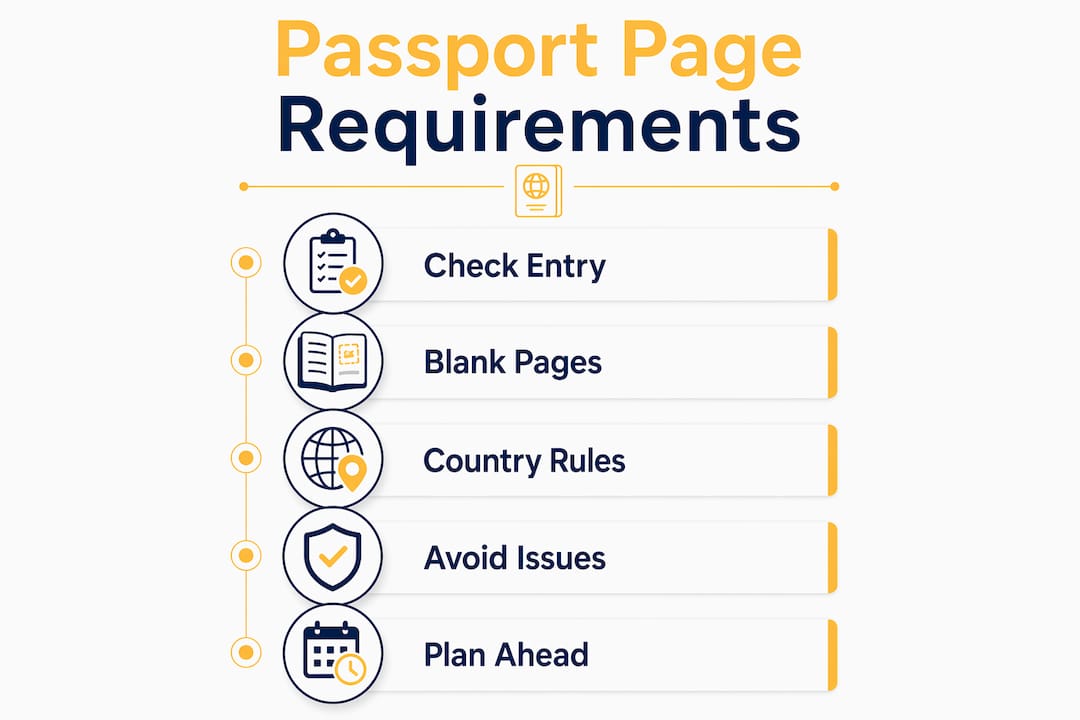
Many countries require between 1 and 4 blank pages for entry. Namibia requires up to 6 blank pages. That number reflects how much physical space their immigration process consumes across entry, exit, and any transit stamps.
The consequences of arriving short on pages are immediate and severe. Airlines face financial penalties for transporting passengers who fail to meet destination entry requirements. As a result, airline staff check blank pages at the gate and will deny boarding before you ever reach the border.
Multi-country itineraries multiply the problem fast. Consider a two-week trip through Southeast Asia covering Thailand, Vietnam, Cambodia, and Indonesia. Each country stamps entry and exit. Visa on arrival in some of these countries consumes a full page. Visa-on-arrival stamps often consume a full page, and exit stamps require additional pages on top of that. A traveler can burn through 8–10 pages on a single regional trip.
Key blank page requirements by destination:
- India: Requires at least 2 blank pages for entry
- Namibia: Requires up to 6 blank pages
- South Africa: Requires at least 2 consecutive blank pages
- Brazil: Requires at least 1 blank page
- United States (re-entry): Requires at least 1 blank page
Pro Tip: Check the U.S. Department of State’s country-specific travel advisories before every international trip. Requirements change, and the airline’s gate agent will not give you a second chance.
Can you add extra pages to your passport?
The short answer is no. Since 2016, the U.S. Department of State no longer adds pages to existing passports. Passport renewal is the only way to get a fresh set of visa pages. This policy change catches many frequent travelers off guard, especially those who remember the old page-insertion service.
Your options when pages run low are straightforward:
- Renew your passport early. You do not need to wait until your passport expires. Renewing early when within 1–2 years of expiry is a proven strategy for frequent travelers who fill pages faster than the clock runs out.
- Request the large book at renewal. The large book provides roughly double the visa pages of a standard book at no additional cost. Specify this when you submit your passport renewal application.
- Apply for a second passport. U.S. citizens who travel frequently to countries with conflicting entry requirements, such as Israel and several Arab nations, can apply for a second valid passport. This is a separate application, not a renewal.
- Request an emergency passport abroad. If you run out of pages mid-trip, a U.S. embassy or consulate can issue an emergency replacement passport. Emergency passports may take from a day to more than a week depending on location, and the cost and delay can derail your itinerary.
Pro Tip: When applying for any passport, always request the large book. There is no downside, no extra fee, and the extra pages can save you from an emergency renewal years down the road.
Common misconceptions about passport blank pages
The biggest misconception travelers hold is that a partially used page still counts as blank. Partially stamped pages are often rejected by immigration officers who require completely unblemished pages for new stamps or visa stickers. A page with a single faded exit stamp in the corner may be unusable for your next destination.
A second misconception is that scattered blank pages throughout the passport satisfy all requirements. Some countries require blank pages to be consecutive, not just present. If your remaining blank pages are spread across different sections of the book, you may not meet the requirement even though the total count looks sufficient.
Passport validity is another area where travelers make assumptions. A passport valid for two more years does not automatically mean you are ready to travel. Many countries require your passport to be valid for at least 6 months beyond your planned departure date. Combine that rule with a low blank page count, and a technically valid passport can still get you denied.
Travelers often focus on passport expiration rather than blank page availability. This oversight is one of the most common causes of denied boarding. Expiration is visible and memorable. Blank page count requires you to physically open the passport and count, which most travelers never do until it is too late.
How to manage your passport pages before they become a problem
Proactive passport management prevents the scramble. These steps apply whether you travel twice a year or twice a month:
- Count your blank visa pages now. Open your passport and count only the fully blank, unstamped visa pages. Ignore endorsement pages entirely.
- Request the large book every time. Whether applying for a new passport or renewing, always specify the large book option on your application form.
- Renew when you have 6–8 pages left. Do not wait until the last page. Processing times vary, and you need a valid passport in hand before your next trip.
- Track multi-country trips carefully. Before a complex itinerary, map out how many pages each country will consume. Add up entry stamps, exit stamps, and any visa-on-arrival pages.
- Check country-specific requirements before every trip. The country entry requirements listed by the U.S. Department of State are the authoritative source. Airline websites and travel forums are secondary references at best.
- Consider a second passport if you travel to conflicting-entry countries. Business travelers visiting both Israel and Gulf states regularly use this option to avoid visa complications.
Multi-country itineraries rapidly deplete passport pages because each country may require multiple blank pages for entry and exit. Planning ahead by at least 6 months gives you time to renew without paying for expedited processing.
Key Takeaways
Extra passport pages are visa pages only. Endorsement pages do not count, partially stamped pages are often rejected, and the U.S. no longer adds pages to existing passports.
| Point | Details |
|---|---|
| Visa pages only | Only fully blank visa pages count toward entry requirements; endorsement pages do not qualify. |
| No page additions since 2016 | The U.S. Department of State stopped adding pages to passports; renewal is the only solution. |
| Large book at no extra cost | The large passport book offers roughly double the visa pages of a standard book for free. |
| Country requirements vary widely | Requirements range from 1 blank page to 6 consecutive blank pages depending on the destination. |
| Renew early, not just before expiry | Frequent travelers should renew when 6–8 pages remain, not when the expiration date approaches. |
What I have learned from watching travelers get this wrong
I have seen travelers with perfectly valid passports get turned away at the gate, not because of expired documents, but because they had three pages left and were heading to South Africa. The gate agent counted the pages in under 30 seconds and denied boarding. The traveler had no idea this was even a rule.
The part that surprises most people is how fast pages disappear on a real trip. A two-week trip through East Africa, covering Kenya, Tanzania, and Rwanda, can consume 8 or more pages before you land back home. Add a visa-on-arrival, a transit stamp, and an exit stamp per country, and the math is brutal.
My honest recommendation is this: get the large book every single time, without exception. The physical difference in your pocket is negligible. The difference in your travel life is enormous. I have never met a traveler who regretted having too many blank pages.
For anyone managing complex multi-country itineraries, especially through Asia, Africa, or the Middle East, consulting a service that knows the specific blank page rules for each destination is worth the time. The rules are not always published clearly, and they change. Getting it wrong costs far more than getting it right.
— David
Fastpassportcenter can help you stay ahead of passport page issues
Running low on passport pages does not have to mean a canceled trip. Fastpassportcenter specializes in expedited passport processing and works directly with the U.S. Department of State to move renewals faster than standard channels. Their experienced agents guide you through every step, including requesting the large book option to maximize your visa page count from day one.
Fastpassportcenter holds an A+ rating from the Better Business Bureau and has earned over 14,000 positive reviews from travelers who needed their passports handled correctly and quickly. Whether you are renewing before a major trip or need an urgent passport renewal because pages are nearly gone, their team handles the details so your travel plans stay on track.
FAQ
What are extra pages in a passport?
Extra pages, formally called visa pages, are the blank pages in a passport book reserved for immigration stamps, entry permits, and visa stickers. Only fully blank visa pages count toward a country’s blank page entry requirement.
Can you add pages to a U.S. passport?
No. The U.S. Department of State discontinued adding pages to existing passports in 2016. Renewal is the only way to obtain additional visa pages.
How many blank pages do most countries require?
Most countries require between 1 and 4 blank pages for entry. Namibia requires up to 6, and some countries, such as South Africa, require those pages to be consecutive.
What happens if you run out of passport pages while traveling?
A U.S. embassy or consulate can issue an emergency replacement passport, but the process can take anywhere from one day to more than a week depending on location, and it adds cost and delay to your trip.
Is the large passport book worth requesting?
Yes. The large passport book provides roughly double the visa pages of a standard book at no extra cost. The physical size difference is minimal, and the extra pages are a practical safeguard for any traveler who crosses multiple borders each year.